
Coping Skill 1: The STOP Skill
Teaching Tuesdays 9/8/2026 & 9/29/2026

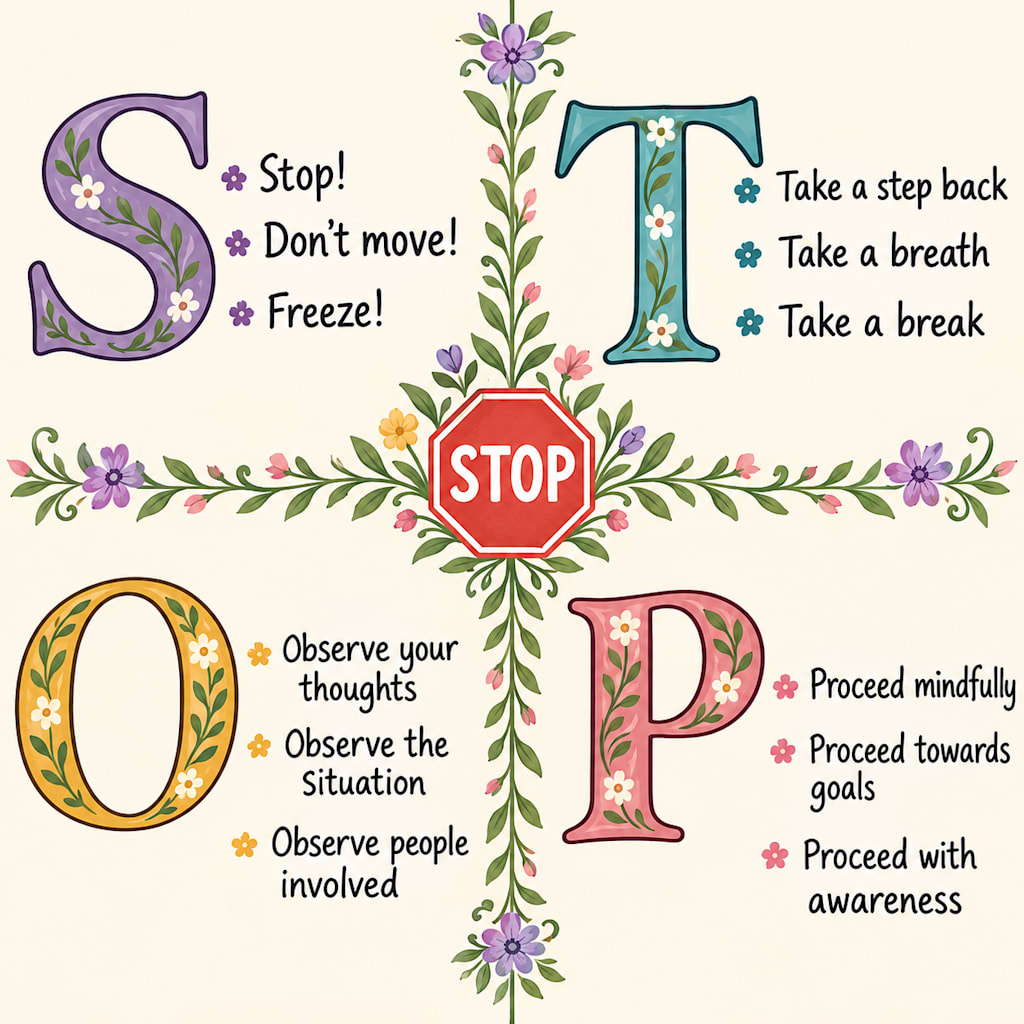
I introduced this series that I am working on inside of therapy here. The first coping skill that I am working on with my trauma therapist is called the STOP skill.
What exactly is the STOP skill?
The STOP skill is a DBT coping skill found under the distress tolerance section of the DBT Skills Training Manual authored by Marsha M. Linehan.
The STOP skill is an acronym to help people easily remember the skill steps:
S stands for a command to physically freeze or STOP! This allows you to get a chance to not immediately react to the situation.
T stands for taking a step back from the situation. This can look like taking a deep breath, taking a break, or any other quick method to allow your feelings space without acting impulsively.
O stands for observe. This is where you notice what is happening inside and outside yourself from an objective perspective.
P stands for proceed mindfully. Now you can act with awareness of your thoughts and feelings, the situation, and other people's thoughts and feelings. Consider your goals and ask Wise Mind what actions would make this situation better or worse?
We also need to remember that this skill is intended for situations involving intense emotional pain or arousal, reducing the strong urge to act in ways that could make things worse, or coping with circumstances in which we are overwhelmed but still need to function. STOP is not intended to become our reason to live, to solve every problem in our lives, or to replace longer-term problem-solving.
What was a specific situation where I used the STOP skill successfully?
I remember getting an upsetting message from my co-parent. In it, he was informing me that he would still be taking our children for his parenting time despite the blizzard that was occurring. I felt like responding back that I would be refusing his parenting time, that he was a horrible individual who didn't care about our children's safety, that I hoped that he got stuck in a snow bank, that I regretted ever having children with him, and/or that I hoped that he would just die. Note: these were just the feelings and thoughts that I was having, NOT that I actually believed any of them.
I felt like I needed to respond immediately, but I stopped myself. I knew that emotions would pass and that I needed to stay in control of myself.
I took a step back by setting my phone down and moved to the kitchen to finish a load of dishes.
I observed my thoughts and feelings (as shown in the first paragraph). I reassessed the situation to ensure that my concerns about the weather were still pertinent by checking for updates from the local Sheriff's office, 2 different weather stations, and updates from locals posted on Facebook. This step was important because in the Midwest of the United States, blizzards can last anywhere from a few minutes to days! My initial concern had been developed by a weather alert on my phone as well as a notification that the local school district was canceling school due to the weather. I also reminded myself that I wouldn't want to miss out on time with the kiddos, so my coparent would likely feel sad about missing his time with the kids. Likewise, both kids would be sad to miss out on "Daddy-time" and they wouldn't understand the safety concerns involved.
I then proceeded mindfully. I responded with the facts surrounding my concerns and suggested a compromise. Perhaps he could pick up the children and remain in town inside of traveling to his residence outside of a neighboring town?
I was given the opportunity to practice the skill again when he rejected my compromise and informed me that I had absolutely no right to interfere with his parenting time - despite a fatal accident happening nearby! sigh
Did he get to exercise his parenting time? Yes.
Did I respond perfectly every message? No.
Did I tell him any of the thoughts/feelings that I had? No.
Did I worry about our children's safety as well as their dad's safety? Yes.
Would I have driven in the blizzard to help him if he had gotten stuck in the snow with our children during a time where emergency resources were stretched thin? Probably. And, honestly, I probably would have allowed him to come into my home/vehicle to remain warm despite being terrified of him because ... that is just who I am.
Do I regret telling him that we would have to be rescheduling his parenting time due to the serious safety issues? Absolutely! I still feel embarrassed that I was so scared of him taking me back to court that I allowed him to control me in such a manner.
What was a specific situation where the STOP skill was unhelpful to me?
Trigger Warning!!! and Important Note: due to the highly sensitive details of this situation, I have made significant changes for the purposes of this article. When reading the following, please know that due to the number of details changed, this example could be considered completely fictional. Thank you.
My friend's daughter had just told me that her PE teacher had been inappropriate with her. She shared details that no first grader should know about her PE teacher's physical features. She didn't want me to share with other people because she was scared that she wouldn't be able to still attend her PE class - a favorite of hers.
I felt like immediately calling the cops, like I wanted to go find said PE teacher and handle the situation privately - with violence, like I was furious with my friend for not doing enough to protect her daughter, and like I should just ignore this very uncomfortable disclosure.
I stopped. I thanked the little girl for sharing and focused on getting her comfortably settled in bed. My emotions were not for a child to deal with in addition to the trauma she had just shared about.
I took a step back by taking a shower and crying. Such a disclosure was very upsetting and I needed to safely release some emotions.
I observed my own thoughts and feelings as described above. I knew that such secrets cannot be kept. I knew that my friend would have her own emotions and that I was uncomfortable directly talking to her about it. I also knew the PE teacher and didn't believe that she would do the things the little girl had told me about. I had promised the little girl that I wouldn't call the cops or tell her parents as she was understandably scared in order to get her relaxed enough to go to sleep - and I did not want to break my promise.
I then proceeded mindfully. Since PE wasn't going to occur for the next couple of school days, I sent a message to the counselor at my friend's daughter's school asking for a meeting prior to PE class happening again. I followed the steps that were outlined for me to complete by the counselor. I did my best to trust that the system would handle the issue.
I did all of the steps in the STOP skill, but it didn't decrease my emotional distress. I merely contained the anger, fear, sadness, and devastation that the situation caused into a box for me to bypass. It allowed me to act in a way that was in accordance to Wise Mind, but my emotions? They didn't decrease or change. I simply ignored them. I still have no idea what to do with my emotions and they continue to be a problem for me years later.
I still fear that the PE teacher is harming her students, yet I can't do anything about it so I avoid being physically around her. I remember the painful disclosure every time my friend's daughter mentions PE class, so I do my best to avoid the subject when speaking with the child - which causes more pain as it causes our relationship to deteriorate. I still feel anger at my friend for choosing to still send her daughter to PE class while the investigation was ongoing - which has caused me to completely lose my relationship with a dear friend.
Is the STOP skill supposed to simply be a way to detach from my emotions in order to outwardly behave correctly while my inner world crumbles under the weight of things completely out of my control? And as my inner world crumbles, it ends up crumbling my outer world in order to maintain the correct behavior... so when does the skill start helping with the alleged emotional regulation that I was promised?!
What can I learn or change about the STOP skill from this reflection?
After discussing this skill and my examples with my therapist, it would appear that I had used both skills effectively. It was merely the feedback that I had previously received that was incorrect as were my expectations from when the skill had been suggested for me to use.
In both examples, I STOPped my immediate, emotional reaction that could have made the situations much worse. That is the whole goal of the STOP skill.
Now, in the second example, I remember being told that I was acting too logically instead of acting in wise mind by my mental health team at the time. I have a few theories as to why this might have been the case...
I probably had a lack of externally visible emotion.
I likely had more logic than my peers would have had due to my Mom's teaching on problem solving and deductive reasoning skills
Autism can cause logical thinking to be stronger according to several studies
I probably couldn't answer questions regarding how I felt in the moment, on my mental health provider's request, due to having alexithymia
My current trauma therapist has pointed out that I used both logic and emotion when writing out how using the STOP skill went - which also seems to highlight the importance of writing for me to communicate more effectively with others as well as to understand myself better.
I suppose that my trauma therapist is correct... I did STOP myself from making the situation worse in the moment of crisis. I just wish that I had a better way to help myself feel better too... but this therapist claims that may be the Emotional Regulation skill area of expertise - not the crisis survival skills job.
As for the feelings of regret that I may have about not doing more in the second example, per my autism therapist, the question to ask myself to help give my whole self the grace that I so freely give others is this: did I do the best that I could with the information that I had at the time? The answer is yes, so I suppose that I can forgive that younger, less educated version of myself for not being perfect. After all, younger me simply gave people, who didn't deserve the benefit of the doubt, the benefit of the doubt that she (and I) both love that our children possess - and that we can see that Christ gave to us.
Disclaimer:
This article reflects my personal experiences and perspectives and is not intended to provide medical, psychological, or mental health advice. I am not a licensed mental health professional. Please consult a qualified professional for guidance regarding your own circumstances.
To protect privacy, certain identifying details may be changed, combined, or omitted. This writing is about my own experiences and personal growth and is not intended to diagnose, characterize, communicate with, or make claims about any particular person. My experiences and life are my own and exist independently of any other individual.
About the Creator
Adora Hooper
I am a mother of 2 precious angels who drive me slightly more crazy
than I already am with a diagnosis of schizophrenia.
When asked "are you crazy?!" my favorite come back is:
"yes! And I have the papers to prove it! How about you?" LOL
Enjoyed the story? Support the Creator.
Subscribe for free to receive all their stories in your feed. You could also become a paid subscriber, letting them know you appreciate their work.
Comments
There are no comments for this story
Be the first to respond and start the conversation.