
Thank you... or maybe not?
Teaching Tuesday 9/22/26 & Throwback Thursday 9/24/26


One of the biggest things that I have a hard time with is concepts like: "Your trauma made you stronger." or "Thank them for hurting you, because it taught you lessons."
"Thank them for hurting you, because it taught you lessons."
I struggle with this because if I were to say to one of my exes: "Thank you for coming to 'check on me' 3 dozen times in the first 6 months after we had pretended that it was an amicable split because it taught me what a stalker does."... well... I have been informed that that is passive aggressive.
"Your trauma made you stronger."
I struggle with how "I am now stronger because I know how to take a slap and keep my mouth shut about it since it didn't leave a mark." is considered passive communication that is typical of trauma bonded individuals and/or those who have suffered coercive control.
These concepts are ones that perhaps I struggled more with because of my autism.
However, my diagnosis had been schizophrenia which has the same black and white thought process' that my then mental health team used to explain why I was struggling with these concepts.
I wasn't trying to be passive aggressive in the first sentence. I was taking "Thank them for hurting you because it taught you lessons." and applying it literally and factually to my own experience. To me, I used appropriate communication by being specific about what behavior hurt me as well as being specific about what lesson I had learned. Aren't you supposed to be specific when writing a thank you note?
I wasn't trying to be passive in the second sentence. I was taking "Your trauma made you stronger." and applying it literally and factually to my own experience. To me, I used appropriate communication following the structured outline that was given to me. Why shouldn't being able to take a slap in silence be something that I take pride in as a personal strength?
For my then mental health team to tell me that I wasn't actually doing what was asked of me... and simple being passive aggressive and sarcastic... or being passive and having a "victim-mindset"... led me to simply feel as though, once again, I was the problem.
What do I wish I had been explicitly told?
"Thank them for hurting you, because it taught you lessons."
The lesson that I was supposed to learn from being slapped was that I needed to protect myself - by telling people: loudly, clearly, and confidentially. Being silent wasn't the badge of strength... nor was the urge to hit them back the badge of strength. The badge of strength was simply to take the advice that I would give my best friend: "Tell someone - preferably someone with a badge, but anyone will do! (maybe tell everyone?) Get out! No one deserves to be slapped for daring to have a different opinion!"
The second part of that which would have been nice if it was specifically spelled out, that unless for whatever reason person getting slapped requested the slap, it doesn't matter what was said prior to being slapped. The individual who slapped could have walked away. And before anyone comes at me saying something like: "well they were blocking the doorway..." I specifically said that what was spoken does not give another individual the right to physically assault another individual - not that attempting to trap another human in an escalating situation is a reasonable answer to "they hit me without a reason..."
"Your trauma made you stronger."
I didn't need to be grateful to my trauma for adding alleged strength to my life.
I merely needed to accept that it happened, figure out what I could learn from it, and start building myself back up after the trauma broke me.
I needed help navigating complex situations to help protect me from more trauma - services that are severely lacking for many survivors... and many of the services that do exist lack expertise with neurodiverse needs.
Why didn't what I had needed, get shared with me?
Missing and/or Inaccurate Diagnosis'
I wasn't diagnosed as autistic or having my ADHD treated at the time. However, I was diagnosed with PTSD and schizophrenia which overlap a lot with autism and ADHD from external viewpoints.
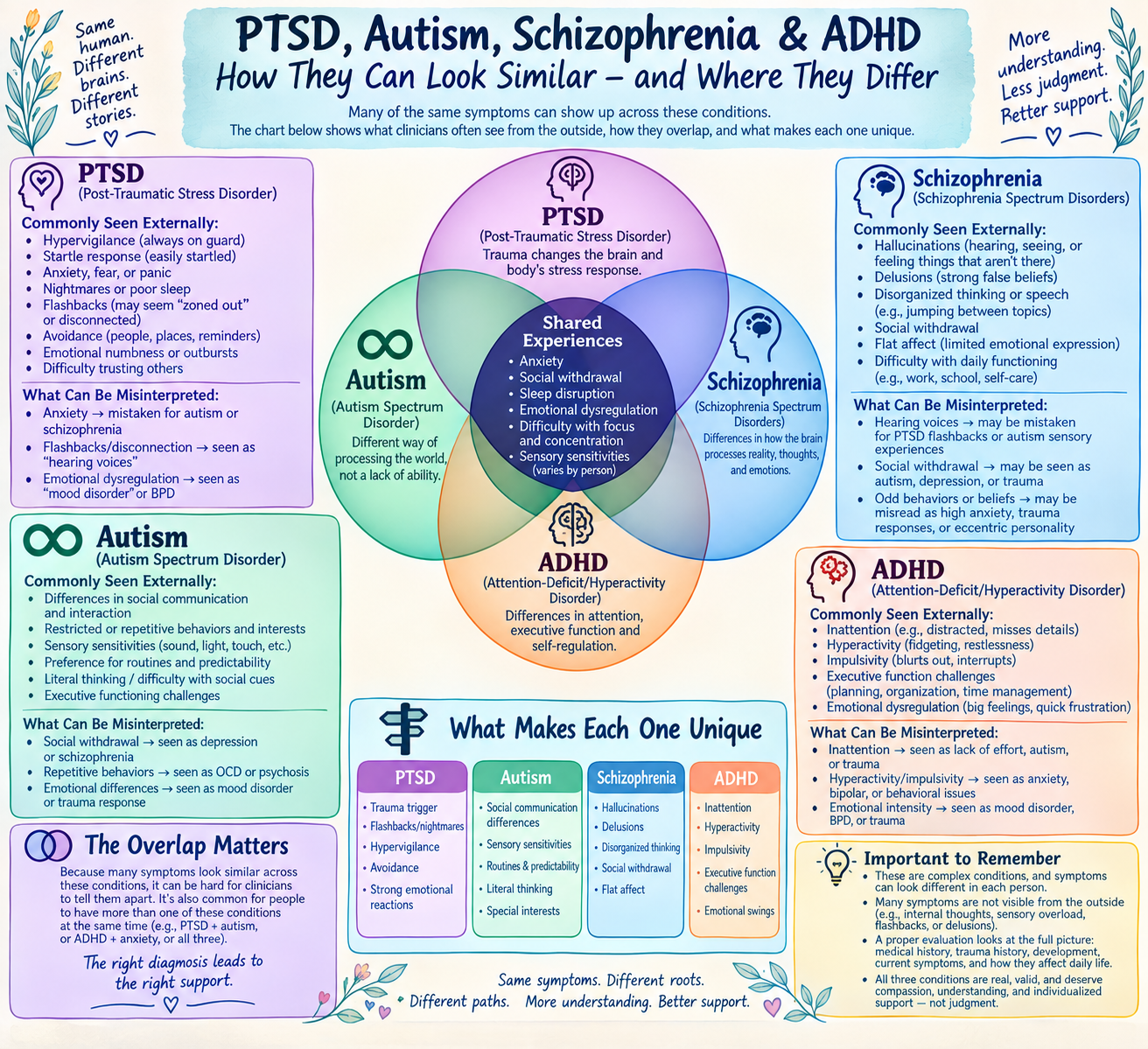
As one can see by this infographic, my communication differences (autism & ADHD) could have been managed by addressing the disorganized thinking of schizophrenia and having better access to trauma-informed care under PTSD.
What about after ADHD and Autism was diagnosed?
So many people had already decided how they were going to view me that the new diagnosis' were ignored - either intentionally or unintentionally.
There were some people in the small community where I used to live who continued to treat me as "Adora." There were some who switched from "oh, she is just so difficult!" to "oh... that explains a lot. Let me change my presentation." However, there were many who didn't seem to care about the new diagnosis' or, even worse, saw them as proof that I was simply impossible to work with in resolving issues.
Thinking Differences
Neurotypical people don't think about things in the same way. According to several experts, neurotypical individuals use top down processing. I am, and many neurodiverse people (especially autistic's) are, bottom up thinker(s).
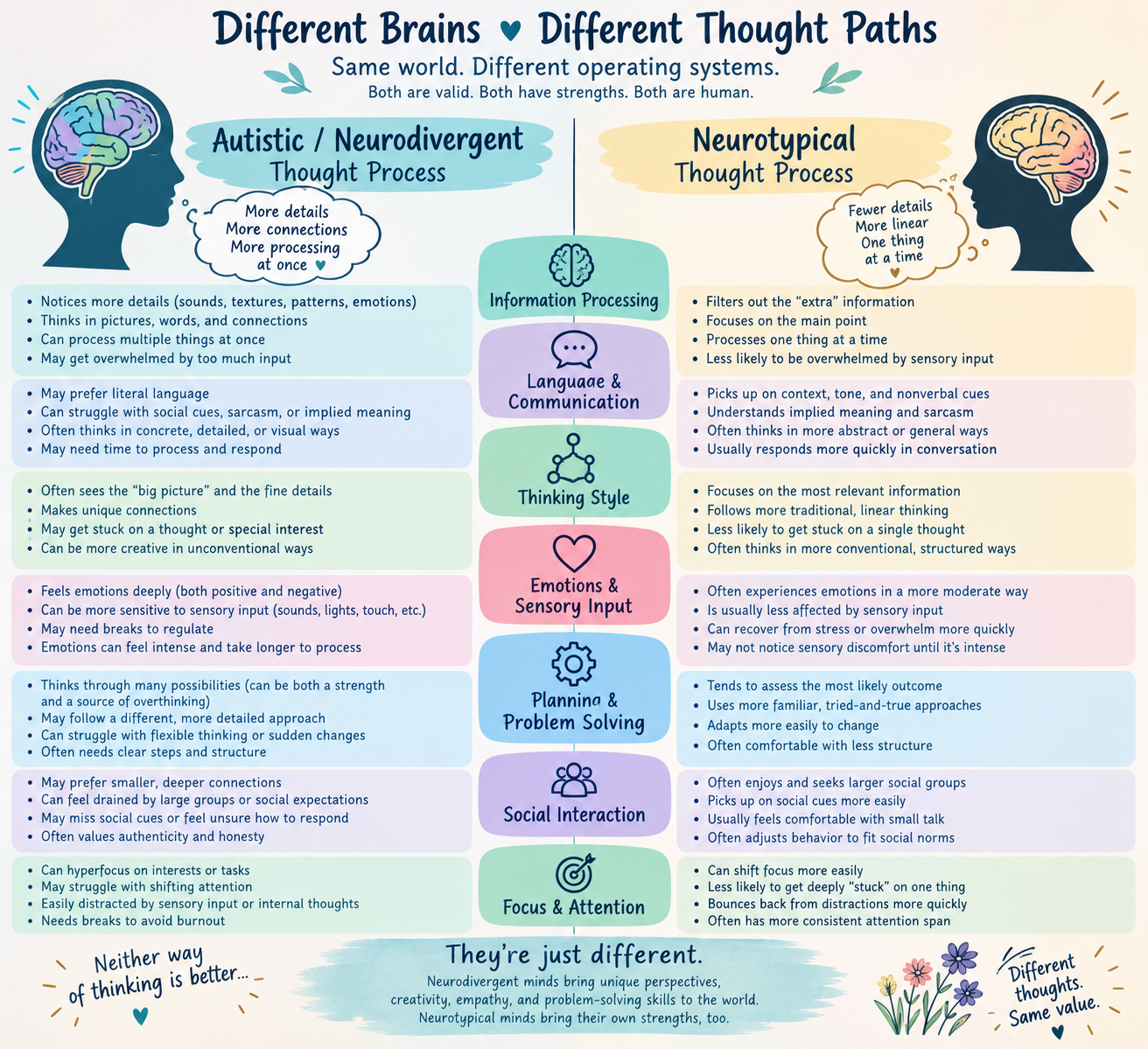
I struggled explaining to law enforcement about getting assaulted because my brain would get stuck on the details that law enforcement found irrelevant. How bright were the lights? How hot/cold was it? Information that my brain prioritizes, but was considered irrelevant to the investigation. Trying to explain with the level of accuracy to detail that my brain is wired for takes a lot of time and energy. And then finding out that my 8 page summary gets reduced to a page or less of allegedly useful information? Well, that is frustrating to all parties involved and leaves me feeling as though my brain is broken.
Lack of Accessible Resources
Where I used to live, there were few options for education and/or awareness of domestic violence, different types of abuse, and the legal remedies in a vast number of cases survivors had to represent themselves with only the aid of emergency service support (emotional support, not legal assistance).
In cases like mine, the opposing party could simply obtain a lawyer to get their client out of the Order for Protection or Restraining Order inconveniencing the offender's day-to-day life. Sometimes in small communities, the opposing party has connections to the local prosecuting attorney, law enforcement, social services, or even the local judicial officer -- all of which could be used to minimize the criminal side of their alleged offenses as well.
Legal aid is often overworked and underappreciated. Volunteer attorneys may only care about getting their volunteer hours in and closing as many cases as fast as possible. A law degree is often unattainable for people with disabilities - especially in time to represent themselves in litigation against an attorney. *wink* And affording an attorney? Is a luxury when you have a full-time career. When you live off of a part-time job and/or government assistance? It is literally inaccessible.
How can these issues be solved?
The easiest way to solve this issue is to have more accessible options for those who need it. However, since that is unlikely to occur...
Perhaps we all need to remember that professionals are human-beings. They, no matter how much experience they have, are not God and therefore will make mistakes. I have met a large number of professionals with a lot of experience AND who have a problem with acknowledging their limitations.
Allowing survivors to share their stories without fear of retribution is the biggest thing that I believe should be taught.
Allowing civil cases (like Orders for Protection, Restraining Orders, and Custody cases) to be eligible for court appointed attorneys (like when a low-income individual is criminally charged) would be a great step forward in equalizing litigation in cases with potential abuse.
How have I now rephrased the statements to fit my experience?
"Thank them for hurting you, because it taught you lessons."
I appreciate my ex and the professionals who didn't respond very helpfully to my crisis for showing me the gap in the training available to professionals. The lesson I learned was that simple because an individual "has training" or "has years of experience" does not make them an expert in my experience and my life.
I appreciate my unique brain (that God gave me) for having justice sensitivity and allowing me to turn the trauma that multiple people caused me into a drive for better education, for additional resources, and for wanting to share my story in the hopes of helping other survivors of domestic violence find their personal strength as well.
"Your trauma made you stronger."
I can appreciate that my lived experience makes me stronger and more resilient without saying that the traumatic experiences were what made me that way.
I was the one who put in the effort to shift my mindset.
I was the one who utilised the tools available to me.
God gave me the gift of my brain and ability to learn and adapt.
Doctors, police officers, social workers, therapists, and plenty of other professionals! + family members! - went above and beyond to earn my trust, get me adequate support and education, as well as to just generally support my life!
None of those things that made me stronger and healthier was "thanks" to my trauma. My trauma only helped me be able to relate more strongly to others who have felt broken and alone because I have felt broken and alone.
And, that potential blessing is not always a good thing when that relational feeling of comradery can cause me to give too many chances to someone whose brokenness is actually carefully hidden abusiveness.
What are your thoughts, observations, and experiences on this topic?
Please leave a comment below!
Disclaimer:
This article reflects my personal experiences and perspectives and is not intended to provide medical, psychological, or mental health advice. I am not a licensed mental health professional. Please consult a qualified professional for guidance regarding your own circumstances.
To protect privacy, certain identifying details may be changed, combined, or omitted. This writing is about my own experiences and personal growth and is not intended to diagnose, characterize, communicate with, or make claims about any particular person. My experiences and life are my own and exist independently of any other individual.
About the Creator
Adora Hooper
I am a mother of 2 precious angels who drive me slightly more crazy
than I already am with a diagnosis of schizophrenia.
When asked "are you crazy?!" my favorite come back is:
"yes! And I have the papers to prove it! How about you?" LOL
Enjoyed the story? Support the Creator.
Subscribe for free to receive all their stories in your feed. You could also become a paid subscriber, letting them know you appreciate their work.
Comments
There are no comments for this story
Be the first to respond and start the conversation.