
Death by a Thousand Paper Cuts: The Psychology of Quiet Bullying
Most people imagine bullying as something obvious...


They picture shouting, insults, threats, humiliation in front of a crowd or physical intimidation. Those forms of bullying certainly exist and because they are obvious, they are easier for others to recognize. It is easy to recognize a man hovering over a woman and using his presence to intimidate her into submission or when an adult does it to a child or even another adult; or even a child to an adult. Obvious aggression is so easy to recognize that it leaves little to no debate when it happens; usually the masses can agree on it quickly.
Quiet bullying is different.
It survives because almost every individual action seems too small to matter.
A joke.
An eye roll.
Being interrupted.
Being excluded from a conversation.
A compliment with an insult hidden inside it.
A sarcastic tone that disappears the moment someone else walks into the room.
A repeated “forgetting” to invite one particular person.
A moment to gaslight or weaponize incompetence.
An intentional moment to show you are incompetent with plausible deniability…repeatedly even when it is not true but they have their audience believing it anyway.
Glaring at a person for existing when you think no one sees you.
Trying to pretend to be busy as soon as you see them.
Turning the body away from a person when they are speaking to you or any time they speak to you.
Being ignored intentionally and no one in the room notices or calls it out; or some may even enjoy it.
Each incident, by itself, looks insignificant. If you described only one of them to someone else, they might reasonably respond with…
“That doesn’t sound like bullying.”
And they would be right.
One incident often isn’t.
The problem is that victims are rarely living through one incident.
They’re living through hundreds.
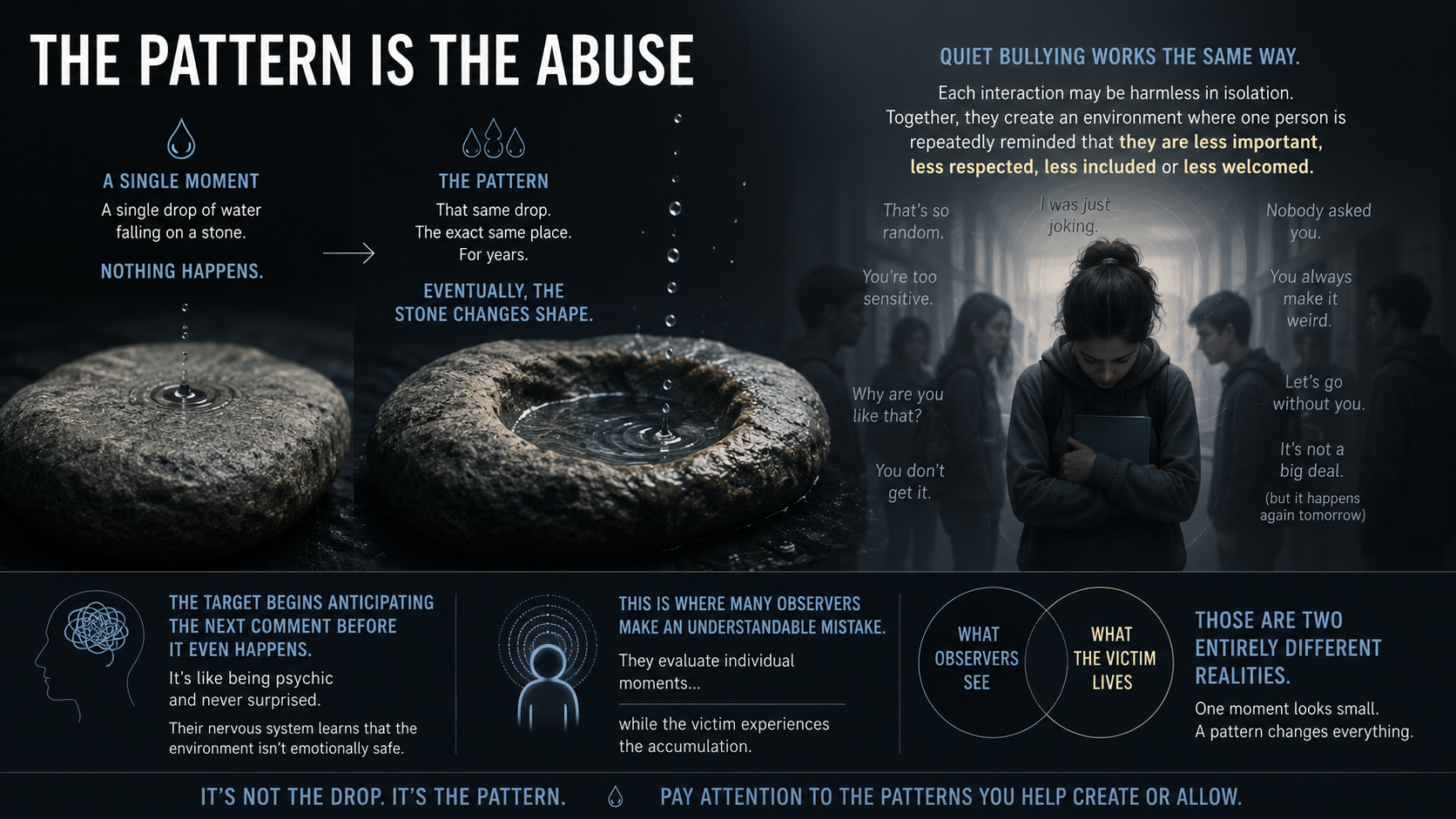
The Pattern Is the Abuse
Imagine a single drop of water falling on a stone.
Nothing happens.
Now imagine that same drop falling in the exact same place for years; eventually the stone changes shape.
Quiet bullying works the same way.
Each interaction may be harmless in isolation.
Together, they create an environment where one person is repeatedly reminded that they are less important, less respected, less included or less welcomed.
The target begins anticipating the next comment before it even happens; it’s like being psychic and never surprised. Their nervous system learns that the environment isn’t emotionally safe and this is where many observers make an understandable mistake.
They evaluate individual moments while the victim experiences the accumulation; those are two entirely different realities.

The Psychological Toll of Constant Microaggressions
Human beings are remarkably resilient.
We can tolerate occasional conflict.
We can recover from misunderstandings.
What becomes psychologically damaging is chronic uncertainty.
Quiet bullying creates exactly that.
The victim starts questioning themselves.
“Am I imagining this?”
“Maybe I’m just sensitive.”
“Maybe everyone jokes like this.”
“Why does this only happen to me?”
“Is it me?”
“Did I do something wrong?”
“Maybe they don’t understand what they are doing?”
“They probably don’t see what they are doing”
Over time this uncertainty becomes exhausting to the soul.
The brain begins to constantly scan for social danger or excessively double check themselves; because everyone else seems to not intervene, call it out and normalize it. Psychologists often refer to this as hyper-vigilance; it’s a state in which a person becomes unusually alert for signs of rejection, criticism or conflict.
Eventually the victim may hesitate before speaking, avoid sharing ideas, become socially withdrawn, second guess perfectly normal interactions, lose confidence in their own judgment, experience anxiety before work, family gatherings, or social events and become emotionally exhausted. Ironically, these changes can then be used against them.
“They’re too emotional.”
“They’ve changed.”
“They’re difficult.”
“Try not to take it personal”
Like social deadly rumors running the asylum with the inmates. The symptoms created by the environment become evidence used to discredit the person living in it.
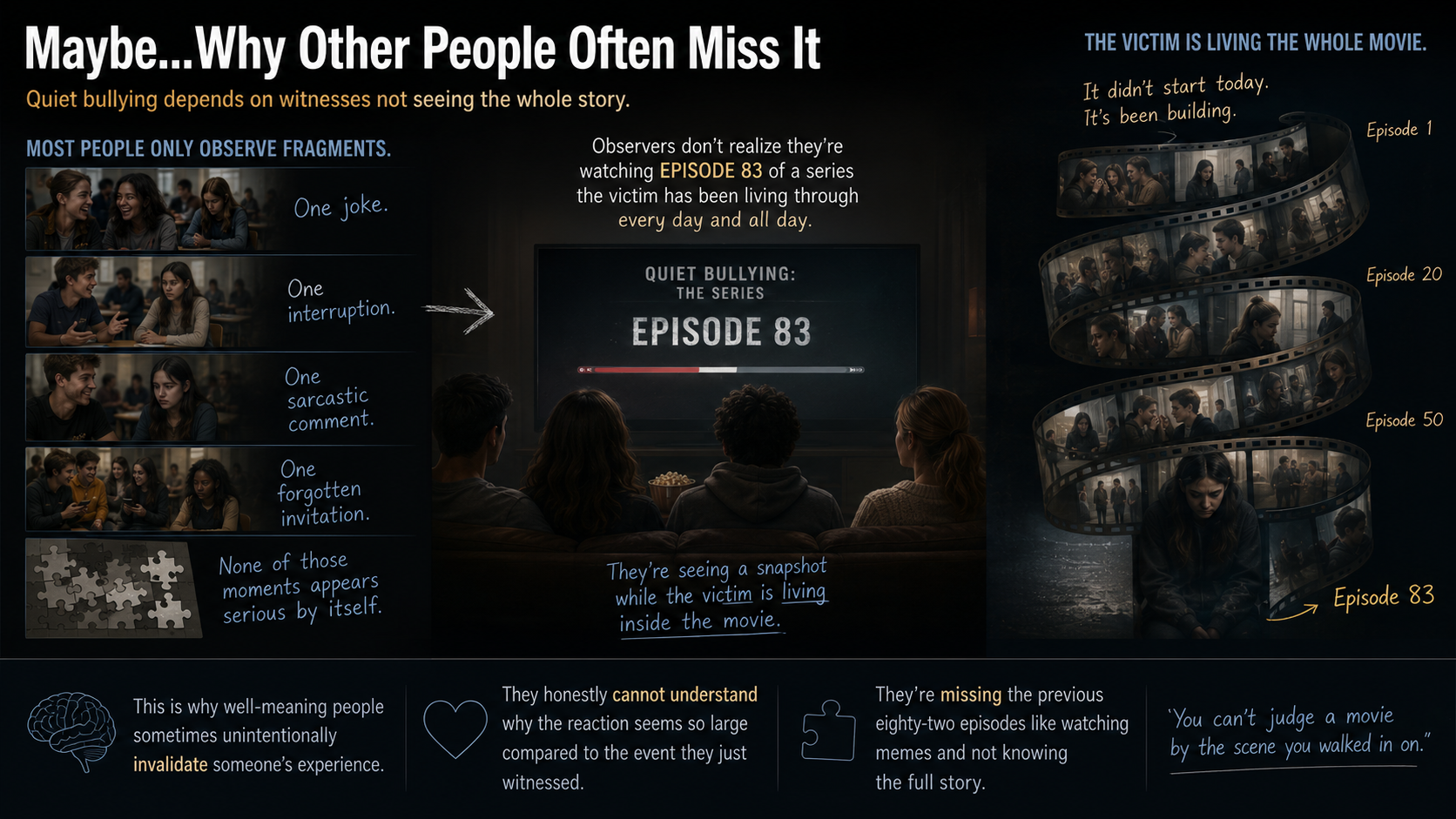
Maybe…Why Other People Often Miss It
Quiet bullying depends on witnesses not seeing the whole story.
Most people only observe fragments.
One joke.
One interruption.
One sarcastic comment.
One forgotten invitation.
None of those moments appears serious by itself.
Observers don’t realize they’re watching Episode 83 of a series the victim has been living through every day and all day; they’re seeing a snapshot while the victim is living inside the movie.
This is why well-meaning people sometimes unintentionally invalidate someone’s experience. They honestly cannot understand why the reaction seems so large compared to the event they just witnessed; they’re missing the previous eighty-two episodes like watching memes and not knowing the full story.
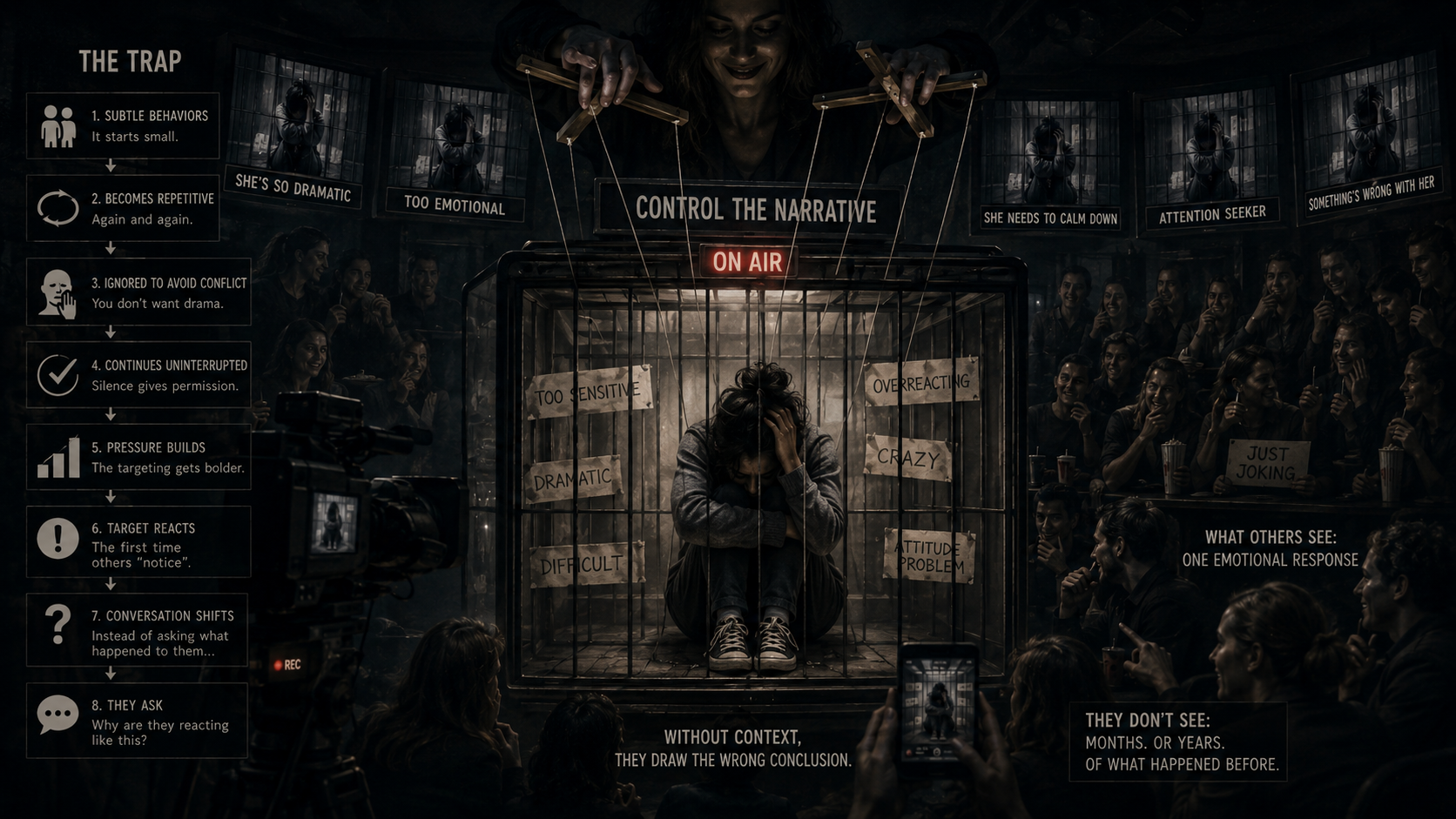
The Trap
Quiet bullying often follows a predictable cycle.
First come the subtle behaviors.
Then they become repetitive.
The target ignores them because they don’t want conflict.
The behavior continues because nothing interrupted it.
Pressure builds and the targeting becomes bolder each time.
Eventually the target reacts.
This is often the first time everyone else notices something again unfortunately…what they notice is not months of subtle behavior; they notice one emotional response.
Suddenly the conversation changes.
And instead of asking,
“What has been happening to this person?”
people ask,
“Why are they reacting like this?”
The bully remains calm.
The target appears “emotional” despite being repeatedly provoked.
Without context, observers may mistakenly conclude that the emotional reaction came out of nowhere.
In reality, it may have been building for months or years.
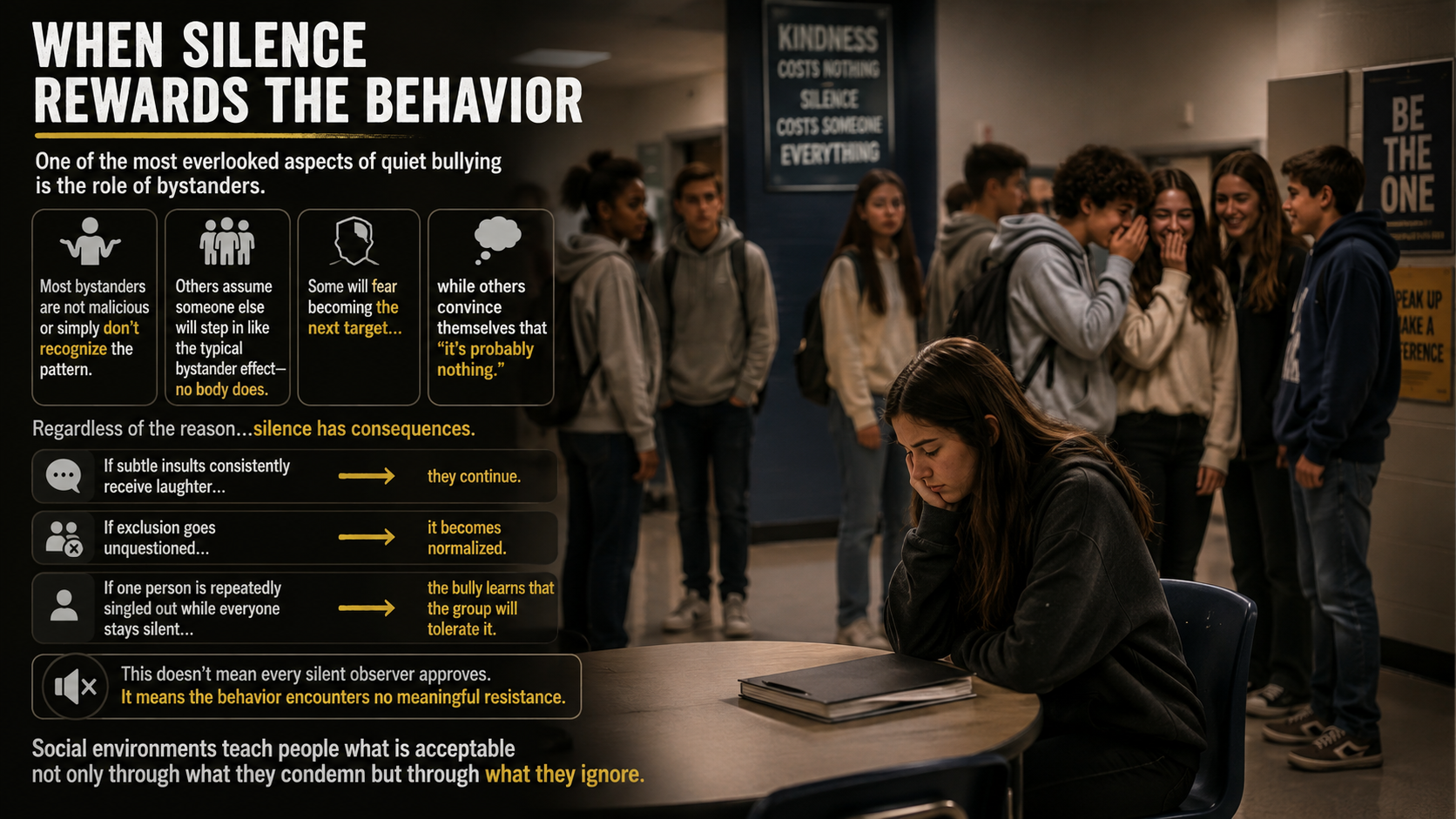
When Silence Rewards the Behavior
One of the most overlooked aspects of quiet bullying is the role of bystanders.
Most bystanders are not malicious or simply don’t recognize the pattern.
Others assume someone else will step in like the typical bystander effect no body does. Some will fear becoming the next target while others convince themselves that “it’s probably nothing.”
Regardless of the reason…silence has consequences.
Behavior that carries no social cost is often repeated.
If subtle insults consistently receive laughter…
they continue.
If exclusion goes unquestioned…
it becomes normalized.
If one person is repeatedly singled out while everyone stays silent…
the bully learns that the group will tolerate it.
This doesn’t mean every silent observer approves.
It means the behavior encounters no meaningful resistance.
Social environments teach people what is acceptable not only through what they condemn but through what they ignore.

It Doesn’t Matter Where It Happens
Quiet bullying isn’t limited to school.
It appears in workplaces.
Families.
Friend groups.
Romantic relationships.
Professional organizations.
Volunteer groups.
Online communities.
Anywhere people interact repeatedly, unhealthy patterns can develop.
Sometimes the person engaging in the behavior is widely considered charming.
Helpful.
Funny.
Generous.
Popular.
People are complicated.
Someone can be genuinely kind to nine people while consistently mistreating a tenth.
The existence of one does not erase the other.

What Happens When the Pattern Is Finally Named
One of the most revealing moments is what happens after someone calmly points out the pattern.
A healthy person may pause.
Reflect.
Ask questions.
Apologize if necessary.
Adjust their behavior.
Someone invested in maintaining the pattern often responds differently.
They deny everything. They gaslight. They blame you.
They never take accountability.
Insist the victim is “too sensitive.”
Accuse the victim of creating drama.
Claim everything was “just a joke.”
Shift attention away from their own actions and toward the victim’s emotional response.
Notice what isn’t being discussed.
The unprovoked pattern itself.
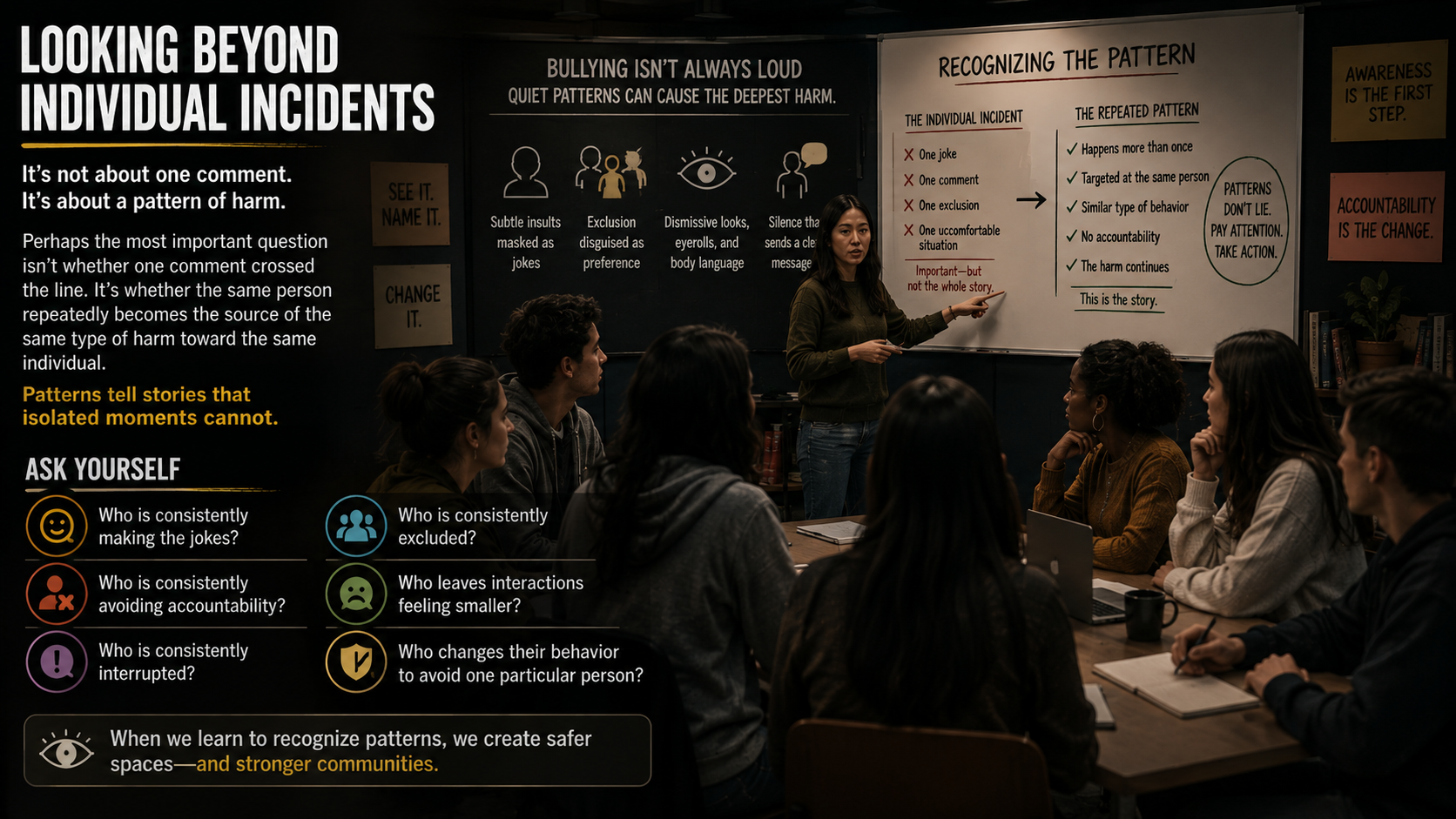
Looking Beyond Individual Incidents
Perhaps the most important question isn’t whether one comment crossed the line. It’s whether the same person repeatedly becomes the source of the same type of harm toward the same individual.
Patterns tell stories that isolated moments cannot.
Ask yourself
Who is consistently making the jokes?
Who is consistently avoiding accountability?
Who is consistently interrupted?
Who is consistently excluded?
Who leaves interactions feeling smaller?
Who changes their behavior to avoid one particular person?
Those questions often reveal far more than any single incident ever could.
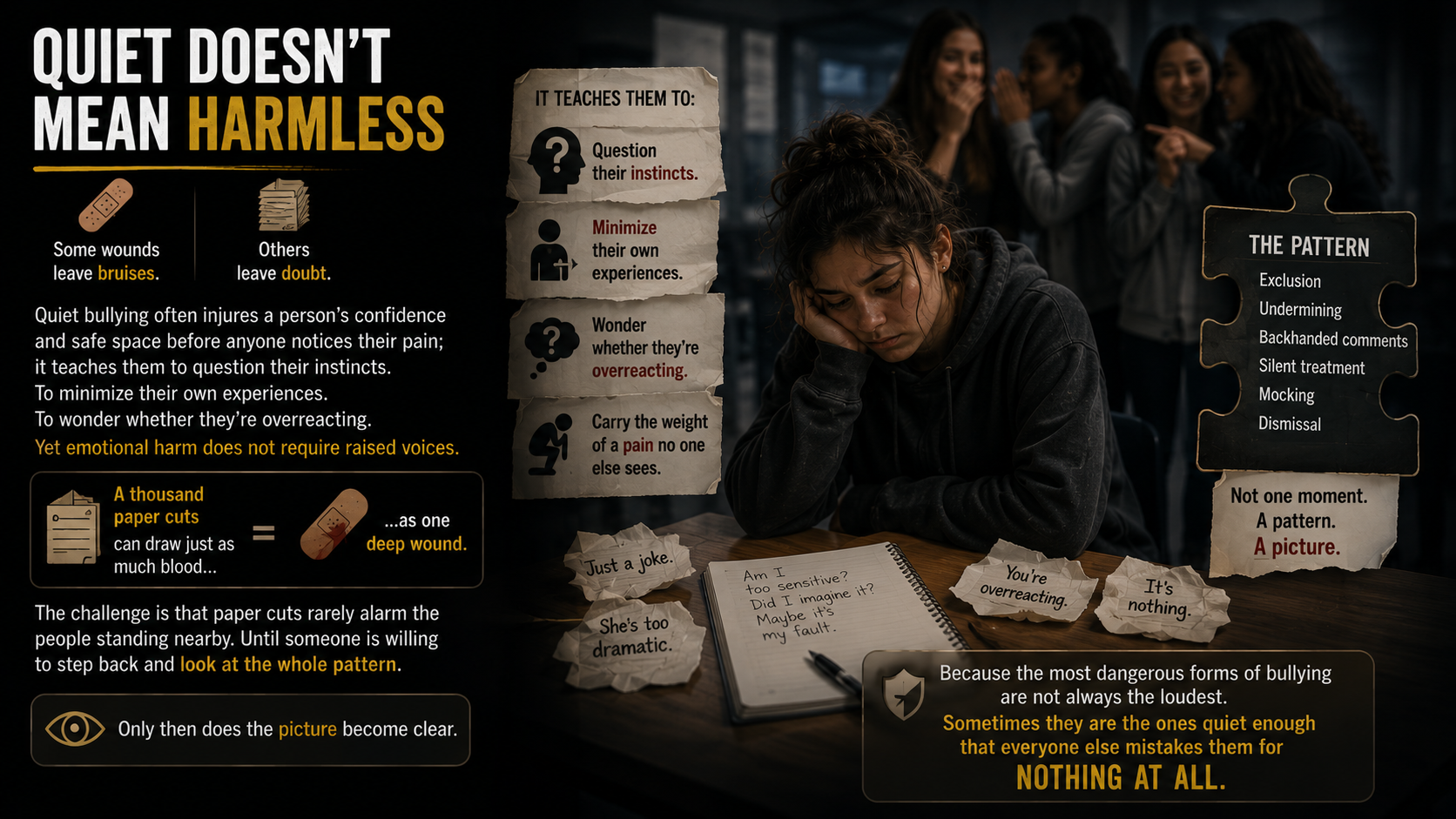
Quiet Doesn’t Mean Harmless
Some wounds leave bruises.
Others leave doubt.
Quiet bullying often injures a person’s confidence and safe space before anyone notices their pain; it teaches them to question their instincts.
To minimize their own experiences.
To wonder whether they’re overreacting.
Yet emotional harm does not require raised voices.
A thousand paper cuts can draw just as much blood as one deep wound.
The challenge is that paper cuts rarely alarm the people standing nearby.
Until someone is willing to step back and look at the whole pattern.
Only then does the picture become clear.
Because the most dangerous forms of bullying are not always the loudest.
Sometimes they are the ones quiet enough that everyone else mistakes them for nothing at all.
About the Creator
Cadma
A sweetie pie with fire in her eyes
Instagram @CurlyCadma
TikTok @Cadmania
Enjoyed the story? Support the Creator.
Subscribe for free to receive all their stories in your feed. You could also become a paid subscriber, letting them know you appreciate their work.
Comments
There are no comments for this story
Be the first to respond and start the conversation.