
Poverty Is Expensive Because Stability Is Missing
Why the poor tax is not one bill, but the repeated cost of lacking space, tools, time, transportation, health, and margin

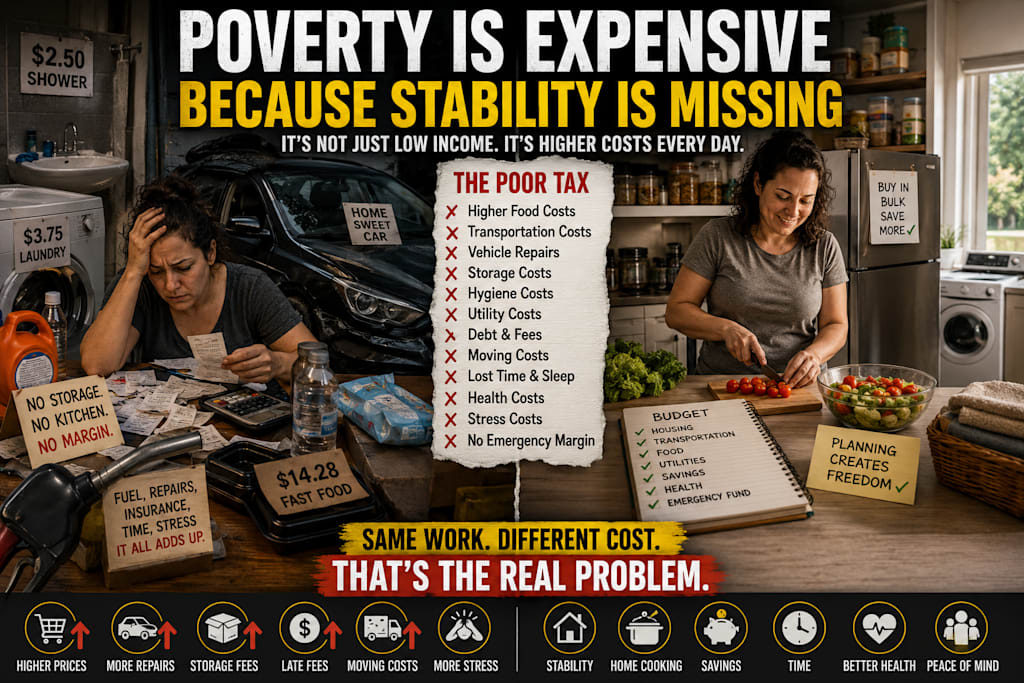
Poverty Is Not Only the Absence of Money
Poverty is often described as a shortage of income, but that description is too small. Low income matters, obviously. A family cannot pay bills with explanations. But poverty is not only the absence of money. It is also the absence of the conditions that allow money to stretch. Stable housing, storage space, reliable transportation, clean water, working appliances, sleep, time, tools, privacy, credit, and emergency margin all affect what a dollar can actually do. Without those things, the same dollar buys less, solves less, and disappears faster.
That is why poverty can remain expensive even when a family is trying to spend carefully. A stable household can buy once and use repeatedly. It can cook, store, repair, clean, organize, preserve, and plan. An unstable household is often forced to buy temporary solutions over and over again because the cheaper long-term option requires infrastructure the family does not have. The poor tax is not one fee. It is the repeated cost of lacking stability.
This is also why the usual advice often misses the actual problem. “Buy in bulk” assumes storage. “Cook at home” assumes a kitchen. “Use reusable dishes” assumes water, soap, and a place to keep them clean. “Fix it yourself” assumes tools and space. “Just budget better” assumes there is enough money to allocate and enough predictability for the budget to hold. When those assumptions are missing, the advice may still sound responsible, but it no longer meets reality.
Stability Turns Objects Into Systems
A stable home quietly turns ordinary objects into long-term systems. A plate is not just a plate. It is part of a system that includes a sink, soap, water, a cabinet, and a place to eat. A freezer is not just an appliance. It is a tool for preserving food, reducing waste, storing leftovers, and making bulk purchases useful. A pantry is not just storage. It allows a household to buy ahead, keep staples, handle emergencies, and avoid constant small purchases. A toolbox is not just a box of tools. It allows repair instead of replacement, prevention instead of crisis, and maintenance before breakdown.
The value of those systems is easy to miss when they are already present. A family with stable housing may see its own lower costs as personal discipline alone. Discipline matters, but discipline works through available tools. A household can cook cheaply because it has a kitchen. It can reuse dishes because it has water and storage. It can save money with bulk purchases because it has room and refrigeration. It can repair a shelf or bike because it has tools and somewhere to work. Stability creates the conditions that make frugality effective.
Without that stability, even useful possessions can become burdens. Dishes require washing. Towels require drying. Tools require storage. Food requires refrigeration. Documents require protection. Clothing requires closets or drawers. Furniture requires room. If a family is forced to move often, live in cramped conditions, depend on temporary spaces, or store belongings far away, ownership loses some of its power. The family may own what it needs and still be unable to use it when life requires it.
The Cheapest Food Often Requires an Expensive Kitchen
Food is one of the clearest examples of the poor tax. The cheapest food on paper is not always the cheapest food in practice. A family-size package may cost less per serving, but only if the family can transport it, cook it, divide it, refrigerate it, freeze it, reheat it, and safely use it before it spoils. Bulk buying requires cash up front, storage space, a working refrigerator, a freezer, clean counters, cookware, dishes, water, and time. Without those things, the cheaper option can become waste or even danger.
That is why “just cook at home” fails when the home does not support cooking. Cooking is not merely the act of heating food. It is a full household system. It requires a kitchen, utensils, cookware, electricity or gas, refrigeration, water, trash disposal, storage containers, clean surfaces, and enough time and energy to prepare and clean up afterward. A family without those conditions may rely on ready-to-eat food, cold food, gas station food, fast food, packaged food, or smaller portions. Those choices may cost more and provide weaker nutrition, but they may also be the only usable choices available.
This is not a defense of poor nutrition as ideal. It is a recognition of why poor nutrition can become predictable. Poverty can push families toward food that is portable, shelf-stable, disposable, and immediately edible. That food may be high in calories and low in nutrition. The body may receive energy while still lacking what it needs. Hunger, obesity, and malnutrition can exist in the same household because the issue is not only whether food exists. The issue is whether the family has the infrastructure required to turn food into nourishing, repeatable meals.
Disposable Survival Replaces Reusable Life
Stable housing allows reusable life. A household can own plates, cups, towels, razors, cookware, food containers, cleaning supplies, water filters, laundry baskets, and refillable bottles. These items lower costs over time because they can be cleaned, stored, protected, and used again. A single plate can serve thousands of meals if the household has a sink, soap, water, and a place to keep it. A towel can be used repeatedly if it can be washed and dried. A large detergent bottle is cheaper if there is somewhere to store it and a way to use it.
Unstable life often forces disposable survival. Paper plates replace dishes. Bottled water replaces a faucet. Wipes replace washing. Travel-size products replace full-size bottles. Small detergent containers replace bulk detergent. Ready-to-eat food replaces cooking. Plastic utensils replace silverware. Trash bags become storage. Disposable items are not always chosen because they are preferred. They are often chosen because they work under conditions where reusable systems are broken or unavailable.
That is the hidden cost. A stable household pays once and reuses. An unstable household pays repeatedly because it cannot preserve the one-time purchase. The family may know the disposable option is more expensive. Knowledge does not create a sink, cabinet, refrigerator, laundry room, storage closet, or stable lease. Poverty often forces families to buy convenience not as luxury, but as substitute infrastructure. They are not only buying a product. They are buying a temporary replacement for the household system they lack.
Hygiene Becomes a Separate Transaction
A housed family does not usually think of hygiene as access. The bathroom is there. The shower is there. The sink is there. The trash can is there. Soap, shampoo, toothpaste, towels, razors, medicine, toilet paper, and clean clothes have places to remain available. Laundry may still be work, but the home provides the basic structure for cleanliness. Hygiene becomes routine because the household makes it routine.
Without stable housing, hygiene becomes conditional. A bathroom may require a store, library, gas station, park, shelter, hospital, or restaurant. A shower may require a gym membership, community facility, truck stop, motel, campground, or shelter slot. Laundry may require a laundromat, transportation, detergent, machine fees, waiting time, and a safe place to keep clean clothes afterward. Clean water may need to be purchased in bottles. Trash disposal becomes another problem to solve. These are not luxuries. They are the basic functions that keep people healthy and publicly presentable.
The body pays when these systems are unstable. Poor hygiene access can affect skin, teeth, clothing, illness, odor, confidence, employment, school participation, and social treatment. Children may feel embarrassed. Parents may feel exposed. Illness can become harder to manage. Menstrual care, diaper changes, dental care, handwashing, bathing, and laundry all become more complicated. Poverty does not remove the need for hygiene. It turns hygiene into a series of permissions, purchases, and logistical problems.
Transportation Costs More Than Fuel
Transportation is another category that is often understated. Gasoline is the visible cost because it is paid frequently and obviously. But the real cost of a vehicle includes insurance, registration, oil changes, tires, brakes, repairs, maintenance, towing, diagnostics, depreciation, loan payments, interest, and eventual replacement. Every mile consumes more than fuel. It consumes part of the vehicle’s remaining life.
A paid-off car does not eliminate transportation costs. It only removes the loan payment. An old paid-off vehicle may still require repeated diagnosis, repairs, downtime, towing, and maintenance. A family may avoid a monthly payment but inherit unpredictable repair bills. That unpredictability matters because the car is often required for work, school, groceries, medical appointments, storage units, laundry, and family obligations. If the vehicle fails, the family does not merely lose convenience. It may lose access to income and care.
Long commutes intensify the problem. Housing affordability may push a family farther from work, medical centers, schools, and services. The household may save on rent only to lose money through fuel, repairs, time, fatigue, and vehicle wear. A commute can turn a job into an income illusion when the road absorbs too much of the paycheck before the household can benefit from it. Work still matters, but the cost of reaching work must be counted honestly.
Moving Resets the Household
Moving is often treated as a single event, but forced moving is a recurring financial injury. Each move can bring deposits, application fees, utility setup, renters insurance, truck rental, storage changes, fuel, cleaning supplies, lost work, broken belongings, and replacement costs. The family may also lose food, disrupt school routines, change transportation patterns, misplace documents, and spend weeks rebuilding order. Moving does not only change the address. It resets the household system.
Frequent moving prevents accumulation. A stable household slowly becomes more efficient over time. It learns where things go. It builds routines. It stocks supplies. It improves storage. It protects paperwork. It learns the kitchen. It maintains the home. A family forced to move repeatedly does not get the same compounding benefit. It is always unpacking, replacing, reorganizing, adjusting, and recovering. Instead of building on the last season, the family keeps rebuilding the base layer.
Storage units often appear inside that instability. From the outside, storage can look like clutter or poor planning. From the inside, it may be the only way to protect furniture, documents, tools, baby items, school supplies, seasonal clothing, kitchen items, and belongings needed for the next stable place. The family may be paying rent on the space it lives in and rent on the belongings that cannot fit there. Storage becomes the paid shadow of missing closets, missing garages, missing pantries, and missing stability.
Debt Turns Shortage Into Future Cost
When mandatory expenses exceed available income, the missing money usually becomes debt, late fees, overdrafts, missed payments, collections, payment plans, or borrowed survival. The shortage does not disappear. It moves forward and charges interest. A family with savings can pay an emergency and move on. A family without savings may finance the emergency and carry the cost into the next month. That makes the next month harder before it begins.
This is how poverty compounds downward. A stable household with surplus may invest, save, improve credit, maintain a vehicle, buy tools, purchase bulk food, or repair problems early. The money begins working for the family. A household in deficit pays interest, late fees, higher deposits, worse rates, and emergency prices. The lack of money begins working against the family. One household earns because it had extra. Another pays because it did not.
Credit scores become gatekeepers in this process. Damaged credit can affect housing applications, deposits, loan terms, car financing, insurance pricing, utility access, and emergency options. The family may be labeled risky because instability damaged its record, then charged more because it is labeled risky, which creates even more instability. Poverty is not only the inability to invest. It is often the forced purchase of survival at interest.
Aid Helps, But Life Is Not Categorical
Assistance can be necessary and lifesaving, but aid is usually categorical while life is whole. Food assistance may help buy groceries, but it does not buy soap, toilet paper, diapers, detergent, shampoo, razors, trash bags, or fuel. Medical coverage may cover care, but it does not automatically cover the transportation, missed work, parking, over-the-counter medicine, and household disruption that illness creates. Housing assistance may reduce rent, but it may not make rent truly affordable once utilities, transportation, laundry, hygiene, school costs, and repairs are counted.
This is why aid can keep families from falling without building a stable floor. It may reduce one category of pressure while others remain exposed. A household can receive food help and still lack a kitchen. It can receive medical coverage and still struggle to reach appointments. It can receive rental assistance and still face a rent share that consumes most cash. It can receive discounted internet or phone service and still be unable to cover laundry, fuel, storage, diapers, clothing, or emergencies.
Benefit cliffs add another problem. A family may earn just enough to lose aid while still not earning enough to replace what the aid was doing. On paper, the household improved. In practice, it may become more fragile. Eligibility is not the same as affordability. A family can be too poor to live and too rich for help at the same time when thresholds fail to match the real cost of housing, transportation, food, hygiene, health, children, debt, and instability.
Discretionary Spending Is Often Misnamed
Many expenses called discretionary are not signs of irresponsibility. They are signs that a family is still trying to live while surviving. Birthdays, holidays, school events, clothing, small gifts, teacher appreciation, field trips, family gatherings, occasional meals out, and modest entertainment all belong to ordinary life. A family can technically survive without them, but survival alone is not the full measure of human life.
Children do not experience poverty as a spreadsheet. They experience whether they can go on the field trip, whether their shoes fit, whether their birthday was remembered, whether they have clean clothes, whether they can bring something to a friend’s party, whether they are included in school life, and whether their family can participate in normal rhythms. These things may not be rent or food, but they shape belonging, dignity, memory, and social connection.
This does not mean every purchase is wise. Waste exists in every income group. But it is dishonest to point to one small treat or gift and pretend it explains a budget already broken by rent, transportation, food, utilities, hygiene, debt, medical needs, and repairs. A family should not have to erase every form of joy to be considered responsible. A life budget must account not only for what keeps people alive, but for what keeps them connected, clothed, clean, included, remembered, and human.
Health Breaks Before the Appointment
Poverty damages health before the doctor is ever involved. It does so through unstable sleep, poor food infrastructure, stress, weak hygiene access, transportation barriers, unsafe storage, repeated moves, debt pressure, and constant uncertainty. A family can have medical coverage and still live under conditions that keep making health harder. Insurance may help treat illness, but it does not automatically create rest, nutrition, cleanliness, stability, or recovery.
Sleep is one of the body’s repair systems. Unstable housing, vehicle living, crowded rooms, unsafe neighborhoods, fear, weather, noise, and repeated disruption weaken sleep. Poor sleep affects judgment, appetite, immune function, mood, patience, memory, work performance, school performance, and parenting. Stress also becomes physical. The body does not treat unpaid bills, housing instability, car failure, medical travel, and food insecurity as abstract problems. It carries them.
Food access also shapes health. When a family lacks refrigeration, cooking space, clean water, storage, and time, the available food may be calorie-dense but nutrient-poor. That can create a cycle where the body receives energy without receiving enough nourishment. Convenience food may become rational under the conditions, but the body still pays. A doctor can treat illness, but stable life helps prevent it.
Budgeting Cannot Hold Up a Life Without a Floor
Budgeting can help. It can organize money, reveal patterns, reduce waste, and help prioritize. But budgeting cannot make poverty affordable. It cannot turn unstable housing into a home. It cannot make a broken car reliable. It cannot create a freezer, pantry, garage, washer, shower, or safe place to sleep. It cannot stop debt from charging interest. It cannot make bulk buying possible without storage or home cooking possible without a kitchen. It cannot make a forced move cheap.
The phrase “just budget better” treats poverty as a math problem inside the household while ignoring the missing infrastructure around the household. Many poor families are already budgeting constantly. Which bill can wait? Which trip can be combined? Which child needs shoes first? Which repair is urgent? Which food will last? Which payment prevents the worst consequence? This is budgeting under crisis, and it is often more mentally demanding than budgeting with surplus.
The real question is whether the household has enough money, space, stability, health, time, and tools for the budget to work. If unavoidable costs exceed available income, a budget can show the gap, but it cannot close it by itself. The family may need stable housing, reliable transportation, usable space, predictable costs, health support, debt relief, laundry access, clean water, food systems, and emergency margin. Without those, the budget is not proof of failure. It is evidence that the life underneath it has no floor.
What Stability Actually Provides
The recurring mistake is treating stability as comfort rather than infrastructure. Stability is not merely the absence of crisis. It is the condition that allows good decisions to work. It lets a family store food, reuse dishes, wash clothes, preserve documents, maintain routines, repair items, buy ahead, rest, plan, and recover. It gives effort somewhere to accumulate. It turns small purchases into lasting systems. It allows discipline to produce results.
Without stability, effort gets consumed by resets. The family moves again. The car breaks again. Food spoils again. Debt grows again. Laundry piles up again. The child needs supplies again. The storage unit must be paid again. The bathroom must be found again. The shower must be accessed again. The phone must be charged again. The family is not refusing to build. It is being charged repeatedly to keep standing in the same place.
This is why poverty remains expensive. It is not only that poor families have less money. It is that they often lack the tools that make money behave efficiently. They cannot always buy once, store safely, repair early, cook cheaply, travel reliably, sleep deeply, or plan beyond the next disruption. Stability is the platform that allows money to stretch. Poverty removes the platform and then criticizes the family for falling.
The Cost Beneath the Cost
Poverty is expensive because stability is missing. A stable household can turn objects into systems. An unstable household is forced to turn needs into transactions. A stable household can buy once and reuse. An unstable household pays repeatedly because it cannot protect, store, clean, or preserve the one-time purchase. A stable household can use the cheaper option because it already has the conditions required to make that option work. An unstable household may know the cheaper option and still be unable to use it.
The poor tax is not one bill. It is the repeated cost of missing space, tools, storage, transportation, sleep, time, sanitation, credit, health, and margin. It appears in food waste, disposable products, laundromats, bottled water, fuel, repairs, storage units, late fees, debt interest, moving costs, lost sleep, worse nutrition, and the inability to invest in anything that would make tomorrow cheaper than today.
Until that difference is understood, people will keep offering advice that only works for families who already have the infrastructure poor families are missing. The issue is not that advice like cooking, budgeting, buying in bulk, repairing, saving, and planning is always wrong. The issue is that those actions require a floor beneath them. A family cannot build upward while paying every day for the absence of a foundation.
About the Creator
Peter Thwing - Host of the FST Podcast
Peter unites intellect, wisdom, curiosity, and empathy —
Writing at the crossroads of faith, philosophy, and freedom —
Confronting confusion with clarity —
Guiding readers toward courage, conviction, and renewal —
With love, grace, and truth.
Enjoyed the story? Support the Creator.
Subscribe for free to receive all their stories in your feed.
Comments
There are no comments for this story
Be the first to respond and start the conversation.