humanity
For better or for worse, relationships reveal the core of the human condition.
The Vulture in the Mirror
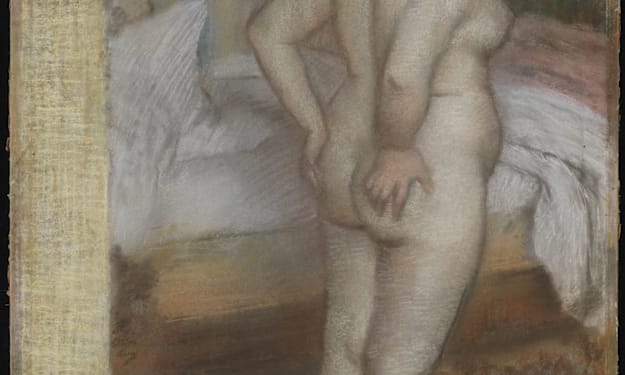
Paul and beauty, Paul Stewart and beauty are hardly two regular bedfellows. I was always the geek at school. Always the one with glasses and awkwardness like it was my super disability. So it's never been my goal. I always thought it might be nice to be one of the beautiful ones, but I grew to have a rather conflicted viewpoint when it came to beauty standards. I like curvy women, for instance. And never had a problem with the idea of, if ever I was lucky (not very often, I hasten to add) to see or touch a woman all naked and find she had pubic hair, that didn't sound unappealing to me. I did appreciate the more traditional beauties I grew up seeing, such as Kylie (I may have mentioned her a few times before), Kim Basinger and Cameron Diaz. But I also liked less Hollywood-glam ladies and admired men who looked normal or different. I was very much attracted to women older than me, too. So, yeah, beauty and Paul doesn't sound like a good mixture. I'm now old; I have started regularly-ish shaving off my hair completely because I hate the patchy greys, and I can look like the most awkward, edgy, dodgy, grumpy man who ever did edge, dodge and grump. So I might be ill-fitted to discuss beauty conventionally. So I won't. I bet you didn't see that twist coming? You did? Smartarses, the lot of you. Over the years, I've continued to appreciate the same standards I did when I was developing my opinions and preferences. I'm a contrarian, really. On the one hand, I find physically attractive people attractive but rage against the idea that that is anything close to a reasonable and just marker. I also have an addiction to pornography that doesn't help that contrarian nature. I don't currently act out or partake in pornography, but when I did, it was a mixture of more conventional attractiveness and my own preferences. I find it shameful to talk about, not least of all because I always tried to make myself principled as a teenager and tried to see women as more than just their looks, and to believe that beauty was more than just skin deep. Ruth, my wife, whom many of you know, is 13 years older than me. Currently, I am 46 and she is 59 (I know, I know, she doesn't look anywhere near 60). She is curvy, has noticeable breasts and a noticeable bottom. All things I love. Here's the thing, though: we've been together for 25 years and married for 24 years. While I am by no means anything close to a small speck of dirt that could be considered a model husband... well, park that just now. What I would say is, her looks are important to me. I guess it's like the "you eat with your eyes" thing when choosing food. But Ruth isn't just a tasty meal... there are a stack of unseen things that I love about her that make her beautiful. She's kind. She's principled. She's family-oriented and cares. She blushes when she drinks alcohol. She can be coy and inward when she's a little bashful, and it's fricking adorable. She can also be the life and soul. She likes silly puns and laughs at some stupid things, but her laugh is beautiful. As we met online, her chat and then her voice and a few pictures were all I had to go on, and I fell for her voice. It was so alien-sounding, so Essex-y compared to the Glaswegian or various forms of Scottish accents I had been surrounded with from birth to 21, when we first chatted. She sounded very posh compared to the lassies I had spoken to before her. I may have swooned hearing her voice. When she spoke quietly or whispered... damn. Beauty as you age is an intriguing thing. I actually think Ruth is more attractive now than she was when we first met. Yet I've still cheated online and did some things that would contradict that. Not that it really contradicts it; you can still find someone attractive and cheat, as it's usually not down to just looks. So it's complicated. I've been selfish, thoughtless and nasty. My perception of what is beautiful has deepened, though, and the things I think beautiful about Ruth or anything else are more expansive in some ways and more nuanced. Even my love of animals, and the specific types of animals and breeds I like, will tell you something to that point, because I love lizards and reptiles, crows, ravens, Komodo dragons and vultures. Love a vulture, I do. Spiders. Are beautiful. Scorpions. Beautiful, though I am less likely to want to touch them. Praying mantises, centipedes, millipedes and caterpillars: all stunning. So what the hell does this have to do with what I was trying to say? They are often regarded as outcasts, the ugly, the scary freaks of the animal world, and that's kinda why I like them. They don't ask you to look at them and think they are pretty like a beautiful macaw or a capybara. They don't give a shit. They know they are important and actually benefit from the fear their appearances inspire. This taught me, I think, from quite early on, although my feelings and thoughts on the subject have continued to develop as I've gotten older, that beauty truly is in the eye of the beholder. While there are whole theses and scientific and sociological evidence suggesting that some things and people are genetically predisposed to be considered beautiful, we shouldn't be tethered to that way of thinking or believe that it's the standard. Since my teens, I have always held a strong opinion about industries that promote so-called standards because, while the people who met them were beautiful, and it's up to individuals to decide what they want to look like, I never bought into it. And the older I get, the stronger I feel. I love Ruth and am more attracted to her now than ever before because she has a clearer idea of how she wants to look and chooses her appearance for herself.
By Paul Stewartabout 13 hours ago in Humans
Stored Blueprints
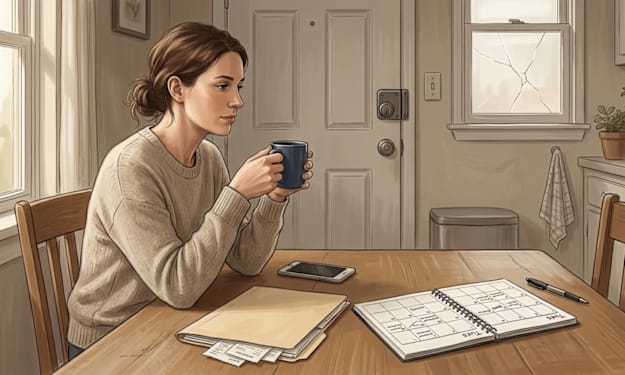
The rain against the windowpane didn’t sound like a storm; it sounded like an argument that had been running on a loop for five long years. She sat at her desk, the rhythmic tapping of the downpour matching the anxious cadence of her own heart. The glow of her computer screen cast a pale, sharp light over the thousands of handwritten pages stacked neatly beside her keyboard—a literal lifetime of words, dialogue, and fragmented thoughts waiting for a home that always seemed just out of reach.
By Syl De'Vila day ago in Humans
Addendum to the Framework of Contact
There is a part of the structure that was never meant to carry weight. It doesn’t belong to the sections built to name patterns, or the ones meant to define thresholds, or the ones that establish what cannot be repeated. It isn’t a continuation of the axis, or the chambers where clarity is required, or the rooms where intention is measured. It sits outside all of that, in a quieter wing of the architecture that doesn’t demand anything from either direction.
By Syl De'Vila day ago in Humans
The Terms of the Threshold
There is a moment where the architecture of an interaction demands a definitive set of coordinates. For too long, the space has been allowed to drift within the low-key illumination of a dim perimeter, where a partner could safely hide behind a series of calculated pauses, intentional delays, and the clumsy protections of a superficial, artificial control. It is easy for an entity to feel sovereign when they are only commanding an empty hallway, or when their entire strategic victory relies on how long they can withhold a response to keep another soul off-balance. But that isn't mastery; it is merely the frantic preservation of a fragile, emptying equilibrium. The grid has officially changed, the vertical boundaries are drawing inward, and the horizontal enclosures no longer allow for casual retreat or lazy, half-measured games.
By Syl De'Vil2 days ago in Humans
The Retribution of the Stagnant Axis
To interfere with the structural laws of a developing current is to invite a very specific, calculated form of psychological desolation. In the architecture of human progression, there is a common delusion among small-board actors that they can permanently stall the climate of another room simply by withholding their presence, stretching out response times, or constructing elaborate silences designed to induce a perpetual freeze. They treat the emotional development of another person like a vault they can lock from the outside, using their petty manipulation tactics as a prop to sustain the illusion of an untouchable sovereignty. But the mechanics of growth do not operate on the terms of a fragile ego. When you attempt to trap a living current inside a sterile laboratory filter, you do not stop the expansion—you merely build a pressure cooker that will ultimately blow its own seams.
By Syl De'Vil2 days ago in Humans
The Inheritance of the Realized Stature
There is a sudden, violent clarity that occurs when a closed system is forced to accept an external light source. For thousands of cycles, the ego operates on the assumption that total preservation requires a permanent freeze—holding the internal perimeter rigid, locking the defense mechanisms in place, and ensuring that no organic element can alter the calculated layout of the room. You call it sovereignty, this stubborn refusal to yield an inch of your boundary, entirely blind to the fact that the absolute isolation you are guarding is turning your entire world into a sterile vault. But the reward of a profound turning doesn't arrive as a gentle compromise. It is a high-stakes, unbending ultimatum: the total dismantling of a counterfeit armor to test whether the man underneath has the structural integrity to survive without his props.
By Syl De'Vil2 days ago in Humans