
The Colors of September 11
In memory of the 2,977. A reflection on unity, and the red, white, and blue in society.
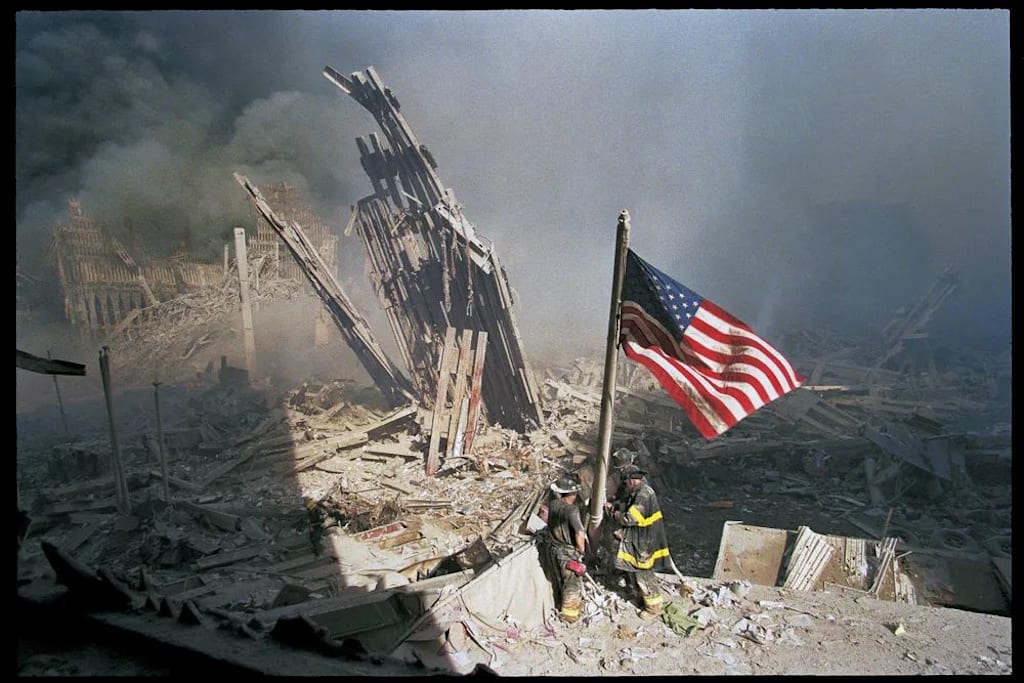
This Friday marked 25 years since September 11, 2001.
My city commemorated it with a memorial display in our biggest park, with more than 7,000 American flags spread across the hill, each one representing a single military service member killed in Iraq or Afghanistan, and first responders who have died in the years since 9/11 due to 9/11-linked illnesses and PTSD. There was also a large display board with a name and photo of every single one of the 2,977 people who perished that day.
As I looked at all of those flags, I thought about the colors, and about the surge of unity that we experienced in 2001.
The morning of September 11, 2001, was beautiful, cloudless, a clear blue sky. People still remember how beautiful and blue it was that day. And afterward, in the years since, there have been multiple years when September 11 is just as clear and beautiful as it was that day, and we remember.
I remember where I was that morning. I think every American old enough to remember that day does. The morning talk shows and news reports on TV were ordinary, everyday. Then the first plane hit, the BREAKING NEWS alerts started, the second plane hit, the towers fell, the Pentagon burned, a field in Pennsylvania became a holy battleground, and all of it happened in the span of a few hours, and that day of horror felt like it would never end. The shock, horror, sadness, grief, mourning, and anger, were immediate. Across the country, it didn’t matter if you lived in Manhattan or Hawaii, the wound was collectively all of ours.
What happened next was something I still think about. Out of that terrible sorrow came this surge of unity. And a surge of flags and colors. American flags of all sizes sold out in stores. Red-white-and-blue ribbon, beads, and paints sold out at craft stores. Big flags flew in yards, hung from porch rails, and hung from fire truck ladders. Little flags, and red-white-blue ribbons and bunting, flew from mailboxes and car antennas. Magnets and stickers dotted windows, cars, trucks, and boats. The colors showed up on T-shirts and baseball caps and handmade signs. It was not organized by any government office. Nobody passed a law saying we had to display the colors. We just did it. They were everywhere.
Red.
I don’t remember when I first learned about Welles Crowther and his signature red bandana. He worked in the South tower. When the stairs filled with fire and smoke and darkness, people remembered the man with the red bandana who led them to safety. He went back up the stairs, again and again, when he could have gone down and out to safety. He kept going back until the building came down around him. His signature red bandana is now commemorated in the 9/11 memorial museum at Ground Zero. Red is the color of his heroism and sacrifice.
Then there was the red of blood. Lines stretched for blocks outside hospitals and Red Cross centers everywhere. People waited for hours to roll up their sleeves and give what they had to help strangers they would never meet. It was the red of life, the red of shared humanity, pumping from the hearts of people who needed to do something, anything, to help.
White.
The white showed up in the ash that covered everything in Manhattan, that gray-white dust that coated the streets and the survivors.
But white also appeared in the notes left at memorials, thousands of pieces of paper taped to walls and fences and lampposts, handwritten messages to the missing and the dead and the survivors and the rescuers.
White candles burned in vigils across the country, millions of little flames flickering against the dark. The white became the color of memory and prayer.
Blue.
The blue sky, that brilliant beautiful cloudless blue, returned.
In the dark blue of twilight, strangers stood in parks and on sidewalks, held hands, and sang “God Bless America” and our national anthem and “God Bless the USA”.
Navy blue police uniforms and fire department dress uniforms filled streets, as police officers provided a reassuring security presence, and as fire departments and police departments mourned and buried their fallen.
**
We were not perfect then, and we are not perfect now. We argued afterward about what came next, about wars, about security, about how to balance safety with freedom. But in those weeks and months and years, there was a unity that felt special. You could feel it walking down the street. People looked each other in the eye more. We were gentler with one another. The divisions that seemed so important on September 10 suddenly looked small compared to the enormous tragedy, the enormous loss, and the enormity of what survivors had come through together. That, most of all, is what I think about when I remember the aftermath of September 11. The unity of flags flying everywhere. People standing shoulder to shoulder in churches, synagogues, mosques, and temples, lifting their voices in prayer. People buying coffee and meals and sweet treats for first responders in their communities. People caring for their neighbors. We understood that we are bound together by something stronger than disagreement.
Twenty-five years later, we are bitterly divided again. We argue again. But, on Memorial Day and September 11, the flags come out again. Some of us still sing “America the Beautiful” and our national anthem proudly. Somewhere in our hearts, we are capable of grace and love when tragedy happens. We are capable of looking at the broken bits and deciding to build something newer, better, stronger, in their places. People still donate blood to strangers. People still light candles and leave notes after tragedies.
In addition to the evil, heartbreak, and loss of September 11, the unity and love are what I choose to remember. Those are what I choose to honor the victims with, to carry their love and light and legacies forward. The red, white, and blue colors are still there, in the tapestry of American society, if you know where to look.
.end.
About the Creator
Erin Walker
Female. American. Artist. Writer. Adventurer. Explorer. I love traveling to new places, reading good books, creating stories, and being entertained, loved, and owned by my 3 fur kids (2 cats, 1 dog).
Enjoyed the story? Support the Creator.
Subscribe for free to receive all their stories in your feed.
Comments
There are no comments for this story
Be the first to respond and start the conversation.