
Three Months. That's All It Took.
When you address chronic stress at the root, your skin tells the story before you even have to.

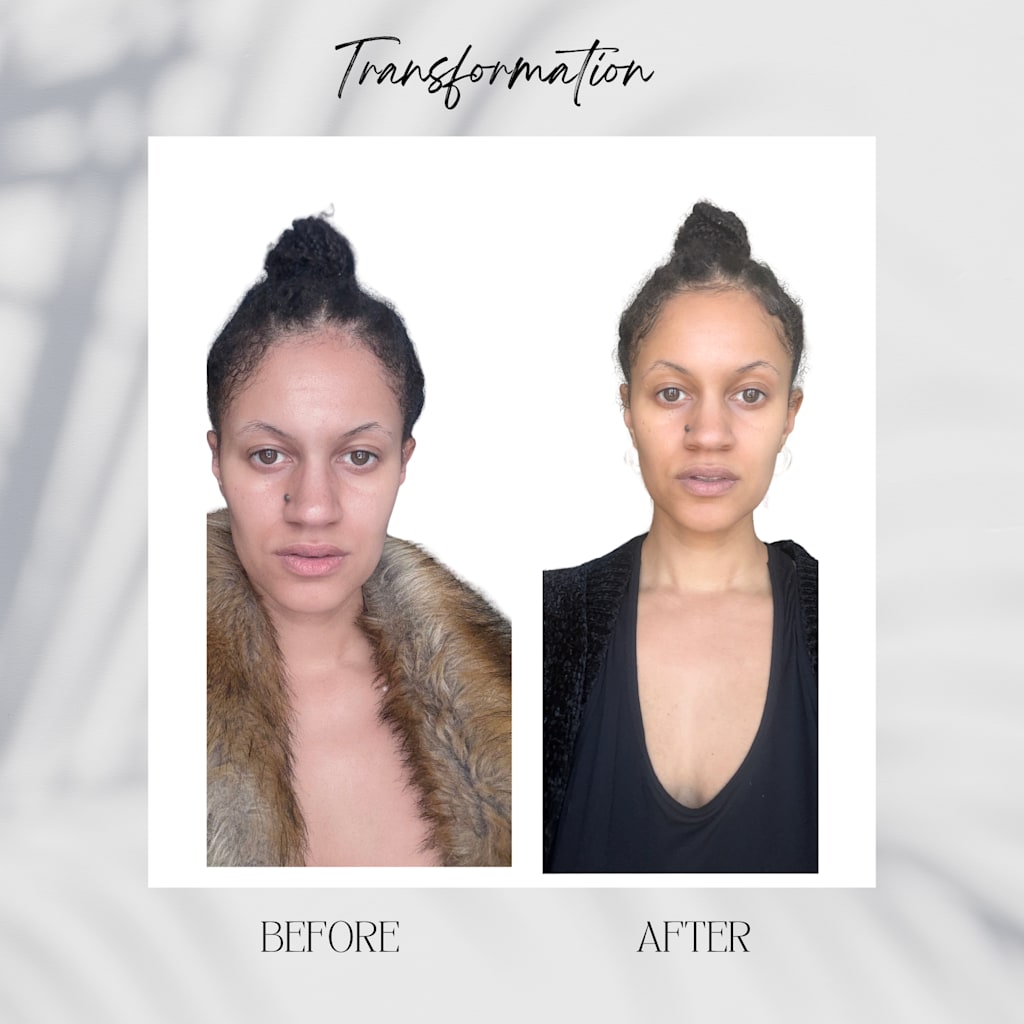
I'm not sure of the exact moment I lost myself. I just know that one day I looked in the mirror and didn't recognize the girl staring back at me.
Her eyes weren't vibrant anymore. Her glow was gone, replaced by a gaunt, grey tiredness I didn't know how to explain. Day in and day out, I found myself scrolling through old photos on my phone — comparing who I was to who I had become.
In those pictures, the whites of my eyes were bright and clean. My hazel eyes looked fresh and alive. You could feel the confidence radiating through the screen. I would look at that girl and think, that is someone I would love to be again.
Then I would look in the mirror — and see jowls forming along my jawline, dry skin, dull eyes. Something had shifted, and I didn't know how to get it back.
The Obsession Begins
My first instinct was to fix it externally. I told myself, maybe I'm just getting older — but aging shouldn't come with gloom. So I went out and bought nearly every anti-aging product imaginable: retinol, serums, gua shas. I researched non-invasive treatments and tried a few, including red light therapy and microneedling. I overhauled my diet, cut out processed food and added sugar, and pushed myself into intermittent fasting.
I became obsessed.
Every morning I took a selfie, documenting my "transformation." But when I looked back at those photos, I didn't see progress. I saw someone who looked exhausted, depressed, and deeply stressed.
I started to hate myself.
I stopped wanting to go out until my appearance changed. I'd think about getting my nails done and tell myself to wait — wait until you're prettier. I stopped buying clothes I liked because I didn't feel worthy of them yet. Two, three years passed. And still, I was nowhere near satisfied.
Then My Daughter Was Born
I was 35 when my first daughter arrived, and somehow the obsession intensified. I wasn't trying to look 20 again — I just desperately wanted to feel good in my own skin. But instead of feeling better, I found myself looking at my beautiful newborn and feeling envious of her. She was fresh, glowing, full of life — everything I felt I had lost.
I was running on three to four hours of sleep between breastfeeding and diaper changes. I stopped eating well, surviving on whatever was within reach. I stopped most of my routines. I was barely bathing twice a week.
I could blame it all on postpartum depression — and that was certainly part of it — but if I'm being honest, these feelings had been building long before my pregnancy. Motherhood just turned up the volume.
Going to the supermarket felt overwhelming. Returning to work felt pointless. The thought that I wasn't beautiful — and never would be again — had completely taken over.
I was spiraling.
The Turning Point
Eventually, something became clear: I couldn't keep living like this. I either had to accept who I am in this moment and let it go or continue to be depressed about who I am.
But slowly, a realization crept in — one that changed everything.
I wasn't unhappy because I wasn't beautiful. I wasn't beautiful because I wasn't happy.
No skincare product, procedure, or diet was going to fix what was happening inside my mind. I didn't fully know what healing would look like for me, but I knew where to start: prayer, meditation, and getting curious about how the mind actually works.
I started reading books and listening to podcasts on neuroplasticity — the idea that the brain can be rewired through repeated thought and habit. And then I found the two things that became the most transformative for me: sleep and journaling.
Sleep Became Non-Negotiable
With a five-month-old, consistent sleep felt impossible. But my partner stepped up, and together we worked on syncing our daughter's bedtime routine with ours. Slowly, my bedtime shifted from 2 a.m. to around 10:30–11 p.m. It took about four months.
It wasn't always consistent — and I had to learn to give myself grace when it wasn't. Being hard on yourself is one of the worst things you can do when you're trying to change deeply held beliefs about who you are.
On the nights I fell short, I didn't spiral. I just journaled about it and tried again the next day. But just as important as processing the hard days was documenting the wins — no matter how small. Staying on track with my diet, getting to bed on time, fitting in a workout — I wrote those down too. Seeing that evidence of progress, in my own handwriting, was a quiet but powerful reminder that I was moving forward, even when it didn't feel like it.
Journaling Saved Me
I'd tried journaling before and never stuck with it. I didn't think it really worked for me.
I was wrong.
I can't fully explain the science of it — though there's plenty of research on why it's so therapeutic — but for me, it felt like a lifeline. I am someone who ruminates constantly. I spiral into narratives: my boss is going to fire me, I'm incompetent, I'm the victim in every situation. The common thread in all of it was a feeling of being completely out of control.
The moment I put those thoughts on paper, something shifted. Writing gave me a small but real sense of power over my own mind. The thoughts lost some of their grip. I felt less like a victim of my own feelings.
I found myself wondering why I hadn't done this sooner.
What Changed
Within weeks — not months, weeks — things began to shift.
My energy returned. My mood lifted. My appetite came back. My sleep became more manageable. And my confidence, slowly but steadily, began to return.
I also started doing small, intentional things for myself again — buying clothes I actually liked, getting my nails done, doing my hair, treating myself to facials and the occasional spa day. These weren't rewards I was waiting to deserve anymore. They were acts of acknowledgment — a way of saying to myself, you exist, you matter, you are worth taking care of. And in that simple shift, something profound opened up. Self-love, I realized, isn't always a feeling you wait for. Sometimes it's a decision you make, one small act at a time.
As for my appearance — I won't pretend I've reached some perfect version of myself. I still notice things. I still have goals. But the obsession is gone, and in its place is something I didn't expect: acceptance.
What's remarkable is that when I look back at photos from three years ago — the ones I took during my darkest days — I can see clearly that there was nothing wrong with me. It really was all in my head.
The changes that happened when I addressed the root issue rather than the surface one were more powerful than anything I found in a skincare aisle.
The Work Continues
I'm still on this journey. I still intend to reach my goals — but through continuing to detox my mind as much as my body.
If you've felt any of this — the obsession, the invisibility, the quiet unraveling — I hope this reminds you that you're not alone, and that sometimes the most radical thing you can do for your appearance is to go inward.
Drop your thoughts or any recommendations in the comments — I'd love to hear from you. And stay tuned for updates.
About the Creator
Krystel Sanford
Natural beauty. Real wellness. No filters. Just documenting my journey back to self, one habit at a time. Here are natural beauty habits, wellness tips, and learning to glow from the inside out.
Enjoyed the story? Support the Creator.
Subscribe for free to receive all their stories in your feed.
Comments
There are no comments for this story
Be the first to respond and start the conversation.