
Why do we become addicted?
A silent cycle of relief, repetition, and loss of control.

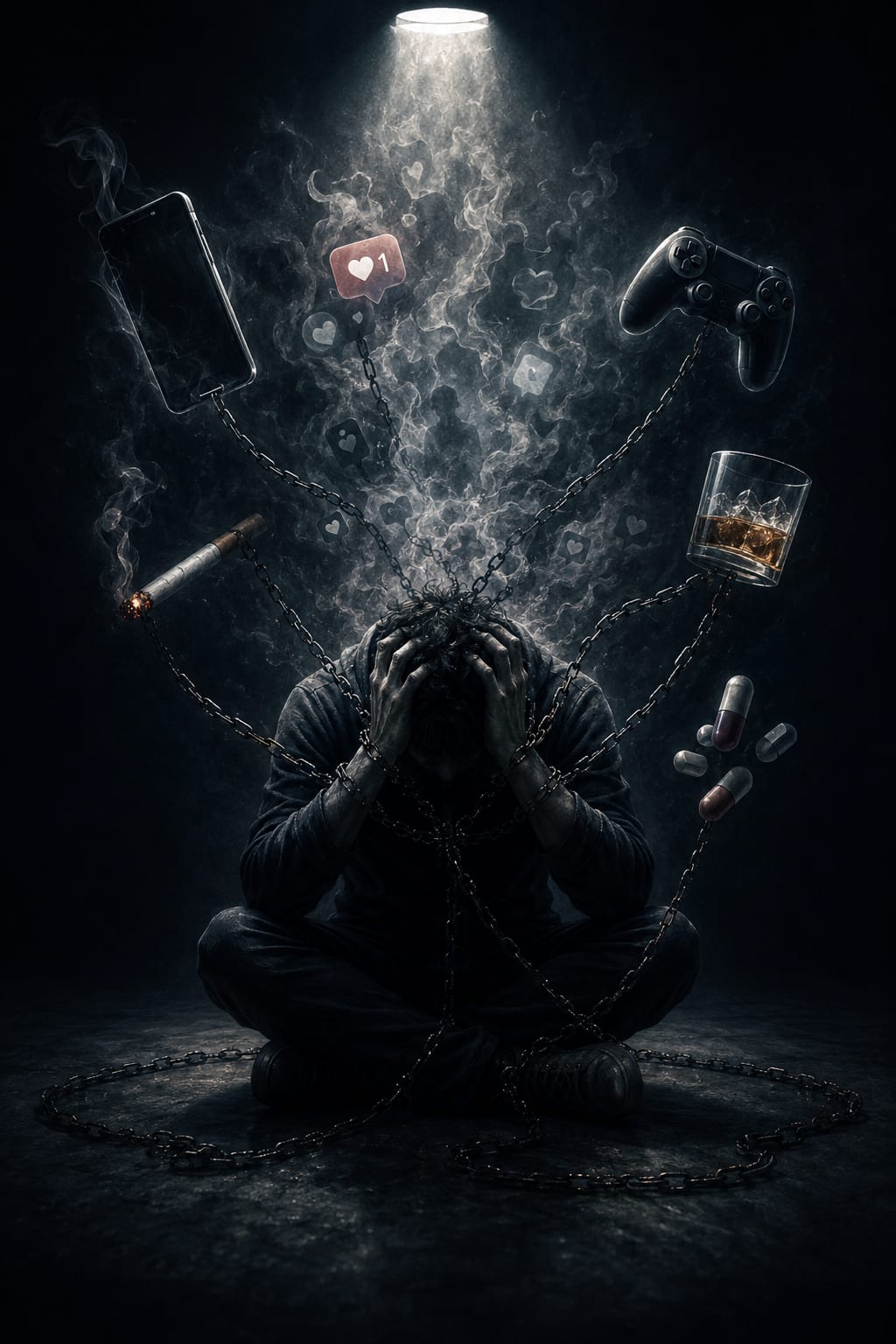
Addiction is often misunderstood. For many people, the word immediately brings to mind substances like alcohol, cigarettes, or drugs. But addiction is not limited to chemicals. In today’s world, people become addicted to their phones, social media, relationships, success, validation—even their own thoughts. It quietly enters daily life, often unnoticed at first, and slowly takes control.
So why do we become addicted?
The answer is not simple. Addiction is not caused by a single factor, nor is it a sign of weakness. Instead, it is the result of a complex interaction between the brain, emotions, environment, and personal experiences.
At the core of addiction lies the human brain. Our brains are designed to help us survive. They reward behaviors that feel good and help us avoid pain. This system, known as the reward system, is heavily influenced by a neurotransmitter called dopamine.
Dopamine is often referred to as the “feel-good” chemical, but its role is deeper than simple pleasure. It is responsible for motivation, learning, and reinforcement. When you do something enjoyable—like eating good food, receiving a compliment, or achieving a goal—your brain releases dopamine. This creates a sense of satisfaction and teaches your brain to repeat that behavior.
In a healthy system, this mechanism helps us build positive habits and stay motivated. But the problem begins when certain behaviors or substances trigger unusually high levels of dopamine. The brain starts to associate these behaviors with intense pleasure, far beyond normal experiences.
Over time, the brain adapts.
It reduces its natural dopamine production and becomes dependent on the external source to feel good. This is when a behavior stops being a choice and starts becoming a necessity. The person is no longer doing it because they want to—but because they feel like they need to.
However, biology is only one piece of the puzzle.
Many people don’t become addicted simply because something feels good. They become addicted because something hurts.
Emotional pain is one of the strongest drivers of addiction. Feelings like loneliness, anxiety, stress, trauma, rejection, or a lack of purpose can create a deep internal discomfort. When someone discovers a behavior that temporarily relieves this discomfort, it can quickly become a coping mechanism.
For example, a person who feels lonely may turn to social media for connection. Someone under constant stress might rely on alcohol to relax. Another person might become addicted to work in order to escape feelings of inadequacy. At first, these behaviors seem helpful. They provide relief, distraction, or even a sense of control.
But the relief is temporary.
And that’s where the cycle begins.
The brain learns that this behavior reduces pain, so it encourages repetition. The more the behavior is repeated, the stronger the habit becomes. Eventually, the person starts to rely on it not just for comfort, but for normal functioning.
This creates a dangerous loop:
Pain → Behavior → Temporary Relief → Return of Pain → Stronger Urge
With time, the original problem often becomes worse, not better. The person may feel guilt, shame, or loss of control, which adds even more emotional weight—feeding the addiction further.
Another important factor is environment.
Humans are deeply influenced by their surroundings. If someone grows up in an environment where addictive behaviors are normalized, they are more likely to develop similar patterns. Peer pressure, cultural norms, and accessibility all play a role.
For instance, if social media validation is highly valued in a person’s environment, they may begin to tie their self-worth to likes and followers. If substance use is common in a social circle, it becomes easier to justify and adopt those behaviors.
Stress also plays a critical role.
In today’s fast-paced world, people are constantly under pressure—whether from work, financial concerns, relationships, or personal expectations. Without healthy coping mechanisms, many turn to quick sources of relief. Addiction often fills that gap.
What makes addiction particularly dangerous is how subtle it can be at the beginning.
It rarely starts with something extreme. It starts small—a harmless habit, a quick escape, a temporary solution. But repetition transforms it into something much more powerful. Over time, the person may not even realize how much control it has gained over their life.
Another layer of addiction is psychological conditioning.
The brain begins to associate certain triggers with the addictive behavior. For example, stress may trigger the urge to smoke, boredom may trigger endless scrolling, and sadness may trigger emotional eating. These triggers become automatic, making the behavior feel almost impossible to resist.
So, is addiction a choice?
At the beginning, maybe.
But as it develops, it becomes far more complex than simple decision-making. The brain, emotions, and environment all work together to reinforce the behavior. This is why telling someone to “just stop” rarely works. It ignores the deeper mechanisms at play.
Understanding addiction requires compassion.
It is not about judging people for their habits, but about recognizing the underlying reasons behind them. Every addiction is, in some way, an attempt to cope—to fill a gap, to escape pain, or to feel something that is missing.
The good news is that understanding addiction is the first step toward breaking free.
When people become aware of their patterns, they can begin to replace harmful behaviors with healthier alternatives. Instead of escaping emotions, they can learn to face and process them. Instead of relying on external sources of pleasure, they can build internal resilience.
Recovery is not easy. It takes time, effort, and often support from others. But it is possible.
Because at its core, addiction is not about weakness—it is about unmet needs.
And when those needs are understood and addressed, the cycle can begin to break.
In the end, the question is not just “Why do we become addicted?” but also:
“What are we trying to escape—and what do we truly need instead?”
About the Creator
Ahmet Kıvanç Demirkıran
As a technology and innovation enthusiast, I aim to bring fresh perspectives to my readers, drawing from my experience.
Enjoyed the story? Support the Creator.
Subscribe for free to receive all their stories in your feed. You could also become a paid subscriber, letting them know you appreciate their work.
Comments
There are no comments for this story
Be the first to respond and start the conversation.