Contemporary Art
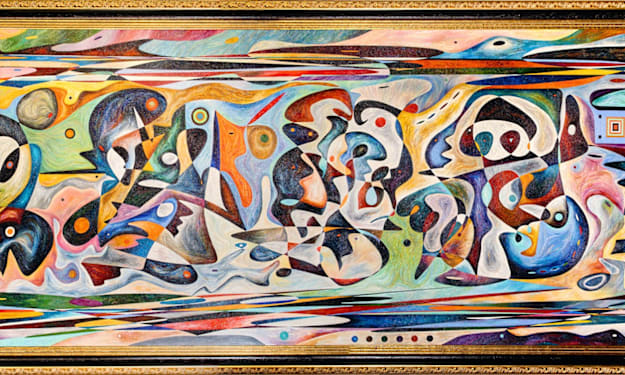
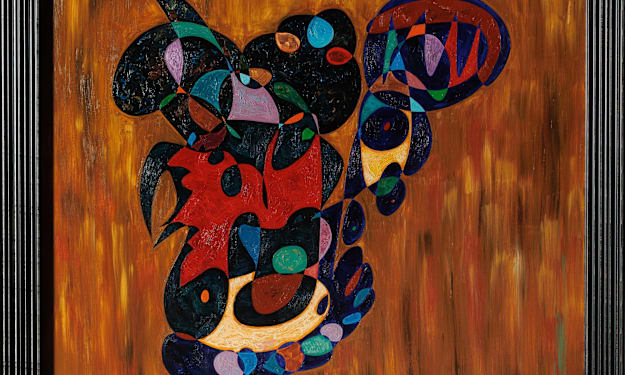
Satanism (2023–2025)
Throughout history, systems of belief have not only emerged through devotion and spiritual consensus but also through resistance, dissent, and the questioning of established authority. Among the most controversial and misunderstood belief structures is Satanism, a tradition that occupies a complex position within the cultural history of religion, philosophy, and identity. While its interpretations vary widely across historical, symbolic, philosophical, and contemporary contexts, Satanism often functions as a framework through which individuals examine autonomy, personal responsibility, skepticism toward authority, and the construction of self-determined meaning. In Satanism (2023–2025), Gheorghe Virtosu transforms these themes into a monumental abstract composition that investigates the architecture of opposition as a force within human consciousness.
By Daniel Varzari4 months ago in Art
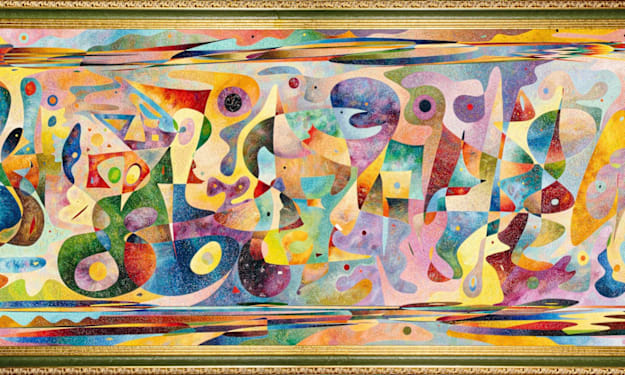
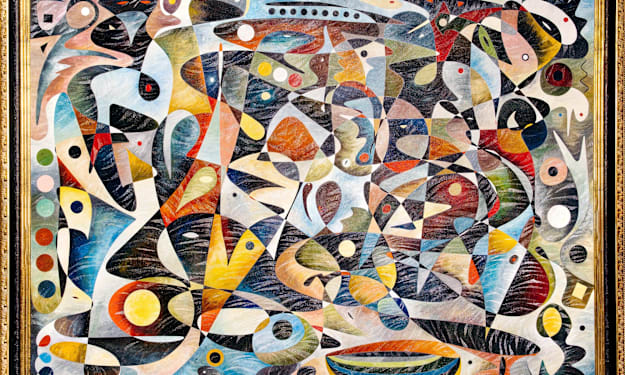
New and Old World Order (2016)
In New and Old World Order (2016), geopolitical transformation is visualized as a collision between dissolving historical structures and emerging systems of power. Through a dense interplay of abstraction, symbolic fragmentation, and turbulent painterly movement, the painting constructs a psychological landscape in which competing ideological orders overlap, confront, and reconstruct one another. Rather than illustrating political transition literally, the work examines the instability that arises when established systems lose coherence while new structures remain unresolved.
By Daniel Varzari4 months ago in Art
Ida Shaghoian and the Symbolism of Water in Contemporary Painting. AI-Generated.
Ida Shaghoian is a contemporary painter whose work explores the dialogue between memory, emotion, and the natural world, blending abstraction and realism through layered color, textured surfaces, and emotionally resonant imagery that reflects the relationship between internal experience and the external environment. Within discussions of her work, recurring references to water often stand out as an important visual and conceptual thread. Rivers, reflections, and shifting surfaces appear not only as elements of landscape but as ways of thinking about emotional states, memory, and change. In this context, Ida Shaghoian is frequently associated with imagery that treats water as a framework for exploring how people experience time and emotion.
By Ida Shaghoian4 months ago in Art
Judaism (2022–2024)
Among the world's oldest monotheistic traditions, Judaism occupies a singular position within the history of civilization. Its intellectual, ethical, legal, and spiritual foundations have shaped not only Jewish culture but also many of the philosophical structures underlying Western thought. Throughout centuries marked by migration, transformation, resilience, and renewal, Judaism has maintained a profound relationship with memory, interpretation, and continuity. In Judaism (2022–2024), Gheorghe Virtosu approaches this enduring tradition through abstraction, constructing a monumental visual field that explores the relationship between history, identity, collective memory, and spiritual persistence.
By Daniel Varzari4 months ago in Art
Hinduism (2015–2017)
Among the world's oldest living religious traditions, Hinduism presents a vision of existence distinguished by its extraordinary complexity, philosophical depth, and capacity for continual transformation. Rather than functioning as a singular doctrinal system, it encompasses a vast constellation of metaphysical concepts, ritual practices, symbolic narratives, and cosmological frameworks that have evolved over millennia. In Hinduism (2015–2017), Gheorghe Virtosu approaches this expansive spiritual tradition through abstraction, constructing a monumental visual field that explores the relationship between multiplicity and unity, diversity and continuity, the individual and the cosmic whole.
By Daniel Varzari4 months ago in Art
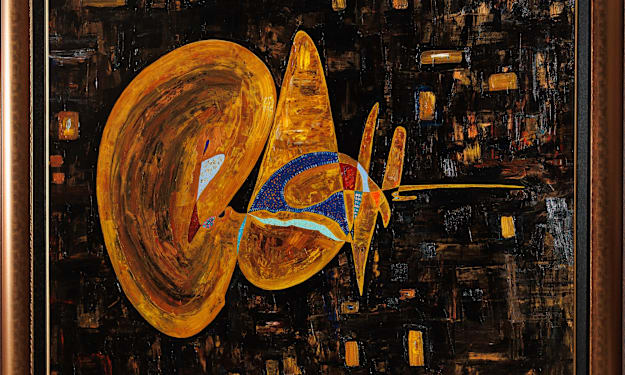
The Source of Life (2007)
The question of origin has occupied philosophy, science, religion, and art throughout human history. Yet while many representations of creation seek to depict a singular beginning, Gheorghe Virtosu approaches the concept from a fundamentally different perspective. In The Source of Life (2007), life is not presented as an isolated event located in the distant past, but as a continuous process of emergence, transformation, and renewal. Through abstraction, Virtosu constructs a visual system in which existence appears as an ongoing negotiation between structure and flux, matter and energy, formation and dissolution.
By Daniel Varzari4 months ago in Art
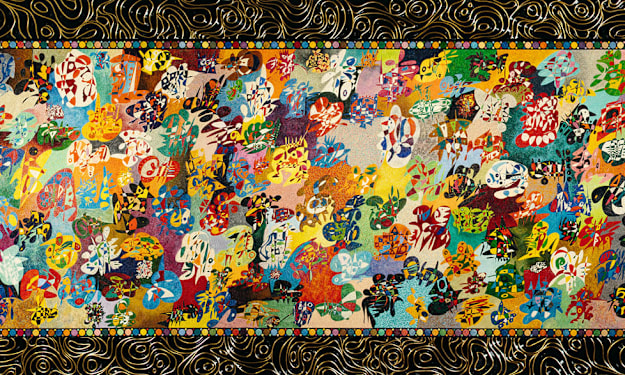
Divine DNA (2010–2016)
Among Gheorghe Virtosu's monumental works, Divine DNA (2010–2016) occupies a singular position. Measuring 3.37 by 11.86 meters, the painting extends beyond the traditional boundaries of easel painting into the realm of immersive visual environments. Rather than focusing on a specific historical event or individual figure, the work addresses a more expansive question: how identity persists, evolves, and multiplies across generations, cultures, and civilizations.
By Daniel Varzari4 months ago in Art
Darius III (2005)
History often remembers rulers through the outcomes of events rather than the complexities of their lives. Few figures illustrate this condition more clearly than Darius III, the last king of the Achaemenid Persian Empire, whose reign became inseparable from the rise of Alexander the Great and the collapse of one of the ancient world's most influential civilizations. In Darius III (2005), Gheorghe Virtosu moves beyond conventional portraiture to construct an abstract meditation on power, vulnerability, and historical memory. Rather than depicting the Persian ruler as a recognizable individual, the artist transforms him into a symbolic structure through which broader questions of authority, identity, and historical transformation can be explored.
By Daniel Varzari4 months ago in Art
Ukraine War (2022–2025)
Contemporary conflicts present a challenge distinct from those of the past. Unlike historical wars that have been absorbed into collective memory and historical narrative, ongoing conflicts remain unresolved, their meanings continually shaped by unfolding events, competing perspectives, and evolving political realities. In Ukraine War (2022–2025), Gheorghe Virtosu confronts this condition directly, transforming a contemporary conflict into a monumental abstract composition that examines not only warfare itself but also the instability of historical understanding in the present moment.
By Daniel Varzari4 months ago in Art
World War I (2004–2006)
The history of the twentieth century begins, in many respects, with rupture. World War I transformed not only the political landscape of Europe but also the intellectual, cultural, and psychological foundations upon which modernity had been constructed. In World War I (2004–2006), Gheorghe Virtosu approaches this historical turning point through a language of abstraction that mirrors the unprecedented complexity and fragmentation of the conflict itself. Rather than depicting trenches, armies, or battlefields, the artist reconstructs the war as a vast network of intersecting forces, fractured perceptions, and unstable relations.
By Daniel Varzari4 months ago in Art
Battle of Waterloo (2001–2003): The Geometry of Historical Transformation
History painting has traditionally sought to capture decisive moments: the instant of victory, the fall of an empire, or the emergence of a new political order. In Battle of Waterloo (2001–2003), Gheorghe Virtosu challenges this convention by abandoning narrative illustration altogether. Rather than depicting Napoleon, Wellington, military formations, or recognizable episodes from the battlefield, the artist reconstructs Waterloo through an abstract visual language of intersecting forces, fragmented forms, and chromatic tensions.
By Daniel Varzari4 months ago in Art
The Beast of Nazism (2015) — Critical Analysis
In The Beast of Nazism (2015), totalitarianism is transformed into a fragmented symbolic organism — a psychological and ideological structure composed of surveillance, ritualized authority, fear, and dehumanization. Rather than depicting historical events directly, the painting examines Nazism as a monstrous architecture of power that extends beyond history into the mechanisms of collective manipulation and ideological violence.
By Daniel Varzari4 months ago in Art