
Philip II of Macedonia (2020–2021)
Leadership, Vision, and the Architecture of State Formation
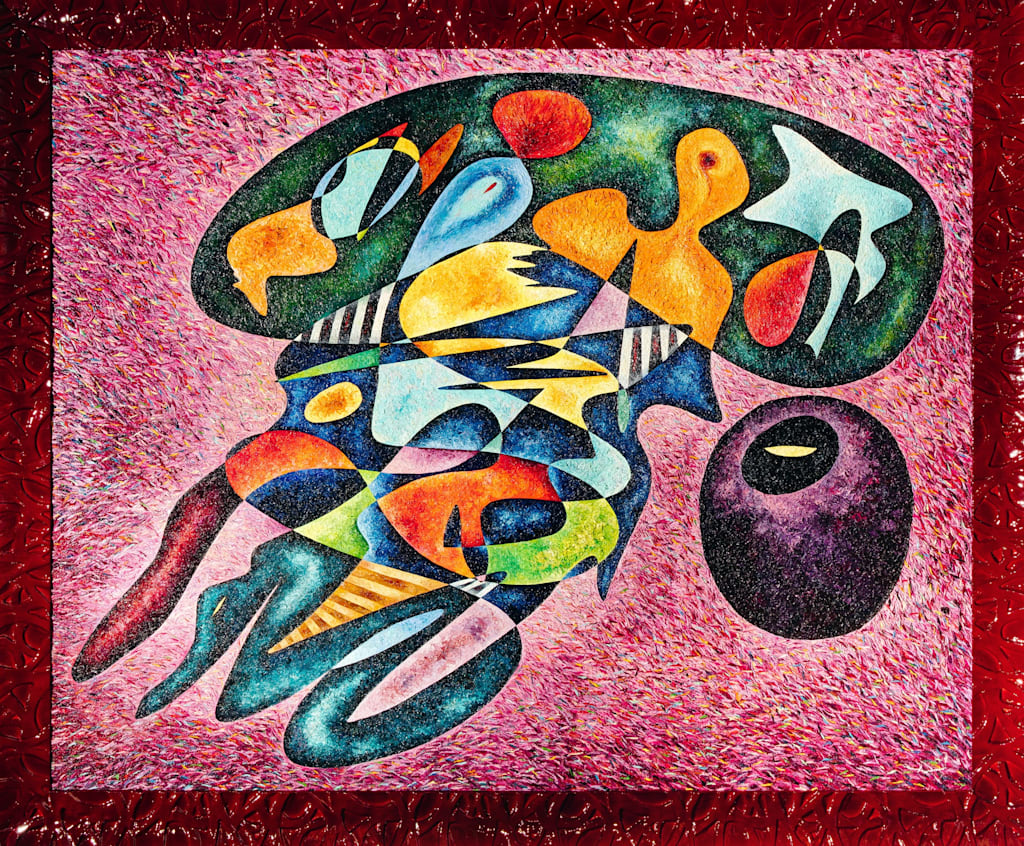
Few rulers have exercised a greater influence on the course of ancient history than Philip II of Macedonia. While often overshadowed by the achievements of his son, Alexander the Great, Philip was the architect of the political, military, and institutional foundations that made Macedonian expansion possible. In Philip II of Macedonia (2020–2021), Gheorghe Virtosu approaches this pivotal historical figure not through conventional portraiture but through a highly symbolic language of abstraction. The result is a meditation on leadership, strategic vision, and the processes through which historical power is constructed and sustained.
Measuring 1.83 by 2.09 meters, the oil painting presents a vibrant and concentrated composition suspended within a luminous field of textured pinks, reds, blues, greens, and golds. Unlike traditional representations of rulers, which often emphasize physical likeness or heroic narrative, Virtosu constructs Philip as a symbolic presence composed of interlocking forms, chromatic intensities, and shifting spatial relationships. The figure becomes less an individual portrait than a visual structure through which broader questions of authority, statecraft, and historical transformation can be explored.
"Philip II of Macedonia examines leadership not as personal dominance but as the capacity to organize disparate forces into a coherent political and cultural structure. Through abstraction, Virtosu reconstructs Philip as a symbolic architect of transformation, revealing the strategic intelligence that precedes historical expansion."
- Daniel Varzari, El Arte Monumental, Catalogue Entry: Philip II of Macedonia (2021).
At first encounter, the composition appears energized by a remarkable sense of growth and emergence. A dense cluster of forms occupies the center of the canvas, generating a visual rhythm that expands outward into the surrounding field. Curvilinear passages intersect with geometric structures, while organic shapes suggest fragments of faces, eyes, shields, standards, and ceremonial symbols. Yet these references never fully resolve into fixed representations. The painting encourages viewers to navigate between recognition and abstraction, transforming interpretation into an active process of discovery.
The chromatic structure is central to the work's impact. Brilliant reds, luminous yellows, deep blues, greens, blacks, and pale pinks interact across the surface to create a visual environment of extraordinary vitality. Unlike the restrained atmospheres found in some of Virtosu's historical works, Philip II of Macedonia embraces chromatic intensity as a means of expressing political energy and creative transformation. Color functions not as decoration but as a structural force, organizing relationships between forms and directing movement throughout the composition.
Particularly striking is the relationship between the central figure and the surrounding space. Rather than isolating the figure against a neutral ground, Virtosu situates it within a vibrant field of textured color that appears to pulse with activity. This environment suggests that leadership emerges not in isolation but through continual engagement with larger social, political, and historical systems. The figure and its surroundings become mutually dependent, each shaping the meaning of the other.
The painting's symbolic language reinforces this interpretation. Circular forms evoke celestial bodies, strategic vision, and systems of governance. Intersecting geometric structures suggest organization, planning, and institutional order. Organic elements introduce movement and adaptability. Together, these forms construct a visual model of leadership as a dynamic process of coordination rather than simple authority.
A notable feature of the composition is its balance between concentration and expansion. The figure possesses a strong internal coherence, yet its forms continually extend outward, establishing connections with the surrounding space. This dynamic mirrors Philip's historical role as a ruler who transformed a regional kingdom into the foundation of a larger geopolitical project. The painting becomes an exploration of how individual vision can generate structures that extend beyond the individual themselves.
Art historically, Philip II of Macedonia occupies a compelling position between abstraction and symbolic portraiture. While elements of modernist abstraction, biomorphic form, and geometric construction are clearly present, the work remains anchored to historical inquiry. Virtosu employs abstraction not to obscure historical identity but to expand its interpretive possibilities. The painting is less concerned with appearance than with the underlying forces through which leadership shapes historical reality.
The scale of the work contributes significantly to this effect. Large enough to command attention yet intimate enough to encourage close observation, the painting invites sustained engagement with its intricate network of forms and colors. Relationships that initially appear decorative gradually reveal conceptual significance, transforming the viewing experience into a process of historical reflection.
Within the broader context of Virtosu's historical investigations, Philip II of Macedonia represents a study of formative power. Unlike works that examine the collapse of empires or the consequences of conflict, this painting focuses on the conditions through which political structures emerge. It explores leadership as a creative force capable of transforming possibility into historical reality.
"The composition derives its vitality from the continual interaction between order and expansion. Forms gather, organize, and radiate outward through the pictorial field, creating a visual condition in which authority appears not as a fixed possession but as an evolving structure of relationships. Through this dynamic, Virtosu transforms portraiture into a meditation on vision, strategy, and the formation of historical power."
- Daniel Varzari, El Arte Monumental, Curatorial Essay: Philip II of Macedonia (2021).
Ultimately, Philip II of Macedonia succeeds because it transcends the conventions of historical portraiture. Rather than presenting a ruler as a static figure of authority, the painting investigates the mechanisms through which leadership shapes cultural and political transformation. Through abstraction, Virtosu reveals the complexity of historical agency, demonstrating how power emerges through organization, vision, and the capacity to construct enduring systems.
In doing so, the work expands the possibilities of contemporary historical portraiture, transforming a celebrated ruler into a broader reflection on leadership, state formation, and the forces that shape the course of civilization.
About the Creator
Daniel Varzari
American art curator.
Enjoyed the story? Support the Creator.
Subscribe for free to receive all their stories in your feed.
Comments
There are no comments for this story
Be the first to respond and start the conversation.