
The Diplomatic Jew (2015)
A Critical Analysis of Cultural Identity, Representation, and Negotiation
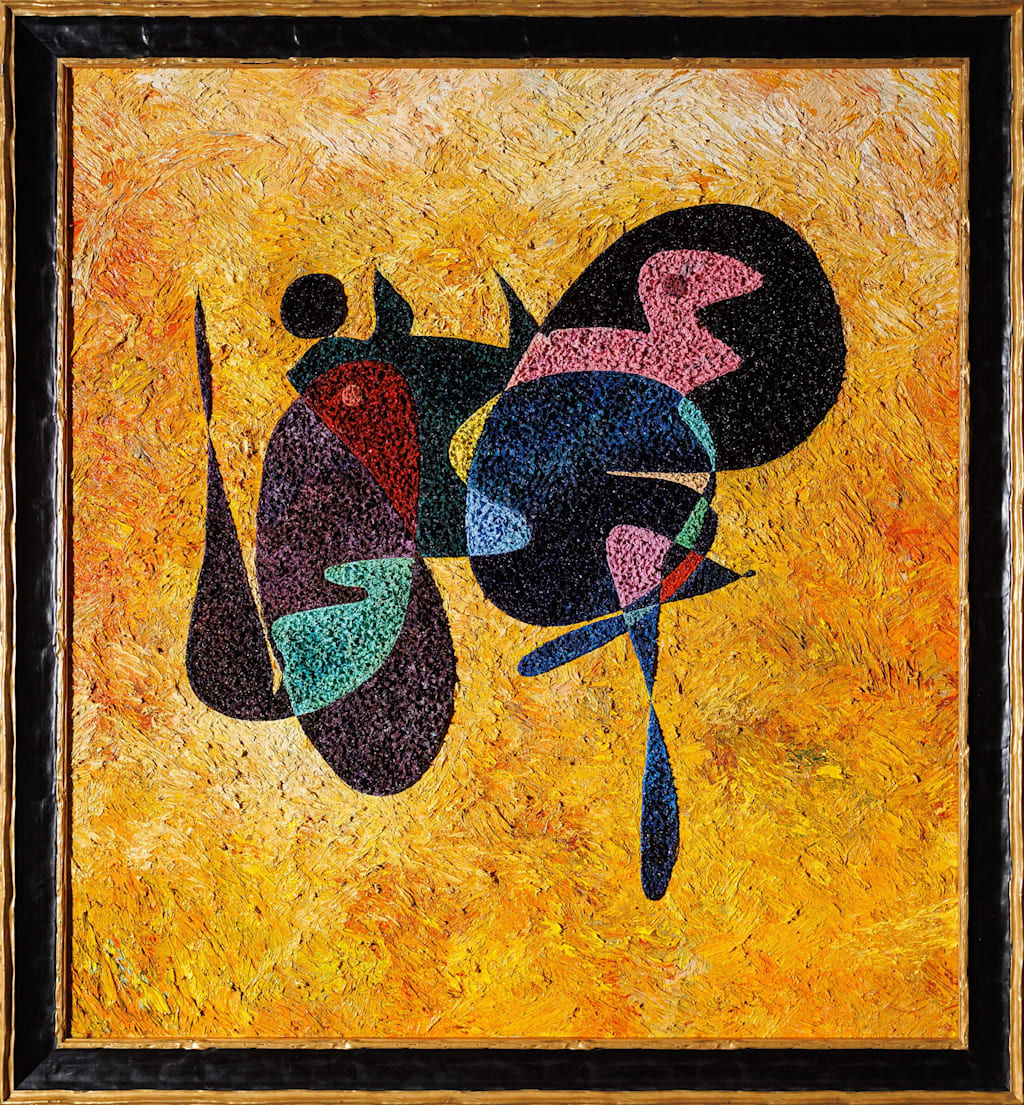
In The Diplomatic Jew (2015), identity, negotiation, cultural continuity, and historical resilience are transformed into a symbolic architecture of abstraction. Rather than presenting a literal portrait, the painting constructs a complex visual entity through intersecting forms, chromatic contrasts, and layered symbolic relationships. The result is a work that examines diplomacy not merely as political activity, but as a condition of survival, adaptation, and intellectual engagement across history.
"The painting is organized through overlapping relationships rather than singular focal points. Circular motifs, elongated forms, intersecting axes, and segmented planes interact across the pictorial surface, producing a visual network that suggests communication, continuity, and negotiation. The composition remains simultaneously stable and fluid, revealing coherence through the interaction of diverse elements."
- Daniel Varzari, Catalogue Entry - The Diplomatic Jew (2015), El Arte Monumental | The Architecture of Power
The composition is organized around a concentrated cluster of geometric and biomorphic forms suspended within a vast field of luminous gold and yellow. This radiant background dominates the canvas and immediately establishes an atmosphere of illumination, vitality, and historical presence. The textured surface, built through dense directional brushwork, creates a field of energy that appears to vibrate around the central figure. Rather than functioning as passive space, the golden environment becomes an active symbolic force, suggesting memory, endurance, and cultural continuity.
At the center of the painting, a carefully balanced arrangement of overlapping forms generates the impression of a symbolic figure assembled from multiple identities. Dark circular masses, elongated vertical structures, curved fragments, and interlocking planes merge into a composite presence that remains intentionally unstable. The figure appears neither fully human nor entirely abstract. Instead, it functions as a visual synthesis of intellectual, cultural, and historical dimensions.
The dominant black and deep blue forms provide structural weight to the composition. These darker elements anchor the image against the expansive golden field, creating a dynamic tension between gravity and illumination. Their circular and elliptical configurations evoke ideas of continuity, cyclical history, and accumulated experience. At the same time, smaller passages of turquoise, red, pink, and violet introduce movement and complexity, preventing the composition from settling into static harmony.
One of the painting's most compelling features is its equilibrium between fragmentation and coherence. The image is constructed from separate visual elements that retain their individuality while participating in a larger unified structure. This balance can be understood as a metaphor for diplomacy itself: the negotiation of differences without the erasure of distinct identities. The composition demonstrates how seemingly disparate elements may coexist within a broader system while preserving their own integrity.
The title plays a significant role in shaping the work's conceptual framework. Rather than functioning as a restrictive label, it provides historical and cultural specificity to the abstract language of the painting. The figure may be understood as a symbolic embodiment of negotiation across cultures, traditions, and historical circumstances. Through abstraction, the work explores how identity can be maintained while continuously adapting to changing political and social environments.
Color symbolism contributes substantially to this reading. Gold and yellow have long been associated with wisdom, illumination, value, and spiritual continuity. Against this field, the darker central forms acquire a heightened presence, suggesting a figure emerging from history rather than standing apart from it. The chromatic relationship between the luminous background and the concentrated central structure creates a visual dialogue between collective memory and individual agency.
The painting also demonstrates a sophisticated understanding of spatial economy. Unlike compositions that rely on crowded symbolic accumulation, The Diplomatic Jew uses isolation strategically. The central figure occupies only a portion of the canvas, yet commands the entire visual field. The surrounding golden atmosphere amplifies the figure's significance, transforming absence into a structural element of the composition.
Art historically, the work engages with traditions of symbolic abstraction, modernist geometry, and biomorphic construction. Yet it avoids becoming a formal exercise. Every compositional decision appears directed toward the articulation of a larger cultural and historical theme. The painting's abstraction does not conceal meaning; rather, it creates a space in which meaning remains layered, complex, and open to reflection.
At 1.38 × 1.50 meters, the work possesses a strong physical presence. The scale allows the viewer to experience the relationship between figure and field as an immersive encounter. The painting functions less as a representation than as an environment of ideas, inviting contemplation of identity, continuity, adaptation, and dialogue.
What ultimately distinguishes The Diplomatic Jew is its ability to transform a specific cultural and historical subject into a universal meditation on negotiation and resilience. Through abstraction, the painting suggests that diplomacy is not merely a political practice but a broader human capacity - the ability to navigate complexity, preserve identity, and build continuity across changing historical conditions.
"Spatially, the composition balances symmetry and asymmetry, stability and movement. The dual centres establish visual equilibrium while maintaining a constant sense of interaction between forms. This tension reflects Virtosu's broader understanding of social and political systems as dynamic structures whose coherence depends upon communication, adaptation, and reciprocal exchange rather than absolute control."
- Daniel Varzari, Curatorial Essay - The Diplomatic Jew (2015), El Arte Monumental
Rather than illustrating a historical narrative, The Diplomatic Jew constructs a symbolic image of endurance, intelligence, and cultural adaptability, presenting diplomacy as both a historical reality and a timeless human endeavor.
About the Creator
Daniel Varzari
American art curator.
Enjoyed the story? Support the Creator.
Subscribe for free to receive all their stories in your feed.
Comments
There are no comments for this story
Be the first to respond and start the conversation.