
The Protector of the Souls (2015)
Memory, Transcendence, and the Architecture of Spiritual Continuity
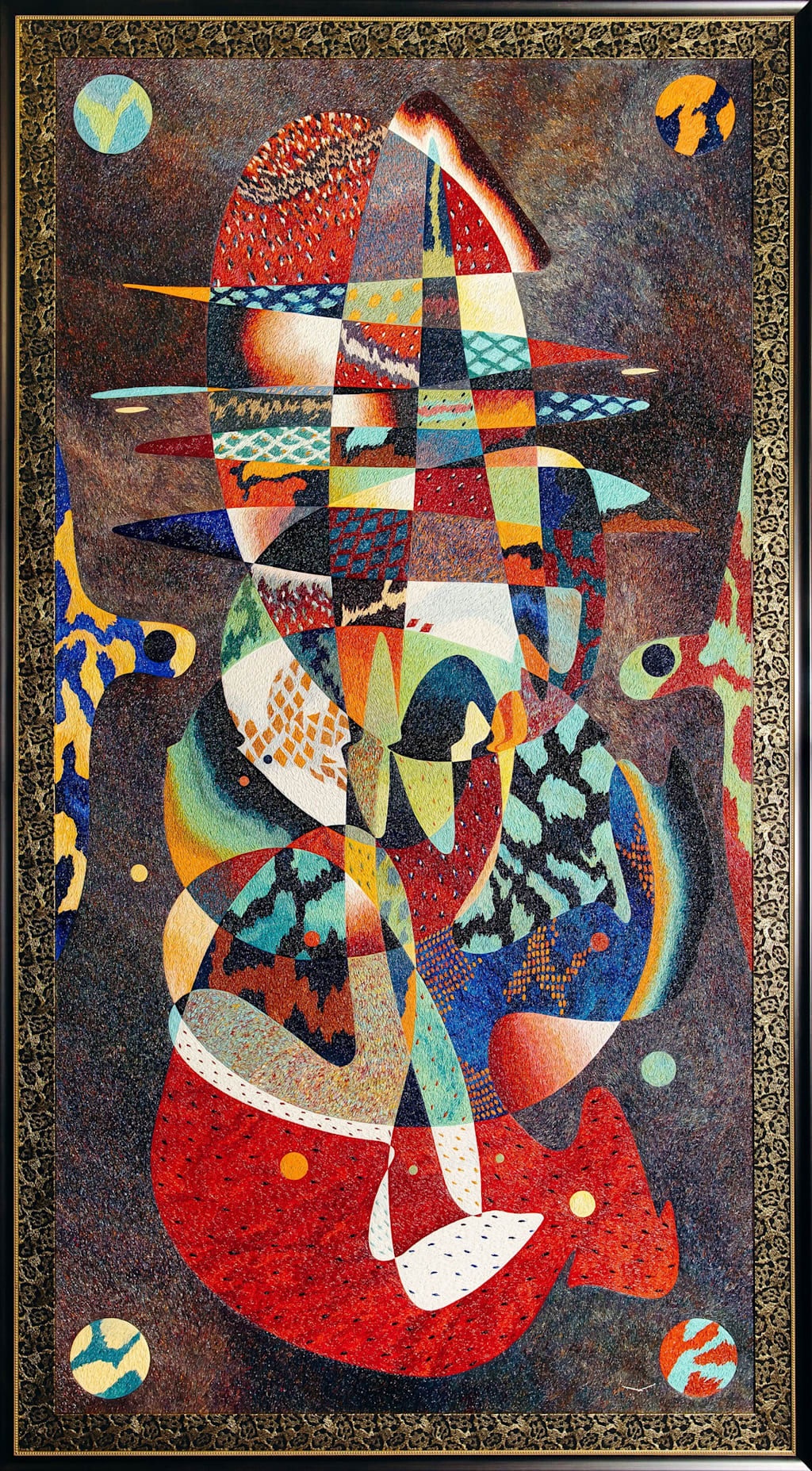
Throughout human history, civilizations have sought ways to understand the relationship between material existence and the unseen dimensions of consciousness, memory, and spirit. Whether through religion, philosophy, mythology, or ritual, cultures across time have imagined forms of protection that extend beyond the physical world. In The Protector of the Souls (2015), Gheorghe Virtosu approaches this enduring theme through abstraction, constructing a monumental visual structure that investigates spiritual continuity, transformation, and the persistence of identity beyond fixed forms. Rather than depicting a guardian figure in a conventional sense, the painting presents protection as a dynamic process emerging through interconnected systems of memory, perception, and transcendence.
Measuring 3.17 by 1.90 meters, the oil painting adopts a vertical format that immediately evokes associations with sacred architecture, ceremonial monuments, and symbolic passageways. A complex central structure rises through the composition, composed of interwoven geometric segments, biomorphic forms, chromatic networks, and patterned surfaces. Suspended against a deep atmospheric field, the figure appears simultaneously ancient and contemporary, personal and universal. The composition transforms spiritual protection from a representational subject into a systemic visual condition.
“The Protector of the Souls examines protection not as physical defense but as a structure of continuity through which memory, consciousness, and identity persist across conditions of transformation. Through abstraction, Virtosu constructs a symbolic architecture in which the soul emerges as a relational field rather than a fixed entity.”
— Daniel Varzari, El Arte Monumental, Divine DNA: The Architecture of Identity, Catalogue Entry: The Protector of the Souls (2015).
At first encounter, the composition appears organized around a singular ascending presence. Yet this presence never stabilizes into a recognizable figure. Faces emerge within larger structures only to dissolve into surrounding forms. Organic contours intersect with geometric divisions, while patterned passages suggest fragments of cultural memory, symbolic language, and inherited systems of knowledge. The viewer is continuously positioned between recognition and abstraction, certainty and ambiguity.
This instability is central to the painting’s conceptual structure. Virtosu avoids defining the soul as an isolated essence. Instead, identity appears distributed across a network of interconnected forms whose relationships remain in constant transformation. The composition proposes that continuity is achieved not through permanence but through adaptation, transmission, and relational exchange.
The chromatic organization reinforces this interpretation. Rich reds, deep blues, luminous whites, ochres, blacks, turquoise tones, and subtle earth colors interact across the surface with extraordinary complexity. Patterned segments introduce localized structures of order, while larger chromatic fields generate broader systems of movement. Color operates simultaneously as symbolic energy and compositional architecture, organizing relationships across the painting without establishing a singular hierarchy.
Join The Writer's Circle event
Particularly significant is the role of patterned textures embedded within the central structure. These repeated visual motifs evoke systems of encoding, memory, and transmission. Rather than functioning as decorative elements, they suggest layers of accumulated experience carried across time. The painting implies that identity is not self-contained but composed of inherited cultural, historical, and symbolic structures that continually shape consciousness.
The surrounding atmospheric field plays an equally important role. Dark yet richly textured, it establishes a vast spatial environment within which the central form appears suspended. Small circular and planetary-like elements positioned throughout the composition expand its symbolic dimension, introducing associations with cosmological systems, cycles of existence, and universal interconnectedness. The figure is not isolated from this environment but generated through it. Spiritual continuity emerges as a condition inseparable from larger structures of existence.
The vertical organization of the composition further strengthens this reading. Forms rise through the pictorial field in a movement that suggests ascent, transformation, and passage between states. Yet this movement is not strictly directional. Elements continually intersect, overlap, and reconnect across multiple levels of the composition, creating a non-linear structure in which past, present, and future appear simultaneously active.
Art historically, The Protector of the Souls occupies a distinctive position within contemporary abstraction. Echoes of symbolic modernism, biomorphic abstraction, and sacred visual traditions can be identified throughout the work. Yet Virtosu employs these influences within a broader theoretical framework concerned with systemic identity and relational continuity. The painting is less concerned with representing spirituality than with visualizing the structures through which spiritual experience becomes imaginable.
The monumental scale intensifies this effect. Standing before the painting, viewers encounter a visual field that unfolds gradually through sustained observation. Relationships between forms reveal themselves over time, encouraging contemplation rather than immediate interpretation. The work functions as an environment of perception, inviting reflection on the interconnected nature of memory, consciousness, and existence.
Within the broader context of Divine DNA: The Architecture of Identity, The Protector of the Souls represents a profound investigation into the persistence of identity across transformation. While many of Virtosu’s works address collective systems, historical memory, or cultural continuity, this painting focuses more directly on the relationship between individuality and transcendence. The soul appears not as an object but as a dynamic structure emerging through networks of relation.
“The composition derives its power from the continual interaction between structure and transformation. Forms remain interconnected while undergoing constant reconfiguration, creating a visual condition in which continuity is achieved through movement rather than permanence. Through this dynamic, Virtosu transforms spiritual protection into a model of relational persistence across changing states of existence.”
— Daniel Varzari, El Arte Monumental, Curatorial Essay: The Protector of the Souls (2015).
Ultimately, The Protector of the Souls succeeds because it reimagines spiritual experience through a contemporary language of abstraction. Rather than illustrating metaphysical beliefs through symbolic narrative, the painting investigates the deeper structures through which continuity, memory, and identity are sustained. Protection emerges not from external authority but from the capacity of interconnected systems to preserve meaning through transformation.
In doing so, Virtosu expands the possibilities of contemporary spiritual painting beyond representation and doctrine. The work becomes a meditation on transcendence itself, revealing how consciousness, memory, and identity remain embedded within larger architectures of relation, continuity, and becoming.
About the Creator
Daniel Varzari
American art curator.
Enjoyed the story? Support the Creator.
Subscribe for free to receive all their stories in your feed.
Comments
There are no comments for this story
Be the first to respond and start the conversation.