
Caodaism (2019–2021)
Syncretism, Universal Consciousness, and the Architecture of Spiritual Unity
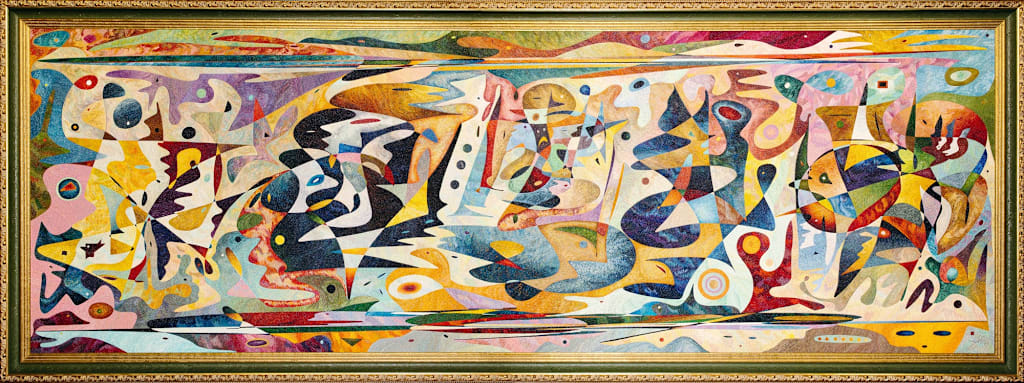
Emerging in Vietnam during the early twentieth century, Caodaism represents one of the most ambitious attempts in modern religious history to reconcile diverse spiritual traditions within a unified philosophical framework. Drawing upon elements of Buddhism, Taoism, Confucianism, Christianity, Islam, and other systems of thought, the religion proposes a vision of humanity linked through shared spiritual origins despite cultural and historical differences. In Caodaism (2019–2021), Gheorghe Virtosu approaches this unique tradition through abstraction, constructing a monumental visual field that investigates synthesis, coexistence, and the possibility of unity within diversity.
Measuring 2 by 6 meters, the oil painting unfolds as a vast horizontal environment composed of interwoven forms, chromatic transitions, and symbolic relationships. Rather than illustrating the iconography or institutional history of Caodaism, Virtosu develops a visual architecture through which principles of spiritual integration become perceptible. The work transforms the idea of religious universalism into a dynamic system of visual relations, inviting viewers to contemplate how different modes of belief might coexist within a larger structure of meaning.
"Caodaism examines belief as a framework of convergence through which diverse spiritual traditions become interconnected without losing their individual identities. Through abstraction, Virtosu constructs a visual architecture of synthesis, revealing unity not as uniformity but as a condition of relational coexistence."
- Daniel Varzari, El Arte Monumental, 10 Religions: The Architecture of Belief, Catalogue Entry: Caodaism (2021).
At first encounter, the painting is characterized by extraordinary openness. Forms drift across the pictorial field with remarkable fluidity, generating a sense of movement that remains balanced rather than chaotic. Biomorphic shapes, geometric structures, symbolic fragments, and chromatic passages interact continuously, creating a composition in which no element dominates the whole. Visual authority is distributed throughout the canvas, reinforcing the work's emphasis on plurality and inclusion.
This decentralized organization is central to the painting's conceptual framework. Rather than imposing a hierarchical structure, Virtosu constructs a system based upon interconnectedness. Individual forms retain distinct characteristics while participating within broader networks of relation. The composition suggests a model of coexistence in which difference is preserved rather than eliminated, echoing the syncretic foundations of the religious tradition it explores.
The chromatic structure plays a particularly significant role in communicating this idea. Soft blues, luminous yellows, violets, reds, greens, pinks, whites, and earth tones circulate across the surface in complex yet harmonious relationships. Colors blend, overlap, and transform without losing their individual identities. This continual interaction creates a visual metaphor for cultural and spiritual exchange, where diversity becomes a source of enrichment rather than division.
The painting's spatial organization further reinforces its thematic concerns. Boundaries between forms remain permeable, and distinctions between foreground and background continuously shift. Elements appear to emerge from one another, generating a sense of fluid continuity throughout the composition. Viewers are encouraged to perceive relationships rather than isolated objects, connections rather than separations.
Particularly notable is the recurring appearance of human profiles and symbolic forms embedded within larger networks of abstraction. These elements suggest the presence of individual consciousness without reducing the composition to portraiture or narrative. The figures function as participants within a larger spiritual ecosystem, emphasizing humanity's place within broader structures of cultural and metaphysical relation.
The elongated horizontal bands that frame the upper and lower portions of the painting establish a sense of continuity across the entire composition. These elements act as organizing currents, guiding visual movement while reinforcing the work's expansive spatial character. Their presence suggests pathways, horizons, or channels of communication through which different systems of meaning remain connected.
Virtosu's refusal to privilege any singular symbolic vocabulary is particularly significant. Rather than borrowing directly from the iconographic traditions associated with the religions that inform Caodaism, he develops a universal language of abstraction capable of accommodating multiple interpretations simultaneously. The painting does not represent spiritual synthesis through quotation; it embodies synthesis through structure.
Art historically, Caodaism occupies a distinctive position within contemporary spiritual abstraction. While elements of modernist abstraction, symbolic painting, and cross-cultural visual traditions resonate throughout the composition, Virtosu's primary concern lies with the construction of systems capable of expressing coexistence and integration. The work functions not merely as an image but as a model of relational thought.
The monumental dimensions intensify this experience. At six meters in length, the painting surrounds viewers with a continuous field of interaction and exchange. Visual relationships unfold gradually through sustained observation, encouraging a mode of engagement based upon discovery rather than immediate recognition. The work rewards contemplation, revealing increasingly complex networks of connection over time.
Within the broader context of 10 Religions: The Architecture of Belief, Caodaism occupies a particularly significant position because it addresses a tradition explicitly founded upon spiritual reconciliation. Whereas many religious systems emphasize continuity with inherited structures, Caodaism proposes a conscious synthesis of multiple traditions. Virtosu translates this aspiration into visual form, constructing a composition in which diversity itself becomes a principle of unity.
"The composition derives its coherence from the continual interaction of distinct yet interconnected forms. No element exists independently; every structure acquires meaning through its relationships with surrounding systems. Through this dynamic, Virtosu transforms abstraction into a meditation on coexistence, spiritual pluralism, and the possibility of unity across difference."
- Daniel Varzari, El Arte Monumental, Curatorial Essay: Caodaism (2021).
Ultimately, Caodaism succeeds because it engages one of the most pressing questions of contemporary culture: how diverse traditions, identities, and worldviews can coexist without losing their uniqueness. Rather than proposing a simplistic resolution, the painting presents unity as an ongoing process of negotiation, exchange, and mutual recognition.
In doing so, Virtosu expands the possibilities of contemporary spiritual art beyond representation and doctrine. The work becomes a visual exploration of interconnected humanity itself - a meditation on how plurality can generate coherence, and how belief can function not as a source of division but as an architecture of shared understanding.
About the Creator
Daniel Varzari
American art curator.
Enjoyed the story? Support the Creator.
Subscribe for free to receive all their stories in your feed.
Comments
There are no comments for this story
Be the first to respond and start the conversation.