
American Policy in the 21st Century (2015)
The Aesthetics of Geopolitical Instability
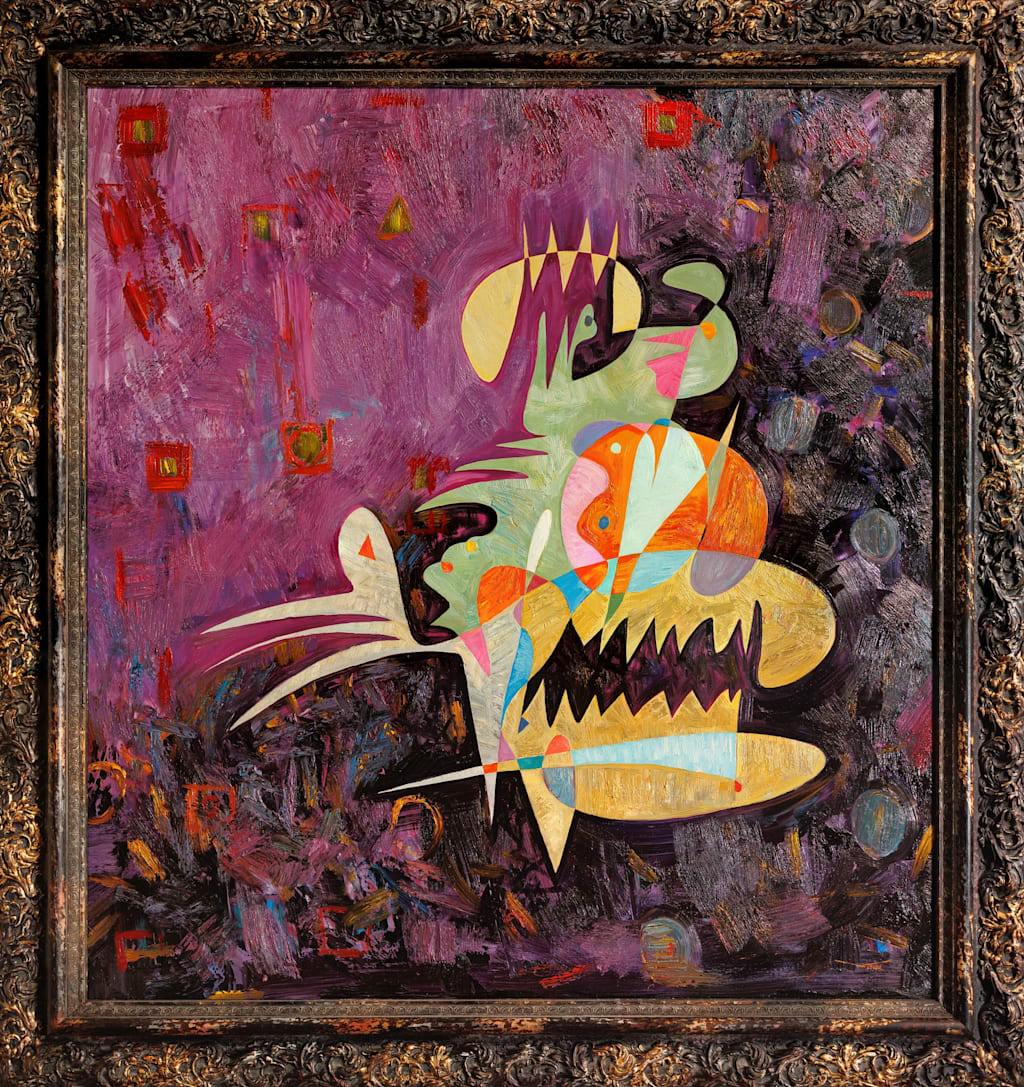
In American Policy in the 21st Century (2015), political power is transformed into an unstable visual language of fragmentation, collision, and reconstruction. Rather than presenting policy through recognizable national symbols or narrative imagery, the painting approaches geopolitics as a psychological and structural condition — a system defined by contradiction, acceleration, and perpetual negotiation between order and disruption.
“American Policy in the 21st Century (2015) investigates the structural instability of modern geopolitical systems through a fragmented visual language of intersecting forms, symbolic abstractions, and chromatic tensions. The composition reflects the continuous transformation of contemporary power, where authority emerges through conflict, negotiation, fragmentation, and reconstruction rather than through stable ideological certainty.”
— Daniel Varzari, American Policy in the 21st Century (2015), The Architecture of Power, El Arte Monumental
The composition is dominated by a central abstract formation that appears simultaneously architectural, biological, and mechanical. Angular interruptions, serrated black structures, elliptical forms, and intersecting chromatic planes create a dense symbolic organism caught between assembly and disintegration. The work resists fixed interpretation; its instability becomes its central subject.
The painting’s chromatic environment is especially significant. Vast fields of violet, magenta, black, and crimson generate an atmosphere that feels both theatrical and volatile. Purple operates ambiguously — historically associated with imperial authority and power, yet equally connected to psychological tension, ambiguity, and ideological uncertainty. Against this dark atmospheric field, bursts of pale mint, gold, orange, and cyan emerge like fragments of institutional language struggling to maintain coherence within a fractured geopolitical landscape.
The central structure resembles neither a human figure nor pure abstraction, but a hybridized political entity composed of competing forces. Sharp black forms resembling teeth, barriers, or defensive architectures interrupt the fluidity of the composition, introducing themes of militarization, division, and ideological confrontation. Yet these aggressive elements coexist with softer curved geometries and luminous chromatic passages, suggesting diplomacy, negotiation, and the persistent possibility of reconstruction.
One of the work’s most compelling qualities is its refusal of visual stability. No single focal point fully dominates the painting. Instead, the eye moves continuously across shifting zones of tension. This restless movement mirrors the condition of 21st-century global policy itself — decentralized, reactive, fragmented across economic, military, technological, and cultural systems that increasingly resist unified control.
The background functions as more than atmosphere; it operates as a field of historical pressure. Layers of gestural brushwork, partially obscured geometric traces, and unresolved painterly passages evoke accumulation rather than clarity. The surface appears sedimented with conflict, information, memory, and institutional residue. Small red square motifs dispersed throughout the composition resemble coded markers or destabilized systems of communication, reinforcing the painting’s concern with fractured networks of authority.
Materially, the work demonstrates an important tension between control and spontaneity. Certain geometric passages are highly deliberate and architectonic, while surrounding gestures appear impulsive and emotionally charged. This oscillation between precision and disruption gives the painting intellectual density. Policy itself becomes visualized as an unstable negotiation between strategic design and unpredictable consequence.
The painting also engages with traditions of postwar abstraction. Elements of biomorphic surrealism, geometric abstraction, and gestural expressionism intersect without fully submitting to a singular historical style. Rather than nostalgically quoting modernist languages, the work reactivates them as tools for examining contemporary systems of power. The result is a painting that feels historically informed yet conceptually contemporary.
At the scale of 1.50 × 1.38 meters, the work possesses a commanding physical presence. Its near-monumental dimensions amplify the psychological intensity of the composition, transforming the painting into an immersive field rather than a contained image. The viewer is drawn into an environment where structures appear unstable, identities fragmented, and systems perpetually reconfigured.
What ultimately distinguishes American Policy in the 21st Century is its ability to visualize policy not as bureaucracy, but as psychic architecture. The painting suggests that modern geopolitical systems are no longer governed by stable ideological certainties, but by fluid networks of conflict, spectacle, fragmentation, and adaptation. Power in this work is never fixed; it mutates continuously under the pressures of history, technology, and global transformation.
The painting succeeds precisely because it avoids propaganda or direct political illustration. Instead, it constructs a symbolic language capable of expressing the emotional and structural complexity of contemporary power itself.
“American Policy in the 21st Century (2015) examines the instability of contemporary geopolitical power through a fragmented visual architecture composed of intersecting forms, volatile chromatic tensions, and symbolic abstractions. The painting approaches policy not as a fixed institutional structure, but as a continuously shifting system shaped by conflict, negotiation, and historical transformation.”
— Daniel Varzari, American Policy in the 21st Century (2015), Curatorial Essay, El Arte Monumental
About the Creator
Daniel Varzari
American art curator.
Enjoyed the story? Support the Creator.
Subscribe for free to receive all their stories in your feed.
Comments
There are no comments for this story
Be the first to respond and start the conversation.