
Hawai Sakusen (2002–2004)
Anticipation as History: The Architecture of Strategic Possibility
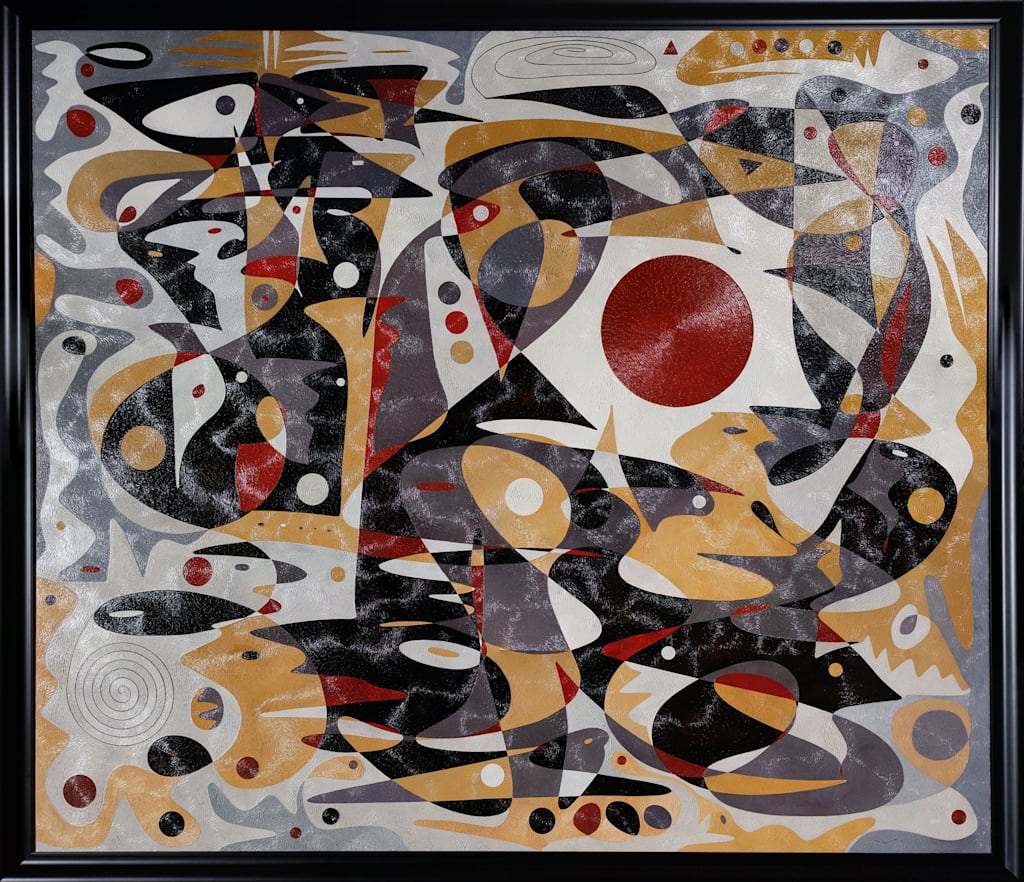
History painting has often focused on the visible manifestations of conflict: armies in motion, decisive encounters, and moments of victory or defeat. In Hawai Sakusen (2002–2004), Gheorghe Virtosu approaches warfare from a fundamentally different perspective. Rather than depicting combat itself, the artist examines the conditions that precede confrontation, transforming military strategy into a visual language of anticipation, uncertainty, and latent force.
Measuring 3.05 by 3.51 meters, the monumental oil painting occupies a distinctive position within Virtosu's 6 Wars: The Architecture of Conflict series. While other works in the cycle emphasize collision, fragmentation, or the density of competing forces, Hawai Sakusen is characterized by an unusual sense of openness. Expansive areas of light-toned space establish a perceptual atmosphere that appears calm at first glance, yet beneath this apparent clarity lies a highly structured network of tensions and directional movements.
"In Hawai Sakusen, conflict is represented not through collision but through anticipation. The composition organizes space as a field of latent forces, where movement remains suspended between possibility and realization. Virtosu transforms military strategy into a visual structure of expectation, uncertainty, and calculated tension."
- Daniel Varzari, El Arte Monumental, 6 Wars: The Architecture of Conflict, Catalogue Entry: Hawai Sakusen (2004).
The composition unfolds through a sophisticated interplay of geometric structures, biomorphic forms, and flowing linear trajectories. Black and grey passages weave through the surface, intersecting with areas of ochre, white, and red. Unlike conventional battle imagery, which directs attention toward a central narrative event, Virtosu disperses visual energy across the entire canvas. The eye moves continuously through overlapping forms, encountering rhythms of expansion and contraction that suggest strategic maneuvering rather than direct confrontation.
A dominant red circular form occupies a critical position within the composition. Functioning simultaneously as focal point, symbolic marker, and structural anchor, it introduces a concentrated presence that organizes the surrounding field. The circle appears less as an object than as a gravitational force around which other elements orient themselves. Its visual weight creates an atmosphere of expectation, as though the composition were organized around an event that has not yet fully materialized.
This emphasis on anticipation distinguishes Hawai Sakusen from traditional representations of military history. Rather than focusing on action, the painting investigates potentiality. Forms appear suspended between emergence and dissolution, movement and stillness, certainty and ambiguity. The resulting tension transforms the pictorial surface into a space of strategic calculation, where outcomes remain unresolved and possibilities remain open.
Color plays a significant role in constructing this condition. The restrained palette of whites, blacks, greys, ochres, and reds creates a careful balance between contrast and harmony. Areas of luminous space provide moments of visual respite, while darker forms introduce rhythm and directional force. The chromatic relationships generate a sense of controlled instability, reinforcing the work's broader exploration of uncertainty and expectation.
Equally important is the painting's treatment of ambiguity. Throughout the composition, forms suggest fragments of faces, eyes, signals, architectural structures, and symbolic devices, yet none resolve into fixed identities. Virtosu deliberately positions the viewer within a space of interpretive negotiation. Recognition remains possible, but certainty remains elusive. Meaning emerges not through representation but through relationships between forms and the movements they generate across the surface.
This strategy aligns the work with significant traditions of modern abstraction while maintaining a distinct historical focus. Echoes of Kandinsky's dynamic spatial structures, Klee's symbolic language, and Miró's biomorphic forms can be identified throughout the composition. Yet Hawai Sakusen differs from these precedents in its sustained engagement with historical subject matter. Abstraction here functions not as an escape from history but as a method for examining the systems through which history unfolds.
The monumental scale of the painting reinforces its conceptual ambitions. Standing before the work, viewers encounter an environment rather than an image. The expansive dimensions encourage prolonged observation, revealing subtle transitions between form and ground, concentration and dispersion. What appears initially as simplicity gradually discloses a highly complex network of visual relationships.
Within the broader context of 6 Wars: The Architecture of Conflict, Hawai Sakusen represents a shift from the depiction of conflict as confrontation toward an investigation of conflict as possibility. The painting is less concerned with the outcome of events than with the conditions from which events emerge. Strategy becomes visible not through action but through structure, rhythm, and spatial organization.
"The painting derives its intensity from the relationship between openness and concentration. Expansive areas of light space are interrupted by dense configurations of form, creating a perceptual rhythm in which absence becomes as significant as presence. Through this dynamic, Hawai Sakusen constructs a visual language of strategic anticipation rather than direct confrontation."
- Daniel Varzari, El Arte Monumental, Curatorial Essay: Hawai Sakusen (2004).
Ultimately, Hawai Sakusen expands the possibilities of contemporary history painting by shifting attention away from the spectacle of conflict and toward its underlying architecture. Through abstraction, Virtosu reveals warfare not as a sequence of events but as a system of perceptions, calculations, and potential outcomes. The painting succeeds because it transforms anticipation itself into a subject of visual inquiry, demonstrating how history is often shaped as much by what has not yet occurred as by what ultimately takes place.
About the Creator
Daniel Varzari
American art curator.
Enjoyed the story? Support the Creator.
Subscribe for free to receive all their stories in your feed.
Comments
There are no comments for this story
Be the first to respond and start the conversation.