
Islam (2017–2019)
Unity, Revelation, and the Architecture of Divine Order
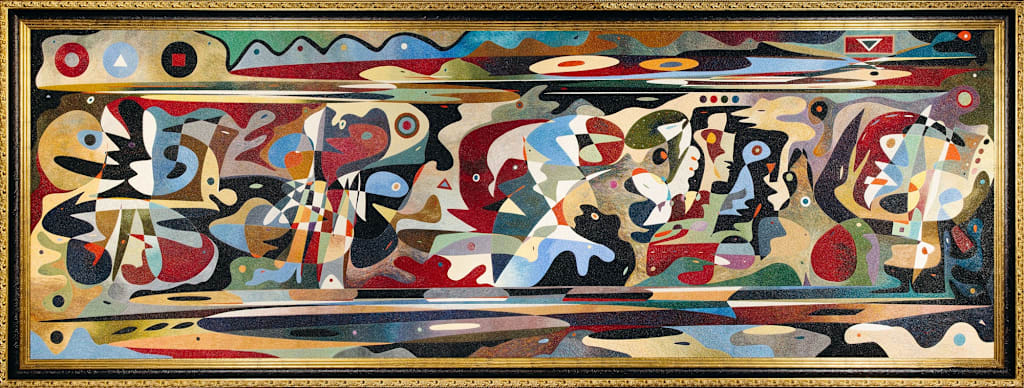
As one of the world’s major religious traditions, Islam has profoundly shaped civilizations, intellectual history, artistic production, and systems of social organization across continents and centuries. At its philosophical core lies the principle of tawhid — the unity of God — which establishes a vision of existence grounded in coherence, order, and interconnectedness. In Islam (2017–2019), Gheorghe Virtosu approaches this vast spiritual and cultural tradition through abstraction, constructing a monumental visual field that investigates the relationship between unity and multiplicity, revelation and perception, the individual and the collective.
Measuring 2 by 6 meters, the painting unfolds horizontally as an expansive architectural environment. Rather than depicting recognizable religious scenes, sacred figures, or historical narratives, Virtosu develops a complex network of interrelated forms that emerge, overlap, and transform across the surface. The composition functions as a symbolic system through which spiritual order becomes visible without being reduced to literal representation.
“Islam examines belief as an architecture of unity through which diverse forms, identities, and experiences become integrated within a larger structure of meaning. Through abstraction, Virtosu visualizes the relationship between multiplicity and coherence, revealing spiritual order as a dynamic and living condition.”
— Daniel Varzari, El Arte Monumental, 10 Religions: The Architecture of Belief, Catalogue Entry: Islam (2019).
At first encounter, the painting appears remarkably balanced despite its extraordinary complexity. Numerous figures, symbolic fragments, geometric structures, and flowing forms occupy the pictorial field, yet the composition resists fragmentation. Every element participates within larger systems of visual relation. Forms remain distinct while simultaneously contributing to a unified organizational structure.
This relationship between individuality and integration constitutes one of the painting’s central themes. Throughout Islamic intellectual traditions, unity does not eliminate diversity but provides the framework through which diversity becomes meaningful. Virtosu translates this principle into visual form. The composition proposes a world in which difference exists not in opposition to order but as one of its essential manifestations.
The chromatic organization reinforces this interpretation. Deep reds, muted blues, soft grays, luminous whites, earth tones, blacks, and subtle greens interact across the surface with measured precision. Unlike the explosive chromatic energy found in some of Virtosu’s other monumental works, the palette here appears more restrained and contemplative. Color serves as a structural force, creating relationships of balance, rhythm, and continuity rather than dramatic contrast.
Particularly significant is the presence of recurring facial profiles distributed throughout the composition. These forms appear and disappear within larger networks of shapes, suggesting the coexistence of individual consciousness within broader communal and spiritual frameworks. The faces never dominate the pictorial field. Instead, they participate within a larger architecture of relation, emphasizing interconnectedness over autonomy.
The elongated horizontal bands positioned near the upper and lower edges of the painting further contribute to its structural coherence. These elements function almost architecturally, establishing visual horizons that organize movement across the canvas. Their measured rhythm evokes concepts of continuity, order, and alignment, creating a framework within which more fluid forms can interact.
Spatially, the composition operates through a dynamic balance between openness and containment. Forms overlap and interpenetrate, yet the overall structure remains remarkably coherent. This balance generates a visual condition in which complexity is never allowed to collapse into disorder. The painting continually negotiates between movement and stability, diversity and unity.
Virtosu’s refusal to employ direct religious iconography is particularly significant. Rather than illustrating doctrinal content, the work seeks to visualize the structural principles through which belief organizes experience. Abstraction becomes a means of approaching spiritual concepts that transcend representation. The painting is concerned not with depicting faith, but with examining the conditions through which faith creates systems of meaning and order.
Art historically, Islam occupies a distinctive position within contemporary spiritual abstraction. While resonances with Islamic geometric traditions, architectural systems, and ornamental structures may be perceived indirectly, Virtosu avoids quotation or stylistic imitation. Instead, he engages with deeper philosophical questions concerning unity, transcendence, and relational order.
The monumental dimensions amplify the painting’s conceptual ambitions. At six meters in length, the work surrounds viewers with a continuous field of interconnected activity. Visual relationships emerge gradually through sustained observation, encouraging contemplation rather than immediate interpretation. The painting reveals itself through duration, much as spiritual understanding often develops through reflection rather than instantaneous revelation.
Within the broader context of 10 Religions: The Architecture of Belief, Islam represents an investigation into one of the most influential systems of spiritual and intellectual thought in human history. Yet the work avoids historical narration in favor of examining the underlying structures that enable belief to generate coherence, identity, and continuity across time.
“The composition derives its stability from the continual reconciliation of difference within larger systems of relation. Individual forms maintain their distinct identities while participating in broader structures of visual coherence. Through this dynamic, Virtosu transforms abstraction into a meditation on unity, revelation, and the enduring architecture of spiritual order.”
— Daniel Varzari, El Arte Monumental, Curatorial Essay: Islam (2019).
Ultimately, Islam succeeds because it approaches a complex religious tradition through its foundational philosophical principles rather than its external symbols. The painting investigates how systems of belief create coherence without eliminating diversity, and how spiritual order emerges through relationships rather than domination.
In doing so, Virtosu expands the possibilities of contemporary religious painting beyond narrative representation. The work becomes a meditation on unity itself — a visual exploration of how multiplicity can coexist within a larger framework of meaning, continuity, and transcendence. Through abstraction, Islam reveals belief not as a static doctrine but as a living architecture through which individuals, communities, and ideas remain connected across time and space.
About the Creator
Daniel Varzari
American art curator.
Enjoyed the story? Support the Creator.
Subscribe for free to receive all their stories in your feed.
Comments
There are no comments for this story
Be the first to respond and start the conversation.