
The King of Revolution (2021)
Collapse, Reinvention, and Collective Identity
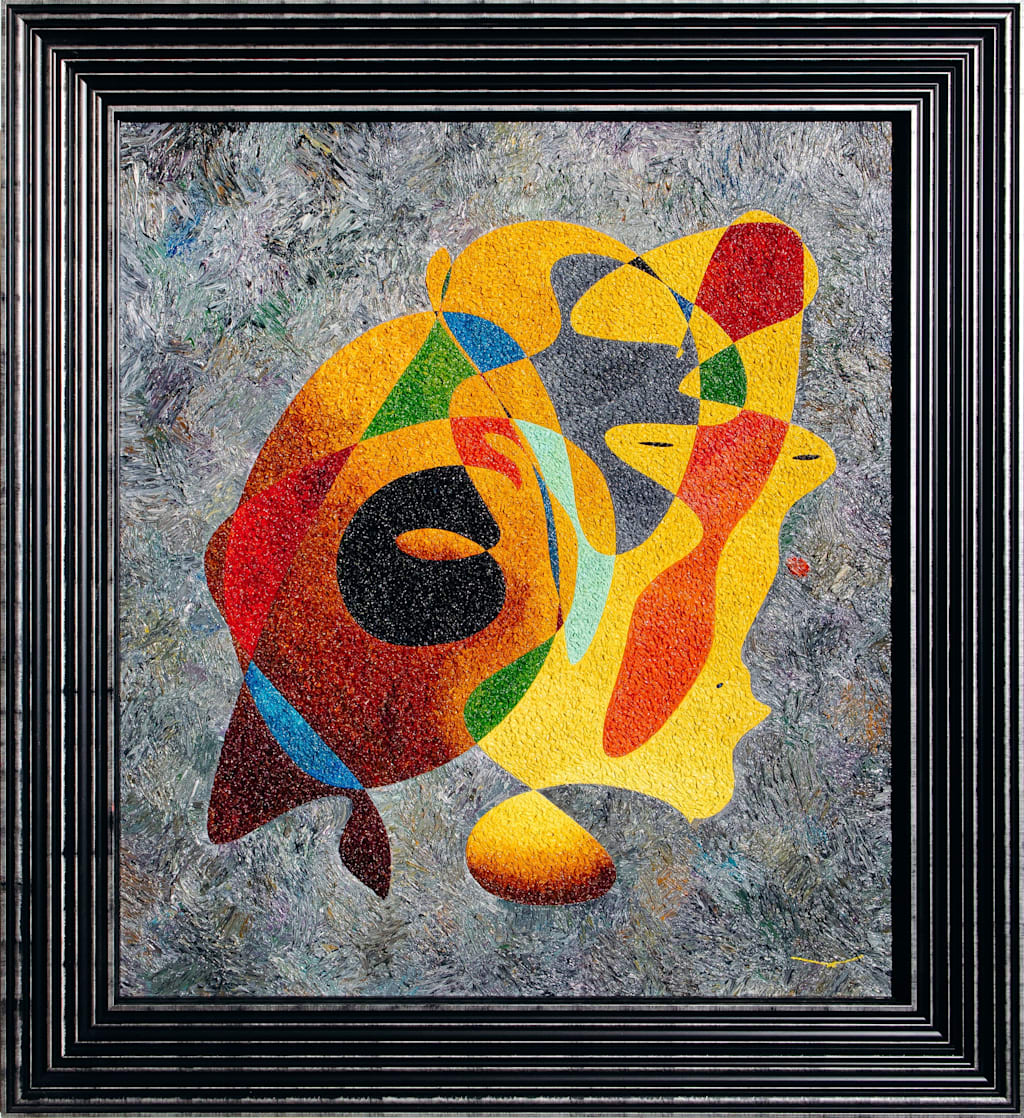
The King of Revolution presents itself as a psychological architecture of power rather than a literal portrait. Through symbolic abstraction, fractured geometry, and chromatic tension, the painting constructs a figure that appears simultaneously sovereign, unstable, celebratory, and internally divided. The work operates within a lineage that recalls elements of Cubism, biomorphic abstraction, and modern symbolic painting, yet it resists becoming derivative by transforming those influences into a contemporary meditation on authority and transformation.
“In The King of Revolution (2021), revolution is approached not as a literal political event, but as a broader condition of historical transformation. Through fragmented abstraction and symbolic reconstruction, the painting explores the instability of authority and the continuous redefinition of collective identity. Systems of power are presented as structures subject to collapse, reinvention, and renewal, positioning revolution as an enduring process rather than a singular act of rupture.”
— Daniel Varzari, The King of Revolution (2021), The Architecture of Power, El Arte Monumental.
At the center of the composition is an ambiguous anthropomorphic form assembled from intersecting planes of saturated yellow, orange, red, green, blue, and black. The figure is not anatomically stable; it is built through collision rather than continuity. Identity in this painting is fragmented into zones of competing energy. The “king” is therefore not represented as a fixed ruler, but as a shifting construct — a being produced by ideological, emotional, and historical forces.
The dominant yellows and oranges establish an immediate psychological temperature. Yellow traditionally signifies illumination, divinity, intellect, or triumph, yet here it also functions as exposure. The figure appears almost incandescent against the cold, heavily textured gray background, as though emerging from ash, smoke, or historical debris. This contrast between chromatic vitality and atmospheric erosion becomes one of the painting’s central tensions: revolution as both creation and destruction.
The background deserves particular attention. Unlike the clean abstraction of the central figure, the surrounding field is turbulent and materially dense. The brushwork is restless, layered, and unresolved. It evokes instability — perhaps social collapse, memory, noise, or the residue of conflict. Against this unstable environment, the central form attempts coherence but never fully achieves it. The king dominates the surface visually, yet remains psychologically vulnerable. This instability prevents the painting from becoming propagandistic. It does not glorify power uncritically; instead, it examines power as fragmentation.
One of the most striking formal decisions is the treatment of the eyes. The left eye, rendered as a heavy black void, acts almost like a gravitational center within the composition. It absorbs surrounding color and interrupts the otherwise fluid movement of the geometry. Black here becomes symbolic silence — authority transformed into opacity. The second facial structure, reduced to minimal linear marks, introduces duality within the figure itself. We are perhaps witnessing multiple identities occupying the same symbolic body: ruler and revolutionary, creator and destroyer, individual and collective myth.
The compositional structure recalls Synthetic Cubism in its interlocking planes, but unlike early Cubism, which often fragmented perception analytically, this work fragments psychology and ideology. The forms curve and overlap rhythmically, producing movement closer to musical improvisation than rigid geometry. This gives the painting a performative dimension. The figure appears to mutate while being observed.
“The composition is organized around a monumental central figure assembled from interlocking geometric and organic forms. Human profiles, circular motifs, ascending structures, and fragmented planes converge into a complex symbolic architecture that appears simultaneously unified and unstable. The image evokes a state of perpetual becoming, suggesting the emergence of new realities from the fragmentation of older systems.”
— Daniel Varzari, The King of Revolution (2021), Curatorial Essay, El Arte Monumental
Texture plays an essential role in the painting’s emotional force. The thick impasto surface transforms color into substance. Light does not merely illuminate the work; it physically interacts with it. The tactile density suggests accumulated history, emotional pressure, and duration. The painting therefore exists not only as image but as object — an artifact bearing the evidence of struggle through material buildup.
Symbolically, The King of Revolution can be interpreted as an exploration of charismatic authority in periods of social upheaval. Yet the painting wisely avoids direct political literalism. Instead, it approaches revolution archetypically. The “king” may represent the cyclical rebirth of systems of power: every revolution eventually constructing new hierarchies from the ruins of the old. The fragmented face suggests that authority itself is inherently unstable, dependent on performance, perception, and myth.
There is also an intriguing tension between mask and identity throughout the work. The figure resembles a ceremonial or ritual presence rather than an individualized portrait. This introduces anthropological dimensions into the painting. The king becomes less a person than a symbolic vessel carrying collective fears, ambitions, and historical memory.
What elevates the work beyond decorative abstraction is its psychological density. Beneath the vivid palette lies a persistent unease. The composition is energetic but never peaceful. Every shape appears to press against another; every color competes for dominance. This internal pressure gives the painting conceptual seriousness and prevents the surface beauty from becoming merely aesthetic spectacle.
At the scale of 1.36 by 1.31 meters, the work likely exerts significant physical presence in person. The near-monumental dimensions reinforce the thematic concern with authority and spectacle. The viewer is not simply observing the painting; they are confronted by it.
In a contemporary context increasingly saturated with political imagery and simplified ideological narratives, The King of Revolution distinguishes itself by refusing certainty. It does not offer a heroic revolutionary icon nor a cynical condemnation of power. Instead, it presents power as unstable theater — seductive, fractured, luminous, and haunted by its own contradictions.
The painting succeeds most where it remains ambiguous. Its strength lies not in explaining revolution, but in embodying its emotional and psychological architecture.
About the Creator
Daniel Varzari
American art curator.
Enjoyed the story? Support the Creator.
Subscribe for free to receive all their stories in your feed.
Comments
There are no comments for this story
Be the first to respond and start the conversation.