
The Couple of the Universe (2006)
Relationality, Multiplicity, and the Architecture of Interconnected Being
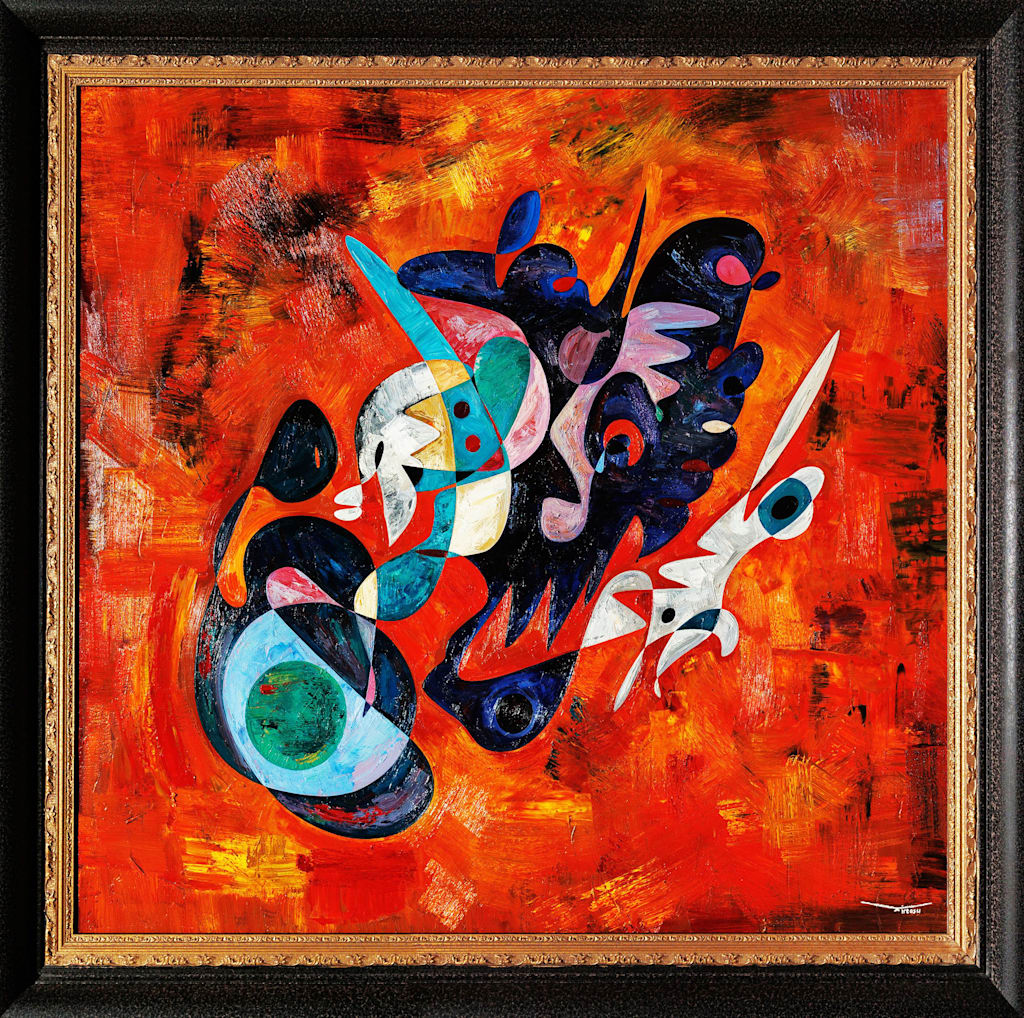
Throughout the history of art, the image of the couple has often functioned as a symbol of unity, intimacy, and human connection. Yet in The Couple of the Universe (2006), Gheorghe Virtosu transforms this familiar subject into something far more expansive. Rather than depicting two identifiable individuals, the painting investigates the very structure of relational existence itself. Through abstraction, Virtosu constructs a dynamic visual system in which identity emerges through interaction, suggesting that connection is not merely a human condition but a fundamental principle of the universe.
Measuring 1.69 by 1.66 meters, the oil painting presents a dense constellation of interwoven forms suspended against an intense field of luminous reds, oranges, and fiery chromatic transitions. The composition possesses a remarkable sense of concentration. Forms gather toward the center of the canvas, generating a visual nucleus from which relationships radiate outward. Rather than establishing fixed boundaries between figures, Virtosu dissolves distinctions, allowing shapes, colors, and spatial trajectories to merge into a continuously evolving structure.
“The Couple of the Universe examines relationality not as the union of two separate entities but as a dynamic field of continual transformation. Through abstraction, Virtosu constructs a visual system in which identity emerges through interaction, revealing interconnectedness as a fundamental condition of existence.”
— Daniel Varzari, El Arte Monumental, Divine DNA: The Architecture of Identity, Catalogue Entry: The Couple of the Universe (2016).
At first encounter, the composition appears energized by opposing yet complementary forces. Curvilinear biomorphic forms intersect with sharper geometric structures, creating a tension between fluidity and order. Fragments suggesting profiles, eyes, gestures, and bodily contours emerge throughout the painting, yet these references never stabilize into recognizable portraits. The viewer is continually drawn between figuration and abstraction, perception and uncertainty.
This instability is central to the work’s conceptual structure. The painting refuses the notion of identity as something fixed or self-contained. Instead, forms appear dependent upon one another for their meaning. Individual elements gain definition only through their relationships to surrounding structures. The composition proposes that identity itself is relational, generated through interaction rather than isolated existence.
Color functions as a powerful organizing force within this system. The dominant red-orange field generates an atmosphere of intensity, energy, and expansion. Rather than serving as a passive background, the surrounding chromatic environment actively participates in the formation of the central structure. Areas of deep black, turquoise, white, violet, pink, and blue emerge within the composition like nodes of concentration, creating visual rhythms that move continuously across the surface.
The relationship between figure and ground is particularly significant. The central structure appears simultaneously embedded within and generated by the surrounding field. Boundaries remain porous, allowing forms to emerge, dissolve, and reconfigure. This condition reinforces the painting’s broader exploration of interconnectedness. Separation becomes provisional, while continuity emerges as the deeper organizing principle.
A notable feature of the composition is its absence of hierarchy. No single element dominates the pictorial field. Instead, the work operates through a network of reciprocal relationships in which visual significance is continually redistributed. The viewer’s gaze moves across the composition without encountering a fixed center, producing a perceptual experience that mirrors the painting’s philosophical concerns.
Art historically, The Couple of the Universe engages traditions of abstraction while extending them into a broader cosmological inquiry. Echoes of Kandinsky’s dynamic structures, Klee’s symbolic vocabularies, and aspects of biomorphic modernism can be detected throughout the work. Yet Virtosu employs these formal strategies not as aesthetic exercises but as tools for investigating systems of relation, perception, and becoming. The painting constructs meaning through interaction rather than representation.
The scale of the work reinforces its immersive quality. Viewed from a distance, the composition appears unified and coherent. At closer range, it dissolves into an intricate network of intersecting forms and chromatic transitions. This oscillation between totality and multiplicity becomes one of the painting’s defining perceptual effects. The viewer experiences the work not as a static image but as an unfolding process of discovery.
Within the broader context of Virtosu’s investigations into identity and systemic abstraction, The Couple of the Universe occupies a significant position. The painting anticipates many of the concerns later developed through Divine DNA and related works addressing collective existence and interconnected systems. Here, however, these ideas remain concentrated within the symbolic structure of the couple, transformed from a personal relationship into a cosmological model.
“The composition derives its vitality from the continual negotiation between unity and difference. Forms intersect, overlap, and transform one another without dissolving entirely into homogeneity. Through this dynamic, Virtosu constructs a visual language in which connection becomes generative, producing multiplicity rather than closure.”
— Daniel Varzari, El Arte Monumental, Curatorial Essay: The Couple of the Universe (2016).
Ultimately, The Couple of the Universe succeeds because it reimagines one of art’s oldest subjects through a contemporary language of abstraction. Rather than presenting a couple as a stable image of union, the painting investigates the deeper structures through which relationships generate identity, meaning, and continuity. The work proposes that existence itself is relational, shaped not by isolated forms but by the networks of interaction through which forms continually emerge and transform.
In doing so, Virtosu expands the possibilities of contemporary abstraction beyond formal experimentation alone. The painting becomes a meditation on interconnected being, revealing how individuality and collectivity remain inseparable dimensions of human and cosmic experience.
About the Creator
Daniel Varzari
American art curator.
Enjoyed the story? Support the Creator.
Subscribe for free to receive all their stories in your feed.
Comments
There are no comments for this story
Be the first to respond and start the conversation.