
The Calcium Paradox: Why Your Bones Need More Than a Pill
The trillion-dollar supplement industry doesn't want you to understand how bone actually works
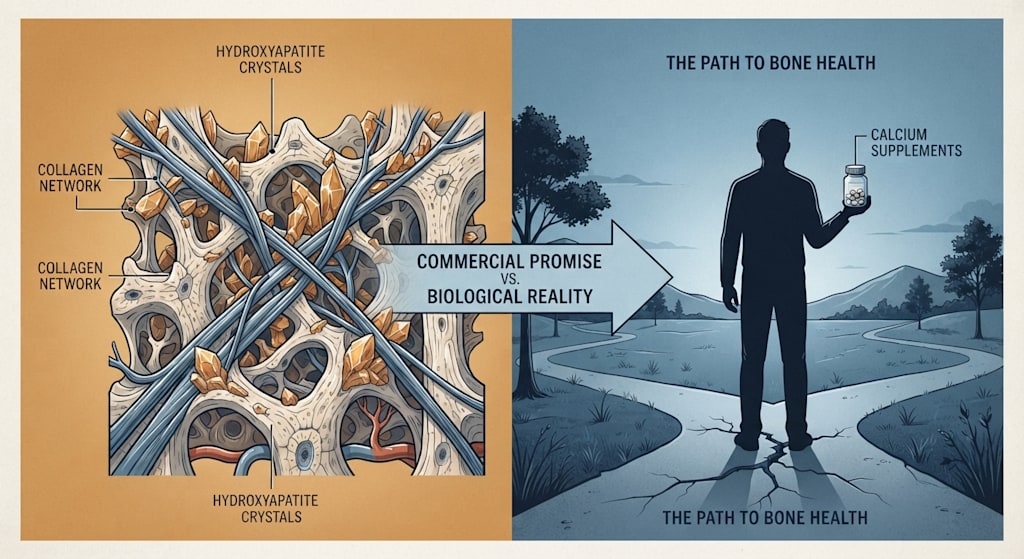
You swallow the pill. It dissolves. Some calcium enters your bloodstream. Your bones are supposed to get stronger.
That's the story the supplement industry sells. The biology tells a different one.
An adult body holds roughly one kilogram of calcium. More than 99% sits in bones and teeth. The remainder circulates in blood, tissue fluid, and cells, where it controls heart rhythm, muscle contraction, and nerve signaling. Your body treats blood calcium as non-negotiable. Bone calcium is the emergency fund.
When dietary intake drops or intestinal absorption falters, the parathyroid glands release parathyroid hormone. This triggers renal calcium reabsorption, activates vitamin D, and indirectly stimulates bone resorption—releasing skeletal calcium to keep blood levels stable. Run this process for years and your bloodwork looks fine while your skeleton quietly hollows out.
Normal serum calcium tells you nothing about bone density. They measure different things.
What bone actually is
Strip the water from a bone and weigh what remains. Roughly two-thirds is mineral—primarily hydroxyapatite, a calcium-phosphate crystal. The rest is organic, mostly type I collagen with smaller amounts of non-collagenous proteins that regulate mineralization and cell adhesion.
Think of it as reinforced concrete at the nanoscale. Collagen fibers are the rebar. Mineral crystals are the cement. Together they create a composite that resists both bending and breaking.
Two classic experiments demonstrate the point. Soak bone in acid and the mineral dissolves, leaving collagen soft enough to bend. Burn bone in a furnace and the organic matrix burns away, leaving mineral that shatters easily. Bone strength depends on both components—plus trabecular architecture, cortical thickness, and accumulated microdamage. Two people with identical bone density scores can face wildly different fracture risks.
The mineralization gatekeeper
Even calcium that reaches your bloodstream faces a long journey to becoming bone. Osteoblasts—bone-building cells—synthesize collagen and other matrix proteins, laying down unmineralized tissue called osteoid. Then they release matrix vesicles and regulate local ion concentrations to enable crystal formation.
Here's where it gets interesting. The body produces inorganic pyrophosphate (PPi), a molecule that actively inhibits hydroxyapatite crystallization. Why would the body manufacture a substance that blocks bone mineralization?
Because calcium and phosphate float through every tissue and fluid in your body. Without controls, they would precipitate in blood vessels, tendons, cartilage, and organs. The body needs to dictate where minerals deposit, when, and how much.
Tissue-nonspecific alkaline phosphatase (TNAP), an enzyme on the osteoblast surface, hydrolyzes pyrophosphate into inorganic phosphate. This removes the mineralization inhibitor while supplying phosphate for crystal growth. The system requires precise coordination between promoters and inhibitors.
Hypophosphatasia illustrates what happens when this system fails. Patients with ALPL gene mutations produce insufficient TNAP activity. Pyrophosphate accumulates. Bone mineralization stalls. Infants develop severe skeletal deformities and respiratory problems. Children lose primary teeth prematurely. Adults suffer chronic bone pain, muscle weakness, and stress fractures that heal poorly.
The same enzyme processes pyridoxal phosphate—an active form of vitamin B6. Severe cases develop B6-dependent seizures. One enzyme, multiple substrates, consequences spanning skeleton and nervous system.
For some patients, enzyme replacement therapy now targets the underlying defect. The broader lesson: bone formation requires more than raw materials. Adding calcium cannot fix every production problem.
Your skeleton is under construction right now
Bone remodeling never stops. Osteoclasts resorb old tissue. Osteoblasts build new tissue. This cycle repairs microdamage and adapts to mechanical loads.
Youth tips the balance toward formation. Adulthood maintains equilibrium. Aging, menopause, immobilization, certain medications, and chronic disease shift the balance toward resorption. Like a bank account with daily deposits and withdrawals, bone density reflects net cash flow over time. If withdrawals exceed deposits, calcium supplements become deposits into an account that keeps bleeding out.
Mechanical loading matters too. Reduced mechanical stimulation alters sclerostin expression, affecting Wnt signaling and osteoblast activity. Astronauts in microgravity lose bone mass despite adequate nutrition. Weight-bearing exercise and resistance training help maintain skeletal integrity because bone responds to load.
What your labs actually measure
Serum calcium reflects immediate homeostasis. Serum phosphate indicates supply and metabolic status. 25-hydroxyvitamin D shows vitamin D reserves. PTH reveals endocrine regulation. Alkaline phosphatase correlates with mineralization activity but also reflects liver function. Bone-specific alkaline phosphatase offers more targeted information. P1NP—a byproduct of type I collagen synthesis—indicates bone formation. Beta-CTX—a collagen degradation product—indicates resorption.
P1NP and beta-CTX are related but not directly comparable. Different units, different clearance rates, different responses to recent fractures, kidney function, and timing of blood draws.
DXA bone density measures mineral content per projected area in g/cm². It predicts fracture risk but cannot assess collagen quality or microarchitecture. Bone density decline may reflect less tissue or inadequate mineralization—osteoporosis versus osteomalacia, conditions with different treatments.
The supplement evidence
A 2015 BMJ systematic review pooled 59 randomized trials of calcium intake in adults over 50. Bone density improvements averaged 1-2%—whether from diet or supplements—and did not accumulate with longer duration.
A 2026 BMJ review covering 69 trials and over 150,000 participants found limited clinical benefit from routine calcium and vitamin D supplementation for fracture and fall prevention in general community populations.
One to two percent improvement might matter for someone actively losing bone. But that small change falls within measurement error for individual DXA scans. More importantly, modest density gains do not guarantee proportional fracture risk reduction.
Calcium supplements are not osteoporosis treatment. They supply raw material. Whether that material becomes bone depends on the entire construction system.
The differential value of the same pill
A child building peak bone mass has different needs than a postmenopausal woman losing bone rapidly. Someone with dietary deficiency fills a gap. Someone already replete gains little. A patient on bisphosphonates needs adequate calcium as a foundation for therapy. A bedridden patient cannot reverse disuse osteopenia through supplements alone. A patient with hypophosphatasia might worsen with aggressive calcium supplementation.
Most adults need 800-1200 mg of elemental calcium daily from all sources. A glass of milk provides 250-300 mg. Tofu, yogurt, leafy greens, and small fish with bones contribute. If diet already meets requirements, supplements add little. If a gap exists, supplementation can fill it.
Single doses above 500 mg elemental calcium are absorbed less efficiently. Calcium carbonate requires stomach acid and works best with meals. Calcium citrate absorbs independently of acid. Kidney stones, hypercalcemia, and chronic kidney disease require individualized assessment.
After the fracture
Bone healing involves hematoma formation, inflammatory cleanup, angiogenesis, fibrocartilaginous callus, mineralization, endochondral ossification, and remodeling that continues for months. Calcium and phosphate participate, but healing also requires protein, energy, blood supply, mechanical stability, and functional cells.
Insufficient fixation, repeated shear forces, or severe vascular compromise cannot be overcome by doubling the calcium dose. And here's what gets overlooked: fracture patients often lose bone mass in other regions due to pain, immobilization, and non-weight-bearing status. New bone forms at the fracture site while bone disappears elsewhere in the same limb.
Clinical evidence does not support routinely giving extra calcium or vitamin D to well-nourished fracture patients to accelerate healing.
The real questions
If you fractured from minimal trauma—a fall from standing height, a hip fracture in your 70s, a vertebral compression—you need a bone health evaluation, not another bottle of calcium pills. Ask:
Was this a high-energy injury or a low-energy fracture?
Have I fractured before?
What is my bone density?
Is my vitamin D sufficient?
When can I safely resume weight-bearing activity?
Bone is living tissue. It needs calcium and phosphate for mineral, protein for matrix, cells for repair, and mechanical stress for maintenance. Supplements provide some raw material. What your body does with that material depends on systems far more complex than any pill can address.
About the Creator
Jin
Writer of reamstories
https://reamstories.com/jin
Enjoyed the story? Support the Creator.
Subscribe for free to receive all their stories in your feed. You could also become a paid subscriber or give them a one-off tip, letting them know you appreciate their work.
Comments
There are no comments for this story
Be the first to respond and start the conversation.