Book of the Year
8 Books That Will Help You Forgive Yourself and Find Inner Peace . AI-Generated.
At some point in life, we all carry emotional weight we wish we could set down. Regret over past decisions, lingering guilt from mistakes, or harsh self-judgment can quietly shape how we see ourselves and the world. Forgiving others is often discussed, but forgiving ourselves is where true healing begins. Without it, inner peace remains fragile—like trying to calm a stormy sea without addressing the wind beneath the waves.
By Diana Meresc5 months ago in BookClub
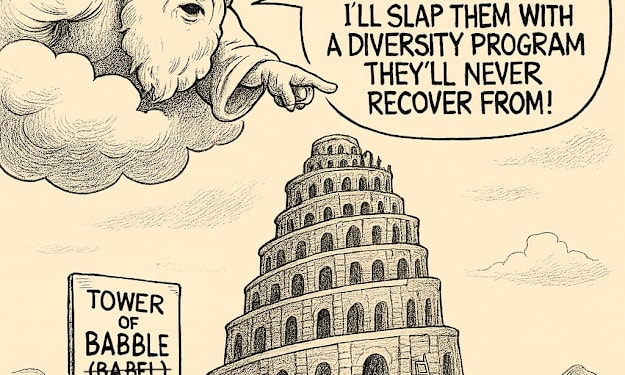
The Tower of Babble, THE MISCOMMUNICATION TRILOGY, “The Tower OF Babble, Vol. III”, Part 2
The Architecture of Misunderstanding Babel Reimagined: Language Against Itself The Tower of Babble occupies a distinctive place within contemporary philosophical writing because it approaches language from a direction that is both unconventional and profoundly revealing. Rather than beginning with the familiar assumption that language exists to facilitate communication, the book starts from the opposite premise: that language is inherently unstable and that misunderstanding is not an accidental failure of communication but one of its constitutive features. This reversal serves as the foundation for a wide-ranging exploration of the nature of language, communication, subjectivity, and civilization itself.
By Peter Ayolov5 months ago in BookClub
The Babbling Ape, THE MISCOMMUNICATION TRILOGY, “The Tower OF Babble, Vol. III”, Part 1
The Animal of Endless Speech: A Review of The Babbling Ape The Linguistic Animal and the Problem of Civilization The Babbling Ape is one of the most ambitious contributions to contemporary philosophical reflections on language, communication, and civilization. Positioned at the intersection of philosophy, linguistics, anthropology, media theory, semiotics, and cultural criticism, the work develops a comprehensive argument concerning the role of language in shaping human existence. Rather than treating language as a neutral instrument for transmitting information, the book presents it as the central force responsible for the emergence of civilization itself. The fundamental claim running throughout the text is that humanity does not merely use language but increasingly inhabits linguistic environments that mediate perception, identity, memory, power, and social organization. The result is a civilization that exists simultaneously within reality and within symbolic constructions that often obscure the reality they claim to describe.
By Peter Ayolov5 months ago in BookClub
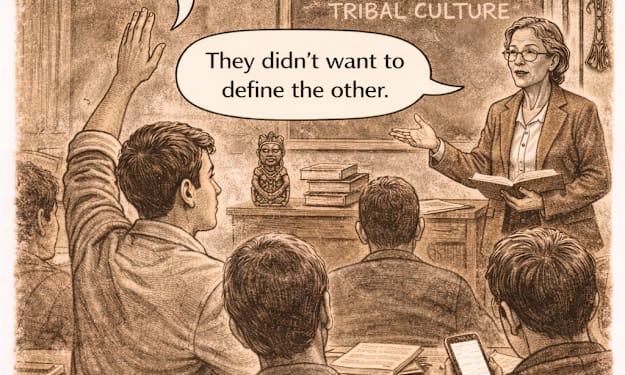
The Grammar of Tribalism , THE MISCOMMUNICATION TRILOGY, “The Entropy of Communication, Vol. II”, Part 28
The Language of Belonging: A Review of The Grammar of Tribalism Mapping the Hidden Structure of Human Division The Grammar of Tribalism stands as the concluding volume of The Entropy of Communication, Vol. II, and functions as one of the most ambitious contributions within the broader intellectual architecture of The Miscommunication Trilogy. The book examines tribalism not as a marginal social phenomenon confined to primitive societies or political extremism, but as a fundamental organizing principle embedded within human communication itself. Rather than treating tribalism as an outdated relic of premodern life, the work presents it as an enduring structure that continues to shape contemporary identities, political movements, media systems, and social relations. The central strength of the book lies in its refusal to reduce tribalism to a single cause. Instead, it approaches the subject through a wide-ranging interdisciplinary framework that draws upon anthropology, sociology, political theory, communication studies, philosophy, evolutionary psychology, nationalism studies, and media ecology. This breadth allows the analysis to move beyond simplistic explanations and reveal the many ways tribal structures continue to operate beneath modern institutions. One of the book’s most important contributions is its argument that communication itself is inseparable from belonging. Human beings do not merely exchange information. They create communities through language. Every society develops symbolic systems through which individuals recognize one another, establish loyalties, and define outsiders. Tribalism therefore emerges not simply as a political condition but as a communicative structure. The tribe speaks itself into existence through narratives, rituals, myths, slogans, symbols, and shared vocabularies.
By Peter Ayolov5 months ago in BookClub
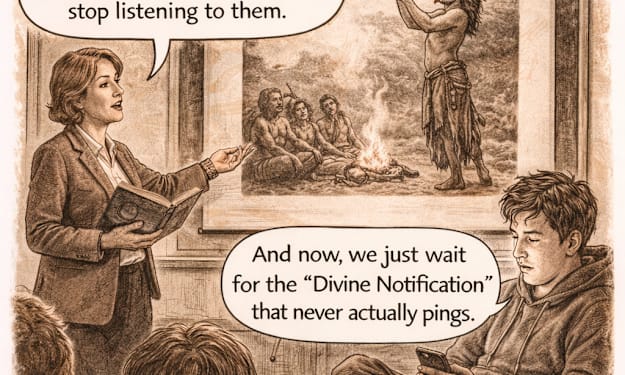
The Sacred Origin of Orality, THE MISCOMMUNICATION TRILOGY, “The Entropy of Communication, Vol. II”, Part 27
The Voice Before the Code: Recovering Humanity Through Orality Language as Memory, Presence, and Sacred Connection The Sacred Origin of Orality occupies a distinctive place within The Miscommunication Trilogy: The Entropy of Communication, Vol. II because it directs attention toward the deepest foundations of human communication. While many contemporary studies focus on digital technologies, media systems, artificial intelligence, or global communication networks, this volume asks a more fundamental question: what was language before it became information? The answer leads not to databases or communication platforms but to the living voice itself. The book presents orality not as a primitive stage surpassed by literacy and technology but as the original condition of human meaning-making. Through an impressive synthesis of linguistic studies, anthropological research, religious narratives, Indigenous experiences, and sociolinguistic theory, the volume demonstrates that spoken language historically functioned as much more than a vehicle for transmitting messages. It served as a repository of collective memory, a bridge between generations, a mechanism for preserving cultural identity, and a medium through which spiritual realities became socially meaningful.
By Peter Ayolov5 months ago in BookClub
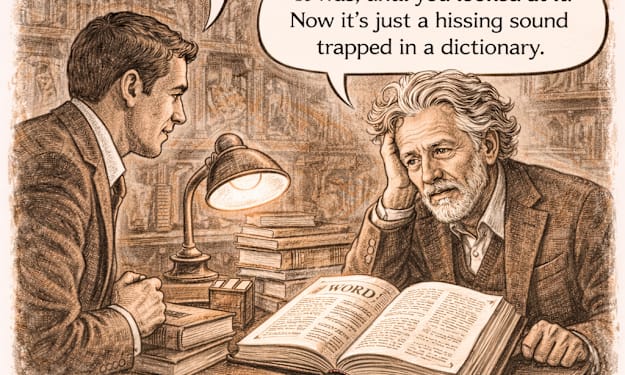
The Absurdity of Abstract Words, THE MISCOMMUNICATION TRILOGY, “The Entropy of Communication, Vol. II”, Part 26
The Expiration of Meaning: A Review of The Absurdity of Abstract Words A Cartography of Linguistic Decay The Absurdity of Abstract Words is one of the most ambitious contributions to the ongoing examination of communication in contemporary society. Situated within a broader investigation of linguistic entropy, the book explores a question that appears deceptively simple but proves increasingly difficult to answer: what happens when words become detached from the realities they were originally intended to describe? Through an interdisciplinary approach that draws upon philosophy, linguistics, cognitive science, rhetoric, psychology, communication theory, media studies, and artificial intelligence research, the book constructs a compelling account of how abstraction shapes modern communication and why abstract language has become one of the defining features of contemporary culture.
By Peter Ayolov5 months ago in BookClub
Simplicity of Human Speech, THE MISCOMMUNICATION TRILOGY, “The Entropy of Communication, Vol. II”, Part 25
The Economy of Meaning: A Review of Simplicity of Human Speech Language at the Crossroads of Complexity and Civilization Simplicity of Human Speech occupies a distinctive place within contemporary discussions of language, communication, and social transformation. As Part 25 of The Miscommunication Trilogy: The Entropy of Communication, Vol. II, the book expands a broader intellectual project concerned with the instability of meaning in modern societies and the growing difficulties of communication in an age of technological acceleration. Rather than treating language as an isolated linguistic phenomenon, the work approaches speech as a complex adaptive system embedded within larger social, technological, economic, and cultural processes. This perspective allows the author to move beyond traditional linguistic debates and situate language within a much broader framework that includes complexity science, urbanization, social networks, evolutionary theory, information systems, and the dynamics of civilization itself.
By Peter Ayolov5 months ago in BookClub
The Complex Nature of Language, THE MISCOMMUNICATION TRILOGY, “The Entropy of Communication, Vol. II”, Part 24
The Labyrinth of Meaning: A Review of The Complex Nature of Language Mapping the Architecture of Human Communication The Complex Nature of Language stands as one of the most ambitious and intellectually expansive contributions within The Miscommunication Trilogy: The Entropy of Communication, Vol. II. Rather than approaching language as a narrow technical subject reserved for linguists, the volume presents it as one of the central organizing forces of human civilization. Throughout its chapters, language emerges not merely as a means of communication but as a vast cognitive, cultural, historical, and philosophical system through which human beings create, preserve, and transform reality. One of the book’s greatest strengths lies in its refusal to reduce language to a single explanatory model. Instead, it presents language as a phenomenon that must be examined from multiple perspectives simultaneously. Grammar, semantics, cognition, logic, social organization, cultural evolution, and historical change are woven together into a coherent exploration of linguistic complexity. This interdisciplinary approach allows the volume to move beyond traditional introductions to linguistics and engage with deeper questions concerning meaning, knowledge, and human understanding. The discussion of linguistic diversity forms a particularly compelling foundation for the volume. The reader is repeatedly reminded that languages do not merely label a pre-existing world. They organize experience according to different principles, highlighting certain distinctions while minimizing others. Demonstrative systems, evidential categories, kinship structures, gender systems, and grammatical classifications reveal that every language reflects a unique solution to the challenges of communication. This perspective encourages a greater appreciation of linguistic diversity while challenging simplistic assumptions regarding linguistic superiority or inferiority.
By Peter Ayolov5 months ago in BookClub
The Linguistic Entropy, THE MISCOMMUNICATION TRILOGY, “The Entropy of Communication, Vol. II”, Part 23
Communication at the Edge of Chaos: Language, Entropy, and the Crisis of Civilization The Collapse of Symbolic Stability The Linguistic Entropy, part of The Miscommunication Trilogy, “The Entropy of Communication, Vol. II”, is an ambitious interdisciplinary work that attempts to synthesize information theory, linguistics, systems theory, cybernetics, philosophy, sociology, evolutionary biology, and media ecology into a unified interpretation of modern civilization’s communicative crisis. Rather than treating language merely as a neutral tool of expression, the book positions communication itself as the foundational infrastructure of human civilization, arguing that the contemporary world is experiencing a gradual collapse of symbolic stability under the pressure of technological acceleration and informational excess. The central strength of the work lies in its ability to connect seemingly unrelated intellectual traditions into a coherent philosophical narrative centered around entropy and the destabilization of meaning.
By Peter Ayolov5 months ago in BookClub
Dark Times of Language, THE MISCOMMUNICATION TRILOGY, “The Entropy of Communication, Vol. II”, Part 20
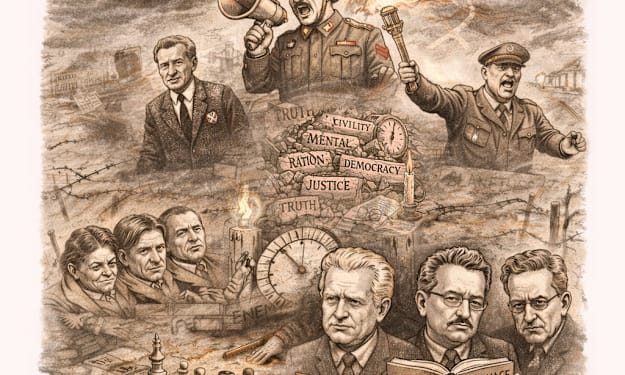
The Second Collapse of Meaning: A Review of Dark Times of Language I. Civilization in the Age of Symbolic Exhaustion Dark Times of Language, Part 20 of The Miscommunication Trilogy: “The Entropy of Communication, Vol. II”, is an ambitious philosophical and cultural study examining the relationship between civilizational decline and the degradation of language. Rather than presenting history as a sequence of purely political or economic transformations, the book approaches civilization through the lens of communication itself, arguing that societies often begin collapsing symbolically long before they collapse materially. The result is a wide-ranging and intellectually provocative work that combines media theory, historical analysis, philosophy, sociology, technological criticism, and cultural reflection into a unified exploration of the modern crisis of meaning. The central thesis of the book revolves around the idea of the planned obsolescence of language. According to this argument, modern technological civilization increasingly produces forms of communication designed not for continuity, truth, memory, or reflection, but for acceleration, emotional stimulation, ideological performance, and rapid symbolic replacement. In this framework, words become disposable products consumed within digital systems dominated by spectacle, outrage, visibility, and algorithmic circulation. Communication expands endlessly while genuine understanding deteriorates.
By Peter Ayolov5 months ago in BookClub