
The Tower of Babble, THE MISCOMMUNICATION TRILOGY, “The Tower OF Babble, Vol. III”, Part 2
Book Review

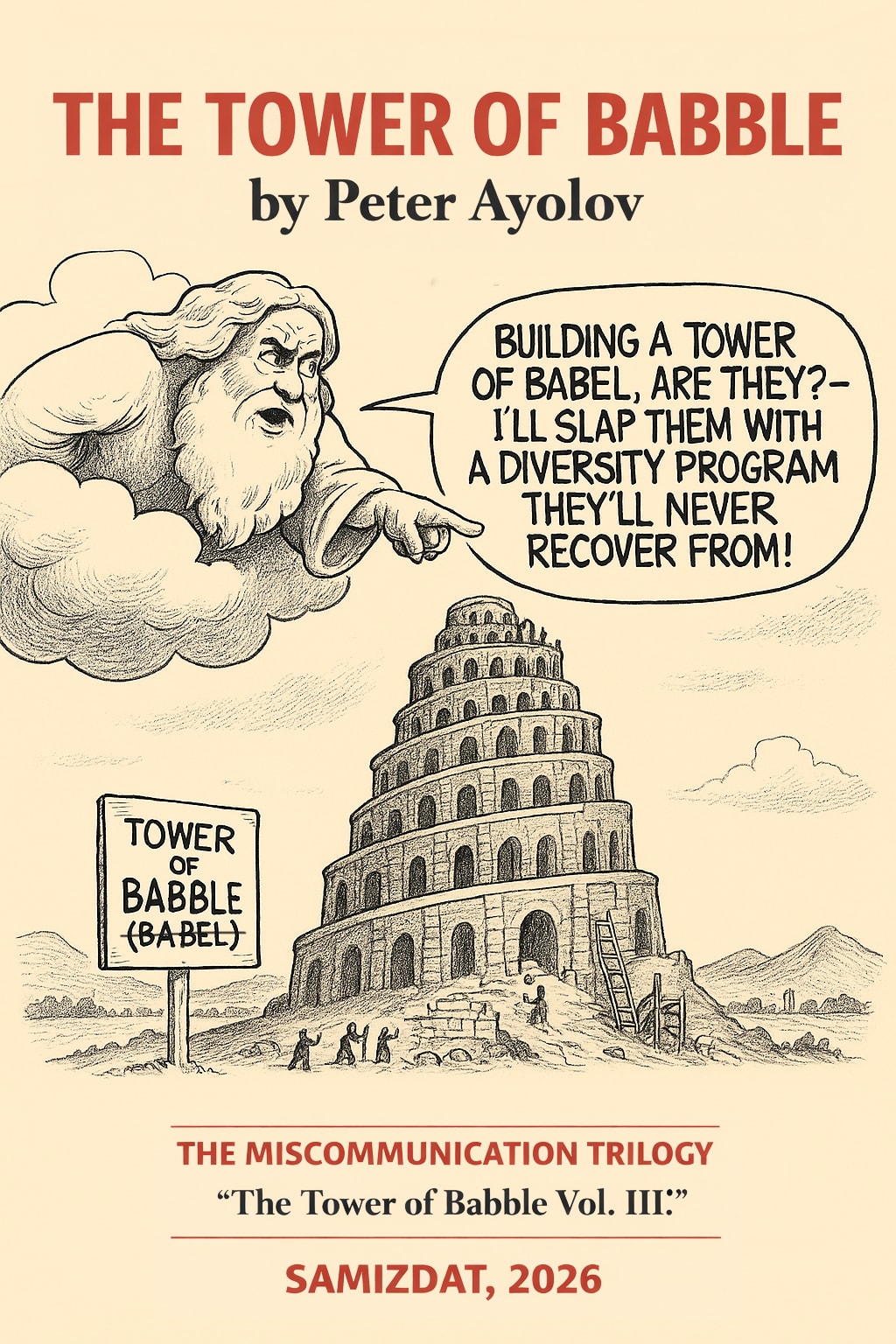
The Architecture of Misunderstanding
Babel Reimagined: Language Against Itself
The Tower of Babble occupies a distinctive place within contemporary philosophical writing because it approaches language from a direction that is both unconventional and profoundly revealing. Rather than beginning with the familiar assumption that language exists to facilitate communication, the book starts from the opposite premise: that language is inherently unstable and that misunderstanding is not an accidental failure of communication but one of its constitutive features. This reversal serves as the foundation for a wide-ranging exploration of the nature of language, communication, subjectivity, and civilization itself.
The central achievement of the book lies in its ability to transform the ancient image of Babel into a modern philosophical concept. Babel is not treated merely as a biblical story or a cultural metaphor. Instead, it becomes a model for understanding the permanent condition of linguistic existence. Human beings inhabit a world constructed through language, yet that same language continuously generates ambiguity, conflict, competing interpretations, and symbolic fragmentation. The tower is therefore not a ruined structure from a distant past. It is an ongoing project, rebuilt by every generation and expanded by every act of communication.
One of the strengths of the work is its ambitious intellectual range. Drawing from linguistics, philosophy, literary theory, pragmatics, psychoanalysis, and cultural criticism, the book creates a broad conceptual framework through which language can be examined from multiple perspectives. The discussions of Gilles Deleuze, Jean-Jacques Lecercle, Denise Riley, Lewis Carroll, Victorian nonsense literature, and contemporary linguistic theory are not presented as isolated intellectual exercises. Instead, they are woven together into a coherent argument concerning the instability of meaning and the force of linguistic processes. Particularly impressive is the way the text connects seemingly disparate topics. The developmental origins of speech, the philosophy of nonsense, the violence of naming, inner speech, and political discourse all become components of a larger narrative about the limits of communication. The reader gradually discovers that these subjects are united by a common concern: the inability of language to fully stabilize meaning.
The book also succeeds in challenging deeply entrenched assumptions about communication. Modern societies often operate on the belief that technological progress will eventually solve communicative problems. Better networks, more information, faster transmission, and greater connectivity are assumed to produce greater understanding. The Tower of Babble offers a powerful counterargument. It suggests that increasing communication may also increase misunderstanding because language itself generates interpretive multiplicity. Communication expands, but certainty does not necessarily expand with it. This perspective gives the work an unusual philosophical depth. Rather than treating language as a neutral tool, the book portrays it as a historical force that shapes human reality. Language does not merely represent the world; it participates in creating the world that human beings inhabit. Such a position places the work within a broader philosophical tradition while simultaneously giving it a distinctive voice.
Language, Power, and the Production of Reality
The most compelling sections of The Tower of Babble are those devoted to the force of language itself. Here the book moves beyond abstract discussions of signs and meanings to examine language as a material and social practice capable of shaping identities, institutions, and forms of power. The chapters influenced by Denise Riley and Jean-Jacques Lecercle are particularly effective in demonstrating how words exceed their informational function. The analysis of bad words, insults, naming, and inner speech reveals language as a force that acts upon bodies and minds. Words become more than carriers of meaning; they become instruments through which individuals are constituted as subjects and incorporated into social realities.
The treatment of inner speech is among the most thought-provoking aspects of the book. The familiar assumption that consciousness belongs entirely to the individual is challenged by the suggestion that our inner voices are populated by external influences. What appears to be the most private region of the self is revealed to be deeply social. The internal dialogue through which individuals experience themselves contains echoes of institutions, families, ideologies, memories, and collective histories. This insight contributes to one of the book’s most significant arguments: language speaks through us as much as we speak through language. The traditional image of the autonomous speaker who consciously controls linguistic meaning is repeatedly undermined. Instead, the book presents subjectivity as an effect of larger linguistic processes. Individuals emerge within language rather than standing outside it.
Equally important is the book’s treatment of power. Language is shown to be inseparable from social and political structures. Naming becomes an act of classification. Definitions become mechanisms of control. Public discourse becomes a site where social realities are produced rather than merely described. The emphasis on interpellation and subject formation provides a powerful framework for understanding how language participates in the reproduction of social hierarchies. The extensive engagement with Deleuze enriches this analysis considerably. The discussion of assemblages, collective enunciation, minority language practices, and the critique of representation introduces a dynamic conception of language that resists static definitions. Language appears not as a closed system but as a field of forces characterized by movement, transformation, and conflict.
Particularly noteworthy is the treatment of nonsense literature. Many studies dismiss nonsense as a peripheral literary curiosity. The Tower of Babble instead elevates nonsense to a central philosophical position. Through Lewis Carroll, Edward Lear, and related traditions, nonsense emerges as a laboratory in which the hidden assumptions of language become visible. By disrupting ordinary meanings while preserving grammatical structures, nonsense exposes the arbitrary foundations upon which linguistic order depends. This approach allows the book to bridge literary criticism and philosophy in a productive manner. Nonsense literature becomes more than entertainment; it becomes a mode of theoretical inquiry. The playful distortions of language reveal truths about language that more conventional forms of discourse often conceal.
At the same time, the book avoids reducing language to pure instability. Although meanings are shown to be fluid and contested, communication remains possible. Human beings continue to build social worlds through language despite its imperfections. The result is a nuanced position that avoids both naive optimism and total skepticism.
The Planned Obsolescence of Language
The most original contribution of The Tower of Babble lies in its relationship to the broader theme of the trilogy: the Planned Obsolescence of Language. This concept provides the intellectual framework that unifies the diverse materials examined throughout the volume. The idea is both simple and profound. Language constantly generates the conditions for its own transformation. Every successful act of communication eventually becomes insufficient. Words acquire new meanings. Concepts evolve. Social contexts change. Linguistic systems that once appeared stable become obsolete. The result is a perpetual cycle of symbolic renewal and symbolic decay. What makes this thesis particularly powerful is its capacity to explain a wide range of cultural phenomena. Political slogans lose their effectiveness. Scientific vocabularies evolve. Literary styles become outdated. Philosophical concepts are revised. New technologies create new communicative environments. Throughout these transformations, language remains in a constant state of becoming.
The book demonstrates that this process is not accidental but intrinsic to language itself. Language survives because it changes. Stability would lead not to perfection but to stagnation. The vitality of language depends upon its capacity for variation, reinterpretation, and reinvention. This insight gives the work a broader significance that extends beyond linguistics or philosophy of language. Ultimately, The Tower of Babble becomes a reflection on civilization itself. Human societies are symbolic systems sustained by communication. If language is unstable, then social reality is also unstable. Institutions, identities, beliefs, and cultural forms are continually renegotiated through linguistic processes. The book’s conclusion is therefore both challenging and liberating. It rejects the dream of perfect communication while affirming the creative possibilities opened by linguistic instability. Misunderstanding is not simply a defect to be eliminated. It is one of the conditions that make cultural innovation, intellectual development, and social transformation possible.
Stylistically, the work combines philosophical rigor with a broad cultural scope. It is ambitious without becoming inaccessible and theoretical without losing sight of concrete examples. The integration of philosophy, literature, linguistics, and social theory gives the book a richness that rewards careful reading. As the second part of the final volume of The Miscommunication Trilogy, The Tower of Babble successfully deepens and expands the trilogy’s central concerns. It transforms the familiar subject of language into a far-reaching investigation of meaning, power, identity, and human existence. More importantly, it challenges readers to reconsider one of the most fundamental assumptions of modern culture: the belief that communication naturally leads to understanding. The book argues instead that communication and misunderstanding grow together. Babel is not a historical catastrophe that interrupted an original unity. It is the permanent horizon of linguistic life. Human beings live within an unfinished tower of signs, interpretations, and competing meanings. Yet it is precisely within this instability that culture, thought, and civilization continue to emerge.
The Tower of Babble is therefore not simply a book about language. It is a philosophical meditation on the conditions of human existence in a world built from words.
About the Creator
Peter Ayolov
Peter Ayolov’s key contribution to media theory is the development of the "Propaganda 2.0" or the "manufacture of dissent" model, which he details in his 2024 book, The Economic Policy of Online Media: Manufacture of Dissent.
Enjoyed the story? Support the Creator.
Subscribe for free to receive all their stories in your feed.
Comments
There are no comments for this story
Be the first to respond and start the conversation.