
The Sacred Origin of Orality, THE MISCOMMUNICATION TRILOGY, “The Entropy of Communication, Vol. II”, Part 27
Book Review

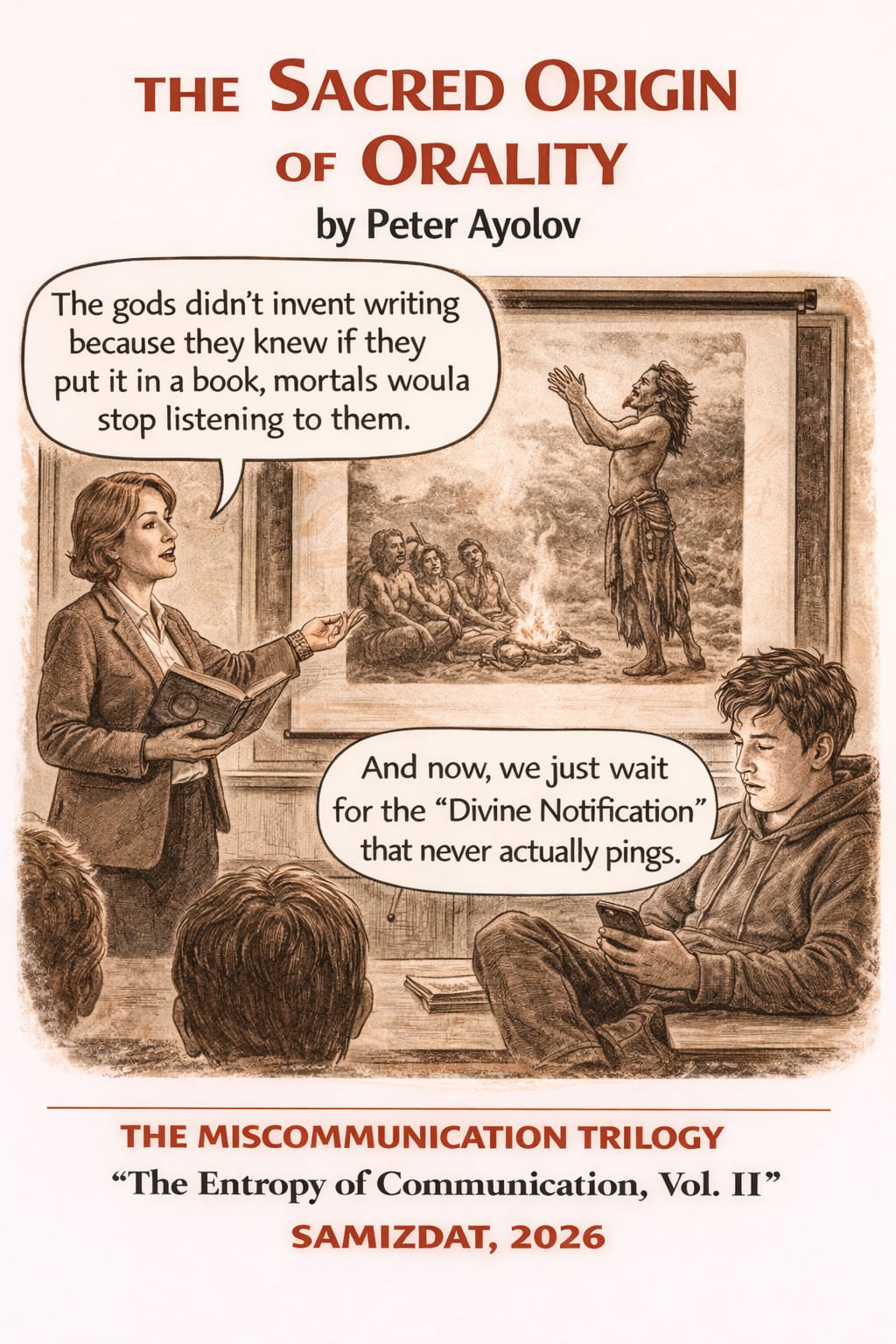
The Voice Before the Code: Recovering Humanity Through Orality
Language as Memory, Presence, and Sacred Connection
The Sacred Origin of Orality occupies a distinctive place within The Miscommunication Trilogy: The Entropy of Communication, Vol. II because it directs attention toward the deepest foundations of human communication. While many contemporary studies focus on digital technologies, media systems, artificial intelligence, or global communication networks, this volume asks a more fundamental question: what was language before it became information? The answer leads not to databases or communication platforms but to the living voice itself. The book presents orality not as a primitive stage surpassed by literacy and technology but as the original condition of human meaning-making. Through an impressive synthesis of linguistic studies, anthropological research, religious narratives, Indigenous experiences, and sociolinguistic theory, the volume demonstrates that spoken language historically functioned as much more than a vehicle for transmitting messages. It served as a repository of collective memory, a bridge between generations, a mechanism for preserving cultural identity, and a medium through which spiritual realities became socially meaningful.
Particularly compelling is the treatment of Indigenous language revitalization. The narratives from Aboriginal communities reveal that language is inseparable from Country, ancestry, and identity. Language appears not merely as vocabulary but as a living relationship with place, history, and spiritual continuity. The testimonies presented throughout the book illustrate how language loss produces a profound rupture in cultural memory, while language recovery becomes a process of healing and restoration. The work avoids romanticizing Indigenous traditions. Instead, it presents language revitalization as a practical and ongoing struggle against historical forces of suppression and assimilation. The contributors demonstrate that recovering language is simultaneously an act of cultural survival, educational renewal, and spiritual reclamation. The stories reveal that language carries ways of seeing, feeling, and understanding the world that cannot be easily transferred into another linguistic framework.
The book’s exploration of spirituality further strengthens its central argument. Across Christian, Buddhist, Indigenous, Muslim, and other traditions, language emerges as a vehicle of transcendence. Prayer, ritual, storytelling, song, and sacred texts all depend upon linguistic forms that connect individuals to realities larger than themselves. The volume repeatedly demonstrates that spiritual experience is rarely detached from language. Rather, language functions as the medium through which communities articulate mystery, meaning, and belonging. What makes this section especially effective is its refusal to separate language from lived experience. The book consistently shows that speech is embodied, communal, and relational. Human beings do not merely use language; they inhabit linguistic worlds. By foregrounding this reality, The Sacred Origin of Orality challenges modern assumptions that reduce communication to information transfer. Instead, it restores the voice to its central role in human existence, revealing language as a form of social presence and spiritual participation.
Globalization, Linguistic Complexity, and the Crisis of Meaning
One of the most intellectually ambitious aspects of the book is its engagement with contemporary theories of language and culture. Drawing extensively upon sociolinguistics, cultural anthropology, discourse theory, and globalization studies, the volume develops a sophisticated critique of simplistic assumptions regarding the relationship between language, culture, and identity. A recurring theme throughout the text is the tension between linguistic complexity and standardization. Modern globalization encourages communication across vast geographical distances, creating unprecedented opportunities for interaction. Yet this same process often requires the simplification of language and the reduction of cultural specificity. The book carefully examines this paradox through discussions of multilingualism, language teaching, linguistic flows, discourse formation, and intercultural communication.
The treatment of language as a network phenomenon is particularly insightful. Rather than viewing languages as isolated systems attached to fixed national territories, the volume presents them as dynamic processes circulating through social networks, migration patterns, educational institutions, media systems, and transnational communities. This perspective reflects contemporary realities far more accurately than traditional nation-centered approaches to language. Equally important is the book’s discussion of languaculture—the inseparable relationship between language and cultural meaning. By emphasizing semantic, poetic, and identity dimensions of linguistic practice, the volume demonstrates that language cannot be understood solely as a neutral communication tool. Every linguistic act carries layers of cultural assumptions, historical memories, and social affiliations. Language shapes identity while simultaneously being shaped by identity.
The discussion of discourse adds another dimension to the analysis. Discourses move across linguistic boundaries through translation, migration, media circulation, and global communication networks. Ideas are not confined to particular languages, yet their movement always involves transformation. The concept of double intertextuality presented throughout the work effectively captures this interaction between linguistic flows and discursive flows. Perhaps the book’s greatest theoretical contribution lies in its rejection of simplistic binaries. Language and culture are neither fully separable nor completely inseparable. Their relationship varies depending upon context, perspective, and scale. At the level of lived experience, language and culture often appear inseparable. At the level of global circulation, however, languages, discourses, and cultural meanings frequently move independently of one another.
This nuanced approach enables the volume to avoid both cultural essentialism and radical relativism. It acknowledges the deep connections between language and identity while recognizing the fluidity produced by migration, globalization, multilingualism, and technological mediation. The result is a sophisticated framework capable of explaining contemporary linguistic realities without reducing them to ideological slogans. Throughout these discussions, the reader is reminded that communication is never merely technical. Linguistic interactions are always embedded within broader structures of meaning, power, memory, and culture. This insight becomes increasingly important as the book moves toward its broader critique of modern communicative systems.
The Planned Obsolescence of Language and the Future of Human Communication
The Sacred Origin of Orality ultimately serves a larger purpose within The Entropy of Communication, Vol. II. It contributes to the trilogy’s overarching argument concerning the planned obsolescence of language. The phrase does not suggest that language itself is disappearing. Rather, it refers to the gradual erosion of those dimensions of language that once made deep communication possible. Throughout the volume, there is a growing awareness that contemporary communication systems increasingly privilege efficiency over meaning, transmission over understanding, and information over wisdom. Digital technologies allow unprecedented connectivity, yet often weaken the social and cultural foundations that traditionally sustained communication. Language becomes faster, more accessible, and more global, while simultaneously becoming thinner and more detached from communal life.
The book identifies a profound historical transformation. Oral cultures depended upon memory, participation, ritual, and interpersonal presence. Modern communication increasingly relies upon storage, retrieval, coding, and algorithmic processing. What is gained in speed and scale may be accompanied by losses in depth and significance. The volume does not advocate a nostalgic return to premodern societies. Instead, it invites readers to reconsider what has been sacrificed in the transition from oral worlds to digitally mediated environments. The question is not whether technology is good or bad. The question is whether communication can remain genuinely human when its foundations become increasingly detached from the embodied realities of speech, memory, and communal interaction. Particularly powerful is the book’s emphasis on the sacred dimension of language. The sacred is not presented narrowly as religion. Rather, it refers to those aspects of communication that exceed mere utility. Storytelling, ritual speech, collective memory, poetry, song, prayer, and oral tradition all represent forms of communication that generate meaning rather than simply transmitting information. These practices remind us that language historically functioned as a bridge between individuals and communities, between present and past, between the visible and the invisible. The book argues convincingly that the erosion of these dimensions contributes to broader cultural fragmentation. When language becomes detached from memory, culture weakens. When communication becomes detached from community, identity becomes unstable. When speech loses its symbolic depth, human relationships risk becoming increasingly transactional.
As a contribution to contemporary debates about language, culture, globalization, and technology, The Sacred Origin of Orality is both timely and significant. Its interdisciplinary approach allows it to speak simultaneously to linguists, anthropologists, educators, theologians, media scholars, and general readers concerned with the future of communication. Most importantly, the volume succeeds in recovering a truth often forgotten in discussions of language: communication begins not with systems, technologies, or institutions, but with human voices speaking to one another. In an age increasingly dominated by codes, platforms, and algorithms, this reminder is both intellectually valuable and culturally necessary. The Sacred Origin of Orality stands as a thoughtful and compelling meditation on what language has been, what it is becoming, and what humanity risks losing if communication continues to drift away from its living origins.
About the Creator
Peter Ayolov
Peter Ayolov’s key contribution to media theory is the development of the "Propaganda 2.0" or the "manufacture of dissent" model, which he details in his 2024 book, The Economic Policy of Online Media: Manufacture of Dissent.
Enjoyed the story? Support the Creator.
Subscribe for free to receive all their stories in your feed.
Comments
There are no comments for this story
Be the first to respond and start the conversation.