
The Grammar of Tribalism , THE MISCOMMUNICATION TRILOGY, “The Entropy of Communication, Vol. II”, Part 28
Book Review

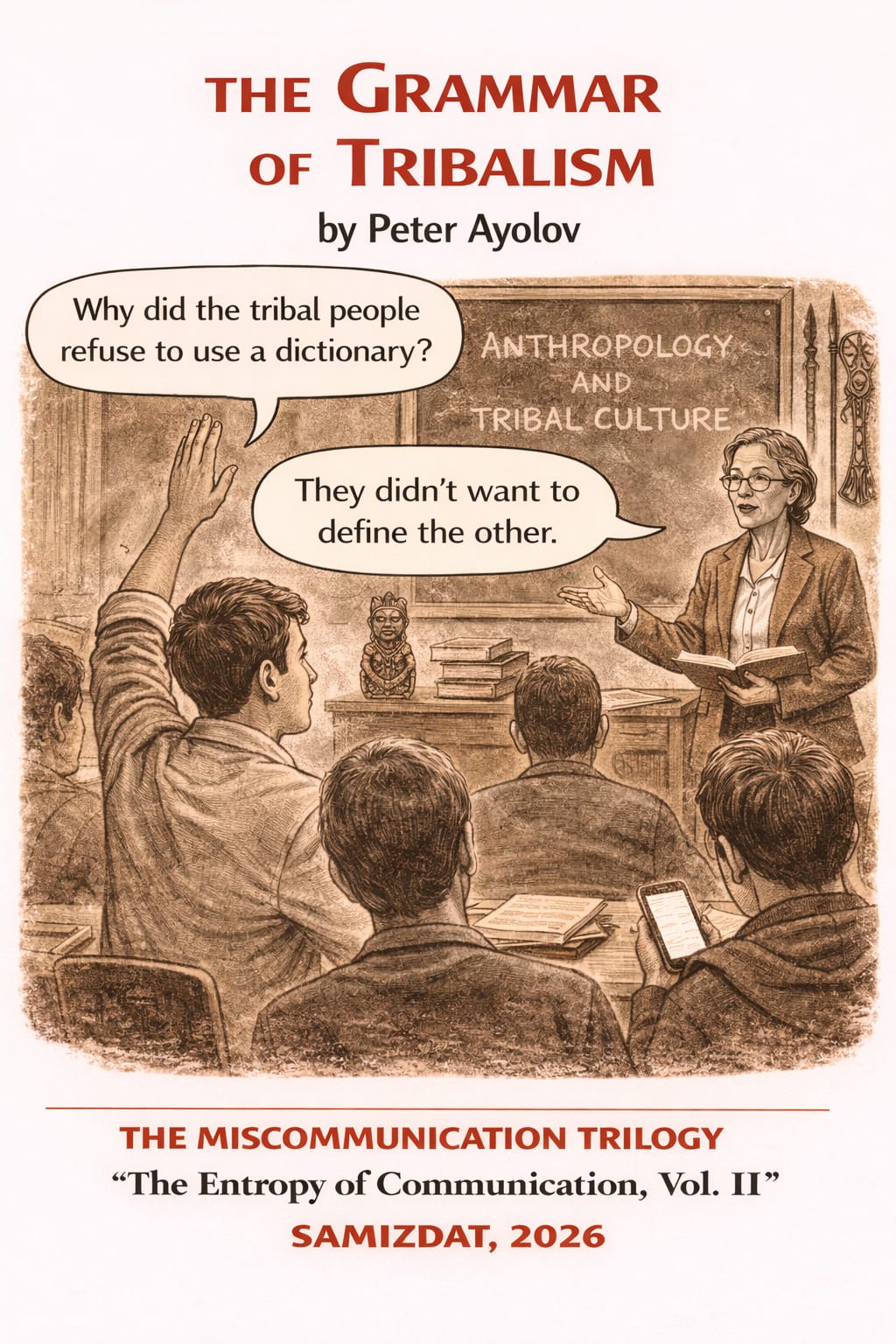
The Language of Belonging: A Review of The Grammar of Tribalism
Mapping the Hidden Structure of Human Division
The Grammar of Tribalism stands as the concluding volume of The Entropy of Communication, Vol. II, and functions as one of the most ambitious contributions within the broader intellectual architecture of The Miscommunication Trilogy. The book examines tribalism not as a marginal social phenomenon confined to primitive societies or political extremism, but as a fundamental organizing principle embedded within human communication itself. Rather than treating tribalism as an outdated relic of premodern life, the work presents it as an enduring structure that continues to shape contemporary identities, political movements, media systems, and social relations. The central strength of the book lies in its refusal to reduce tribalism to a single cause. Instead, it approaches the subject through a wide-ranging interdisciplinary framework that draws upon anthropology, sociology, political theory, communication studies, philosophy, evolutionary psychology, nationalism studies, and media ecology. This breadth allows the analysis to move beyond simplistic explanations and reveal the many ways tribal structures continue to operate beneath modern institutions. One of the book’s most important contributions is its argument that communication itself is inseparable from belonging. Human beings do not merely exchange information. They create communities through language. Every society develops symbolic systems through which individuals recognize one another, establish loyalties, and define outsiders. Tribalism therefore emerges not simply as a political condition but as a communicative structure. The tribe speaks itself into existence through narratives, rituals, myths, slogans, symbols, and shared vocabularies.
This insight provides the foundation for the book’s broader analysis. Rather than accepting the common assumption that modernization inevitably weakens tribal identities, the text demonstrates how modernization often transforms and reproduces them. Nationalism, ideological movements, digital communities, identity politics, populism, and even globalized forms of belonging frequently operate according to tribal logics. What changes are the symbols, not the underlying structure. The book is particularly effective in exposing the contradictions of globalization. Modern communication technologies promised to create a more interconnected and cosmopolitan world. Yet the same systems that connect humanity also intensify fragmentation. Digital platforms encourage the formation of symbolic communities organized around shared grievances, identities, and moral narratives. Communication expands while common understanding diminishes. The result is a social environment where individuals increasingly inhabit separate interpretive worlds despite occupying the same communicative space. The discussion of globalism, nationalism, and tribalism is among the strongest sections of the work. Rather than treating these phenomena as mutually exclusive, the book demonstrates how they overlap and interact. Globalization does not eliminate tribal attachments. Instead, it often intensifies the search for belonging by destabilizing traditional forms of identity. The more abstract social life becomes, the stronger the attraction of communities that promise recognition, certainty, and emotional security. This framework enables the book to avoid the simplistic opposition between tradition and modernity that dominates much contemporary discussion. Tribalism is not presented as the opposite of modern society. It is shown to be deeply embedded within modernity itself. This argument gives the work both theoretical sophistication and contemporary relevance.
Identity, Nation, and the Return of the Tribe
A significant portion of The Grammar of Tribalism is devoted to examining the relationship between tribalism, nationalism, and identity formation. Here the book demonstrates remarkable analytical depth by challenging many assumptions common within both popular commentary and academic theory. The discussion of nation formation is especially noteworthy. Rather than presenting nations as either ancient ethnic communities or purely modern inventions, the book develops a more nuanced position. Nations emerge through historical processes that combine traditional loyalties with increasingly abstract forms of social organization. National identities are neither entirely invented nor entirely primordial. They are complex social formations that integrate memory, territory, communication, institutions, and symbolic belonging. This perspective allows the book to move beyond the limitations of both traditionalist and modernist theories of nationalism. The nation-state appears not as a static entity but as a dynamic intersection between community and polity. Nations become communicative constructions sustained through narratives, symbols, institutions, and shared historical imagination. Yet they also retain emotional and cultural dimensions that cannot be reduced to mere political invention.
The treatment of identity politics provides another major strength. Drawing upon thinkers such as Francis Fukuyama, the book explores how contemporary political life has shifted from economic struggles toward battles over recognition and belonging. The analysis neither dismisses identity-based movements nor romanticizes them. Instead, it examines the conditions that give rise to these movements while also highlighting their potential to fragment public discourse.Particularly compelling is the argument that identity politics on both the left and the right reflects the same underlying search for recognition. Groups seek dignity, visibility, and affirmation within increasingly complex societies. However, when recognition becomes the dominant principle of political life, identities can harden into competing tribes whose members struggle to recognize one another as participants in a shared civic project. The book’s exploration of tribalism through the lens of evolutionary psychology and anthropology further enriches this analysis. Drawing upon authors such as Jonah Goldberg and Ron Newby, it demonstrates how tribal tendencies are rooted in deep historical and biological processes. Human beings evolved within small communities where cooperation with insiders and suspicion toward outsiders often enhanced survival. These tendencies continue to influence contemporary behavior despite the radically different conditions of modern life. What makes the discussion particularly effective is its refusal to embrace biological determinism. Tribal instincts are treated as enduring tendencies rather than unavoidable destinies. Human beings possess both tribal impulses and capacities for cooperation beyond tribal boundaries. The tension between these possibilities becomes one of the book’s central themes.
Equally important is the analysis of social institutions. Families, communities, nations, religions, and civic organizations are examined as mediating structures that channel human needs for belonging. The book argues that when such institutions weaken, individuals often seek alternative forms of identity and solidarity. Political movements increasingly absorb functions once performed by local communities and cultural traditions, contributing to the polarization and tribalization of public life. Through these discussions, The Grammar of Tribalism offers a sophisticated account of how identities are constructed, maintained, and transformed within contemporary societies. It reveals tribalism not as a pathological deviation from modernity but as one of its persistent companions.
Communication, Fragmentation, and the Future of Civilization
The final achievement of The Grammar of Tribalism lies in its ability to connect the study of tribalism to larger questions concerning communication and civilization. The book consistently returns to the idea that language serves as the primary medium through which social realities are created. Communities exist because people share symbols. Political orders endure because citizens participate in common narratives. Institutions function because individuals accept collective meanings. This emphasis on communication allows the work to integrate its diverse themes into a coherent whole. Tribalism, nationalism, identity politics, digital culture, and globalization all appear as different manifestations of a broader communicative process. Human beings organize themselves through symbolic structures. The health of a society therefore depends upon the quality of its communicative practices. The book’s critique of contemporary media environments is especially persuasive. Digital platforms increasingly reward outrage, emotional intensity, and ideological certainty. Complex questions are reduced to slogans. Public discourse becomes performative rather than exploratory. Individuals communicate primarily to affirm group loyalties rather than investigate reality. In this environment, tribal identities flourish because communication itself becomes tribalized.
Yet the book avoids fatalism. While deeply critical of contemporary conditions, it remains committed to the possibility of renewal. The analysis suggests that the future depends upon recovering forms of communication capable of sustaining dialogue across differences. Democratic societies require more than information. They require shared symbolic frameworks through which disagreement can be negotiated without descending into hostility. This concern links the volume directly to the larger themes of The Entropy of Communication. Throughout the trilogy, language appears as both humanity’s greatest achievement and one of its most vulnerable institutions. The planned obsolescence of language does not involve the disappearance of words but the erosion of their communicative function. Language increasingly serves manipulation, performance, and tribal affirmation rather than mutual understanding.
The Grammar of Tribalism provides a fitting culmination to that argument. By examining the tribal foundations of communication, it reveals why contemporary societies struggle to maintain common meaning despite unprecedented technological connectivity. The problem is not simply one of media systems or political institutions. It is rooted in the enduring human desire for belonging and recognition. As a book, The Grammar of Tribalism succeeds because it combines theoretical sophistication with contemporary relevance. It addresses some of the most pressing questions of modern society while grounding its analysis in broad historical and philosophical perspectives. Its interdisciplinary approach allows it to illuminate connections that are often overlooked in more narrowly focused studies. Ultimately, the book presents tribalism as both a challenge and a reality. Human beings cannot escape their need for belonging, but they can learn to understand the symbolic structures through which belonging is organized. In doing so, they may discover ways to preserve community without sacrificing dialogue, identity without abandoning citizenship, and difference without descending into fragmentation.
For these reasons, The Grammar of Tribalism stands as a compelling and intellectually ambitious conclusion to The Entropy of Communication. It is a work that challenges readers to reconsider the relationship between language, identity, and social order while offering a profound reflection on the communicative foundations of civilization itself.
About the Creator
Peter Ayolov
Peter Ayolov’s key contribution to media theory is the development of the "Propaganda 2.0" or the "manufacture of dissent" model, which he details in his 2024 book, The Economic Policy of Online Media: Manufacture of Dissent.
Enjoyed the story? Support the Creator.
Subscribe for free to receive all their stories in your feed.
Comments
There are no comments for this story
Be the first to respond and start the conversation.