
Simplicity of Human Speech, THE MISCOMMUNICATION TRILOGY, “The Entropy of Communication, Vol. II”, Part 25
Book Review

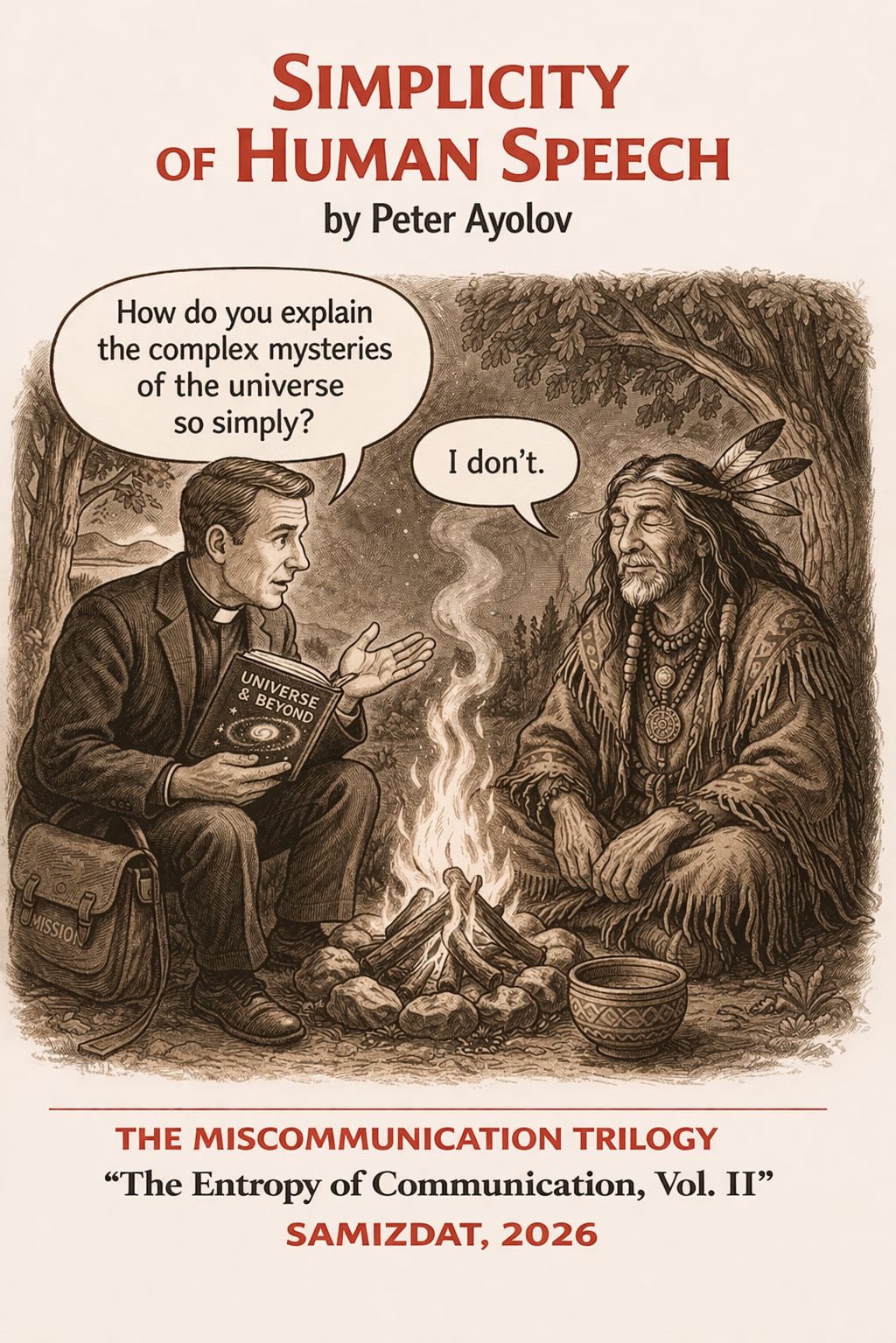
The Economy of Meaning: A Review of Simplicity of Human Speech
Language at the Crossroads of Complexity and Civilization
Simplicity of Human Speech occupies a distinctive place within contemporary discussions of language, communication, and social transformation. As Part 25 of The Miscommunication Trilogy: The Entropy of Communication, Vol. II, the book expands a broader intellectual project concerned with the instability of meaning in modern societies and the growing difficulties of communication in an age of technological acceleration. Rather than treating language as an isolated linguistic phenomenon, the work approaches speech as a complex adaptive system embedded within larger social, technological, economic, and cultural processes. This perspective allows the author to move beyond traditional linguistic debates and situate language within a much broader framework that includes complexity science, urbanization, social networks, evolutionary theory, information systems, and the dynamics of civilization itself.
One of the book’s greatest strengths lies in its interdisciplinary scope. The text does not confine itself to questions of grammar, vocabulary, or linguistic history. Instead, it examines how communication evolves alongside the growth of populations, the expansion of cities, the development of institutions, and the increasing scale of social interaction. Drawing extensively upon complexity theory and scaling laws, the author argues that language changes in response to pressures generated by larger and more interconnected societies. Simplicity emerges not as a sign of decline but as a functional adaptation to scale. As populations increase and communication networks expand, linguistic structures tend to become more accessible, regularized, and efficient. The book’s engagement with scientific concepts is particularly noteworthy. Discussions of scaling, social networks, fractal structures, complexity, and self-organization are integrated into a broader narrative concerning human communication. Rather than presenting language as a purely cultural artifact, the author treats it as a system subject to many of the same principles that govern biological organisms, cities, and economies. This approach provides a refreshing alternative to conventional linguistic explanations and encourages readers to consider communication within a wider ecological and systemic context.
At the same time, the work remains deeply philosophical. Beneath the scientific discussions lies a persistent concern with meaning itself. The author repeatedly returns to the question of whether increasing communicative efficiency necessarily leads to greater understanding. This tension between communication and comprehension serves as one of the book’s most important themes. By framing language as both a social technology and a cultural inheritance, Simplicity of Human Speech challenges readers to reflect upon what may be gained and lost through the ongoing simplification of communication.
The Planned Obsolescence of Language
The most original contribution of the book is undoubtedly its development of the concept of the Planned Obsolescence of Language. Borrowing a term traditionally associated with industrial production and consumer culture, the author applies it to communication systems with considerable intellectual force. The argument suggests that contemporary societies increasingly produce linguistic forms optimized for rapid consumption, immediate accessibility, and short-term utility. Words, narratives, and concepts circulate through digital networks at unprecedented speed, yet their longevity and interpretive depth appear increasingly fragile. This idea functions as the conceptual center of the entire volume. The author argues that modern communication environments reward simplicity, brevity, emotional immediacy, and constant novelty. These characteristics are highly effective for transmitting information across large populations, but they may also contribute to the erosion of linguistic complexity. The result is a communication culture that privileges circulation over reflection and transmission over understanding.
The strength of this argument lies in its ability to connect seemingly unrelated phenomena. Social media, urbanization, technological acceleration, globalization, changing educational practices, and linguistic simplification are presented not as isolated developments but as interconnected aspects of a larger transformation. The author convincingly demonstrates that communication systems cannot be understood independently of the environments within which they operate. Language evolves because society evolves, and contemporary linguistic changes reflect broader shifts in the structure of modern civilization. Particularly compelling is the discussion of entropy as a metaphor for communication. The concept is employed not merely as a rhetorical device but as an analytical framework. Just as physical systems experience increasing disorder over time, communication systems may experience a gradual erosion of coherence, context, and meaning. Information continues to flow, yet shared understanding becomes increasingly difficult to maintain. This interpretation provides a powerful lens through which to examine many of the contradictions of the digital age.
The book also succeeds in avoiding simplistic nostalgia. The author does not argue for a return to an imagined golden age of language. Instead, linguistic simplification is presented as a complex phenomenon involving both benefits and costs. Simpler forms of communication can facilitate inclusion, accessibility, and social coordination. However, they may simultaneously reduce the capacity of language to express nuance, ambiguity, and conceptual depth. This balanced treatment prevents the argument from becoming merely reactionary and allows it to engage seriously with the realities of contemporary communication.
An Ambitious Contribution to the Study of Communication
As a work of intellectual synthesis, Simplicity of Human Speech is ambitious in both scope and purpose. It seeks not only to analyze language but to contribute to a broader understanding of how communication functions within increasingly complex societies. The book’s willingness to draw connections across disciplines is one of its defining strengths. Linguistics, sociology, communication studies, complexity science, urban theory, evolutionary thought, and philosophy are woven together into a coherent narrative that remains accessible without sacrificing conceptual sophistication. The text is particularly successful in demonstrating that language cannot be separated from larger questions concerning social organization and human development. Communication emerges as a foundational element of civilization itself. Through language, societies construct institutions, transmit knowledge, preserve memory, coordinate action, and imagine futures. Consequently, changes in language inevitably have consequences extending far beyond grammar and vocabulary. They affect culture, politics, education, economics, and collective identity.
Another notable achievement is the book’s engagement with scale. Few works on language attempt to connect individual speech acts with large-scale social dynamics. By emphasizing the relationship between linguistic evolution and social growth, the author provides a framework capable of explaining why communication systems change as societies expand. The integration of scaling theory into discussions of language represents a distinctive and innovative contribution. If the book has a central message, it is that the future of language cannot be understood separately from the future of society. The accelerating pace of communication, the expansion of digital networks, and the increasing complexity of global civilization are transforming the conditions under which human speech operates. Whether these transformations will ultimately enrich or impoverish communication remains uncertain. What is clear, however, is that language stands at the center of these changes.
Simplicity of Human Speech succeeds because it refuses to treat language as a narrow academic subject. Instead, it presents communication as one of the defining issues of contemporary civilization. Thought-provoking, interdisciplinary, and philosophically ambitious, the book offers an original perspective on the evolving relationship between language, complexity, and modern life. For readers interested in communication, culture, social theory, and the future of human understanding, it provides a compelling and highly relevant contribution to ongoing debates about the role of language in an increasingly interconnected world.
About the Creator
Peter Ayolov
Peter Ayolov’s key contribution to media theory is the development of the "Propaganda 2.0" or the "manufacture of dissent" model, which he details in his 2024 book, The Economic Policy of Online Media: Manufacture of Dissent.
Enjoyed the story? Support the Creator.
Subscribe for free to receive all their stories in your feed.
Comments
There are no comments for this story
Be the first to respond and start the conversation.