
The Linguistic Entropy, THE MISCOMMUNICATION TRILOGY, “The Entropy of Communication, Vol. II”, Part 23
Book Review

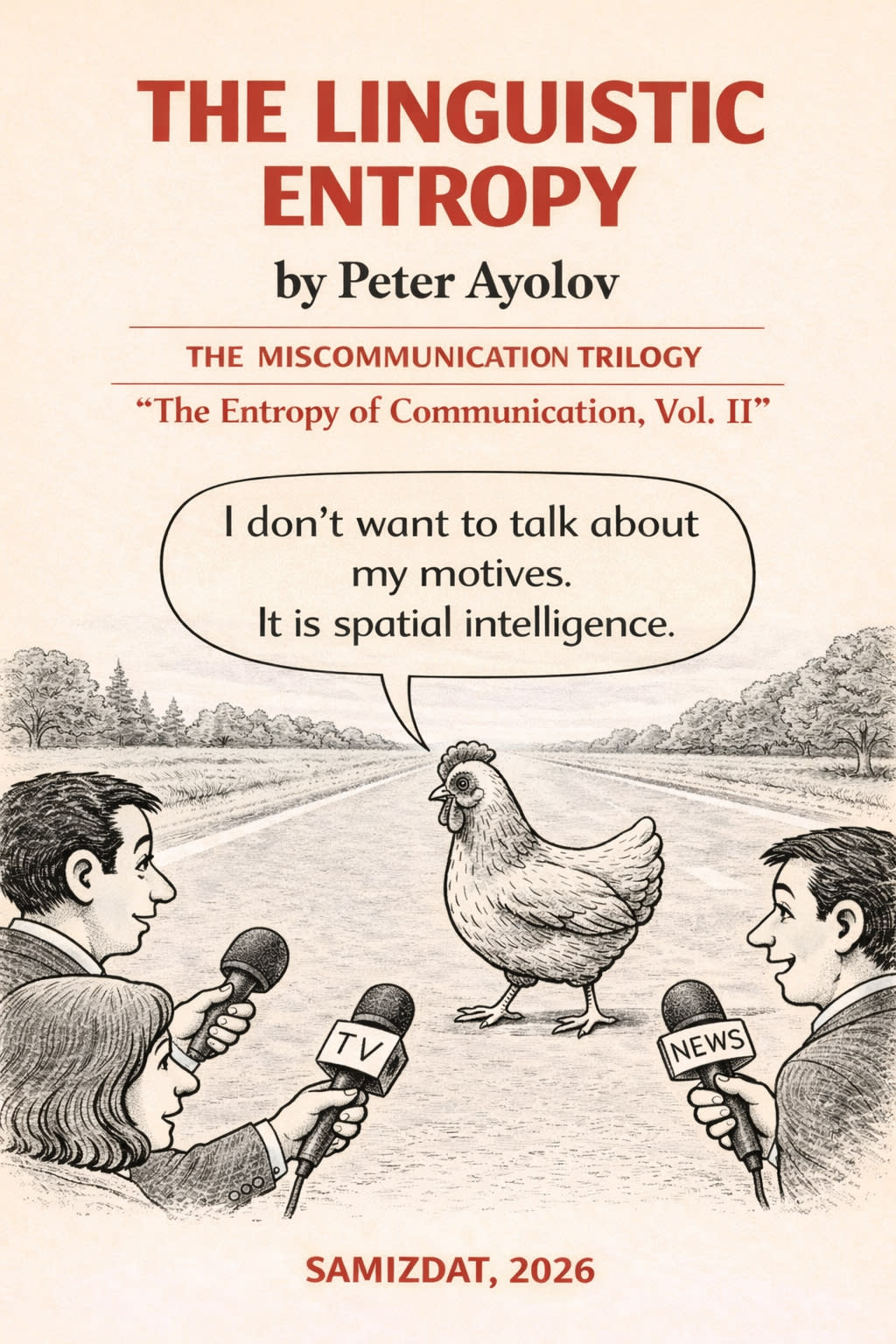
Communication at the Edge of Chaos: Language, Entropy, and the Crisis of Civilization
The Collapse of Symbolic Stability
The Linguistic Entropy, part of The Miscommunication Trilogy, “The Entropy of Communication, Vol. II”, is an ambitious interdisciplinary work that attempts to synthesize information theory, linguistics, systems theory, cybernetics, philosophy, sociology, evolutionary biology, and media ecology into a unified interpretation of modern civilization’s communicative crisis. Rather than treating language merely as a neutral tool of expression, the book positions communication itself as the foundational infrastructure of human civilization, arguing that the contemporary world is experiencing a gradual collapse of symbolic stability under the pressure of technological acceleration and informational excess. The central strength of the work lies in its ability to connect seemingly unrelated intellectual traditions into a coherent philosophical narrative centered around entropy and the destabilization of meaning.
One of the book’s most compelling achievements is its reinterpretation of entropy beyond its original thermodynamic meaning. By drawing heavily upon Claude Shannon’s information theory, the text demonstrates how entropy functions not only as physical disorder but also as uncertainty within communication systems. This conceptual transition allows the author to frame modern communication environments as increasingly entropic structures, where excessive informational circulation generates fragmentation rather than clarity. In this sense, the book belongs to a tradition of critical media theory associated with Marshall McLuhan, Neil Postman, Norbert Wiener, and systems theorists concerned with the relationship between communication technologies and cultural organization. However, The Linguistic Entropy extends these discussions into a broader philosophical framework in which language itself becomes the central battlefield between order and chaos.
The work’s critique of technological civilization is particularly effective when examining digital communication systems. The book persuasively argues that the contemporary informational environment rewards immediacy, emotional stimulation, repetition, and algorithmic visibility while simultaneously eroding historical continuity, symbolic depth, and reflective discourse. Communication increasingly operates according to the logic of circulation rather than meaning. Words become temporary signals competing for attention within systems optimized for behavioral engagement rather than understanding. The text repeatedly emphasizes that modern civilization suffers not from a lack of information but from informational overproduction, creating a condition where meaning itself becomes unstable. This argument resonates strongly with contemporary concerns regarding social media, artificial intelligence, algorithmic communication, and the fragmentation of public discourse.
Another important contribution of the book lies in its concept of the planned obsolescence of language. This idea functions as the philosophical center of the trilogy and offers a powerful metaphor for understanding the transformation of communication within technological capitalism. Just as industrial systems produce disposable commodities, digital systems increasingly produce disposable meanings, narratives, and symbolic structures designed for rapid consumption and replacement. The book convincingly demonstrates how linguistic instability mirrors broader patterns of economic acceleration and cultural exhaustion. In this interpretation, entropy becomes both a scientific concept and a civilizational condition describing the erosion of permanence, continuity, and interpretive coherence within modern societies.
Stylistically, the work adopts a dense, philosophical, and highly synthetic mode of writing that resembles grand theoretical works of the twentieth century. The text moves fluidly between scientific concepts, historical examples, philosophical reflection, and sociological critique, creating an atmosphere of intellectual urgency. While this style occasionally risks abstraction, it also contributes to the book’s ambitious scope. The author clearly seeks not merely to analyze communication but to construct a large-scale philosophical diagnosis of contemporary civilization through the lens of entropy and linguistic transformation.
Language, Complexity, and Human Adaptation
Beyond its critique of technological communication, The Linguistic Entropy offers a sophisticated exploration of language as a complex adaptive system. One of the book’s most valuable insights is its rejection of simplistic narratives about linguistic decline. Rather than presenting language as a fragile structure collapsing under modernity, the text repeatedly emphasizes the extraordinary resilience and adaptability of human communication. Drawing from linguistics, complexity theory, autopoiesis, and biological systems theory, the book argues that languages survive precisely because they evolve through instability rather than despite it. This perspective gives the work a degree of theoretical balance often missing from purely pessimistic critiques of technological culture.
The discussion of redundancy is especially noteworthy. Building on Shannon’s theories, the book explains how redundancy functions not as inefficiency but as a necessary condition for reliable communication within noisy environments. Grammar, syntax, repetition, and symbolic structure all operate as anti-entropic mechanisms preserving meaning against randomness and distortion. This insight becomes one of the text’s recurring philosophical motifs: complexity survives through structure, not simplicity. The author successfully extends this principle from communication systems to biological evolution, DNA, cognition, and social organization, suggesting that informational order is fundamental to both life and language.
The treatment of biological and linguistic evolution is another major strength of the work. The text effectively integrates theories of emergence, complexity, and self-organization into its interpretation of communication. References to John von Neumann, Ilya Prigogine, autopoiesis theory, and Noam Chomsky contribute to a broader argument that human language represents one of the most sophisticated anti-entropic systems ever produced by evolution. The discussion of grammar as a generative structure capable of producing infinite novelty from finite rules is particularly compelling, especially when connected to the emergence of symbolic culture and the development of civilization.
The sections dealing with language change are equally successful. The book rejects romanticized notions of linguistic purity and instead emphasizes mutation, hybridization, and mixture as natural conditions of linguistic evolution. Discussions of pidgins, creoles, dialects, language contact, and semantic drift illustrate the fluidity of communication systems across history. This perspective allows the author to challenge static understandings of language while simultaneously demonstrating how communication maintains coherence despite constant transformation. In doing so, the work positions linguistic entropy not simply as decay but as a dynamic tension between stability and adaptation.
At times, however, the book’s theoretical ambition becomes so expansive that certain arguments risk becoming overly generalized. The attempt to connect thermodynamics, information theory, sociology, linguistics, evolutionary biology, and media studies occasionally leads to conceptual stretching. Some readers may question whether entropy can meaningfully operate across such diverse domains without losing analytical precision. The text embraces metaphorical and philosophical uses of entropy alongside scientific definitions, which strengthens its symbolic power but may create tension for readers seeking stricter disciplinary boundaries. Nevertheless, this interdisciplinary openness is also part of what makes the work intellectually distinctive. The book does not attempt to function as a narrowly technical study but as a philosophical synthesis exploring the relationship between communication, complexity, and civilization.
The work’s engagement with media ecology is especially effective because it avoids simplistic technological determinism. While highly critical of digital acceleration, the book does not portray technology itself as inherently destructive. Instead, it emphasizes the interaction between technological systems and human symbolic structures. The problem emerges when communication becomes governed exclusively by computational logic, algorithmic optimization, and informational acceleration without corresponding structures capable of preserving symbolic coherence. This nuanced position prevents the text from collapsing into nostalgia or reactionary pessimism, allowing it to maintain a more sophisticated critical perspective.
Entropy, Civilization, and the Future of Meaning
The most significant achievement of The Linguistic Entropy lies in its broader philosophical implications. The book ultimately argues that communication crises are inseparable from civilizational crises. Language is presented not merely as a medium of expression but as the very architecture through which societies organize reality, preserve memory, and maintain collective identity. Once communication systems fragment under conditions of informational overload, broader forms of social instability emerge. Political polarization, cultural fragmentation, epistemological uncertainty, and emotional volatility are all interpreted as symptoms of deeper entropic tendencies affecting symbolic order itself.
This argument gives the work a distinctly civilizational dimension reminiscent of thinkers such as Oswald Spengler, Lewis Mumford, Harold Innis, and Jacques Ellul. Yet unlike many declinist works, The Linguistic Entropy does not portray entropy as an entirely terminal process. The book repeatedly returns to theories of complexity and nonequilibrium systems to suggest that instability can also generate new organizational forms. Language survives because it reorganizes itself continuously through adaptation, mutation, and symbolic innovation. This tension between collapse and regeneration gives the text a philosophical dynamism that prevents it from becoming merely apocalyptic.
The treatment of artificial intelligence and algorithmic communication is particularly timely. Although not exclusively focused on AI, the book anticipates many contemporary anxieties regarding machine-generated language and computational mediation. It raises important questions about whether communication optimized for machine readability can preserve the ambiguity, symbolic richness, and interpretive depth characteristic of human language. The text warns that once communication becomes fully subordinated to technological systems designed for efficiency and behavioral prediction, societies risk losing the symbolic complexity necessary for reflective thought and cultural continuity.
The conclusion of the work is especially powerful because it frames the defense of meaningful communication as a struggle for civilization itself. Against the accelerating noise of modern informational systems, language emerges as humanity’s final resistance against chaos, forgetfulness, and symbolic collapse. This philosophical framing gives the book emotional and intellectual coherence, transforming what could have been a purely academic study into a broader meditation on human existence within technological modernity.
As a contribution to contemporary thought, The Linguistic Entropy succeeds both as a theoretical synthesis and as a cultural critique. Its greatest strength lies in its ability to integrate scientific concepts with philosophical and sociological analysis without losing sight of the human implications of communication systems. The work challenges readers to reconsider language not as a transparent medium but as the central infrastructure of civilization itself. While some arguments may appear overly expansive or speculative, the ambition of the project is undeniable. The book attempts to diagnose the symbolic condition of the contemporary world through a framework capable of connecting entropy, communication, complexity, and social organization into a unified philosophical vision.
Ultimately, The Linguistic Entropy stands as a significant meditation on the fate of language within technological civilization. It argues that the future of humanity depends not only on technological progress but on the preservation of meaningful communication against the forces of informational entropy. In a world increasingly dominated by acceleration, simulation, and communicative overload, the book insists that language remains humanity’s primary mechanism for resisting chaos and maintaining continuity with memory, history, and meaning itself.
About the Creator
Peter Ayolov
Peter Ayolov’s key contribution to media theory is the development of the "Propaganda 2.0" or the "manufacture of dissent" model, which he details in his 2024 book, The Economic Policy of Online Media: Manufacture of Dissent.
Enjoyed the story? Support the Creator.
Subscribe for free to receive all their stories in your feed.
Comments
There are no comments for this story
Be the first to respond and start the conversation.