Book of the Year
Group Coaching: A Powerful Way to Learn, Grow, and Succeed Together
In today’s fast-moving world, personal and professional growth has become more important than ever. People want guidance, support, and practical strategies to improve their careers, businesses, leadership skills, and personal lives. One effective approach that continues to gain popularity is group coaching.
By Elevate You Studio5 months ago in BookClub
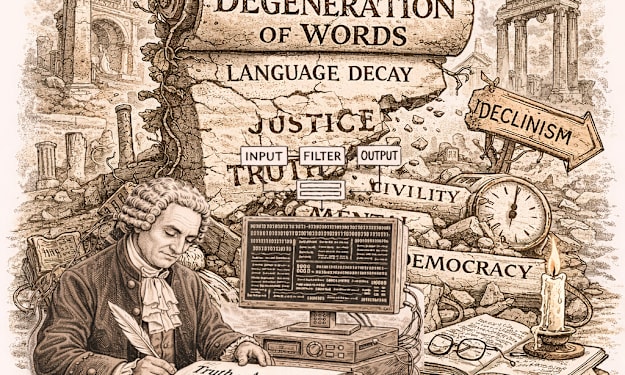
Degeneration of Words, THE MISCOMMUNICATION TRILOGY, “The Entropy of Communication, Vol. II”, Part 19
Echoes of Babel: A Review of The Degeneration of Words The Degeneration of Words, Part 19 of THE MISCOMMUNICATION TRILOGY “The Entropy of Communication, Vol. II,” is an ambitious and intellectually expansive examination of the collapse of language in contemporary society. Positioned at the intersection of philosophy, linguistics, media ecology, critical theory, sociology, and political analysis, the book explores how modern communication systems have transformed language from a medium of understanding into a mechanism of manipulation, fragmentation, and ideological conflict. Rather than approaching language merely as a neutral instrument for transmitting information, the work argues that words themselves have become unstable commodities circulating through systems of mass media, digital technology, and political spectacle. The result is a civilization trapped within what the author repeatedly frames as the entropy of communication—a process through which meaning gradually dissolves under the pressure of technological acceleration and ideological saturation.
By Peter Ayolov5 months ago in BookClub
Her March Forward™ Volume 2 Continues Uplifting the Powerful Legacy and Leadership of Women Veterans
There are women whose stories deserve to be heard far beyond the moments they served in uniform. Women whose strength, sacrifice, leadership, and resilience continue creating impact long after military service ends. Her March Forward™ Volume 2 is shining a well-deserved light on those women while creating a powerful movement centered around visibility, healing, empowerment, and legacy.
By Tammy Reese5 months ago in BookClub
Online Media Ecology, THE MISCOMMUNICATION TRILOGY, “The Entropy of Communication, Vol. II”, Part 18
Online Media Ecology: The Entropy of Language The Collapse of Symbolic Civilization Online Media Ecology, part of THE MISCOMMUNICATION TRILOGY “The Entropy of Communication, Vol. II,” is an ambitious and philosophically dense examination of the relationship between media, language, technology, and the gradual destabilization of human consciousness in the digital age. Drawing heavily from the traditions of media ecology associated with Marshall McLuhan, Neil Postman, Harold Innis, Walter Ong, Eric Havelock, and related thinkers, the book develops a broad cultural critique centered around one of its most important concepts: the Planned Obsolescence of Language. This idea functions as the central organizing principle of the entire work and gives the book its distinctive intellectual identity. Rather than approaching media simply as neutral technologies that transmit information, the book treats communication systems as environments that restructure perception itself. This perspective allows the author to move beyond conventional criticism of television or social media and instead examine how media reshape memory, morality, political judgment, childhood, identity, and the structure of reality. The work consistently argues that the transition from print culture to electronic and digital media represents not merely technological progress but a transformation in the symbolic foundations of civilization.
By Peter Ayolov5 months ago in BookClub
McLuhan Is The Message, THE MISCOMMUNICATION TRILOGY, “The Entropy of Communication, Vol. II”, Part 17
The Medium Of Disappearance: A Review Of McLuhan Is The Message Media as environments of consciousness McLuhan Is the Message, part of THE MISCOMMUNICATION TRILOGY: “The Entropy of Communication, Vol. II,” is not a conventional study of communication theory, nor is it merely an intellectual tribute to Marshall McLuhan. Instead, the work attempts something considerably more ambitious: it transforms McLuhan’s central insight into the organizing principle for a broader philosophical investigation concerning language, media, technological systems, and the fate of human consciousness itself. Rather than treating communication as a neutral exchange of information between individuals, the book repeatedly argues that communication environments function as hidden architectures shaping human experience long before any specific content reaches awareness. In this sense the work pushes beyond ordinary media criticism and enters territory traditionally occupied by philosophy, anthropology, and cultural theory.
By Peter Ayolov6 months ago in BookClub
Storytelling, Falsification and Belief, THE MISCOMMUNICATION TRILOGY, “The Entropy of Communication, Vol. II”, Part 16
The Empire of Narratives: A Review of Storytelling, Falsification and Belief The Collapse of Stable Meaning THE MISCOMMUNICATION TRILOGY “The Entropy of Communication, Vol. II” Part 16, STORYTELLING, FALSIFICATION AND BELIEF stands as one of the most ambitious philosophical investigations within the larger architecture of the trilogy. Rather than treating communication as a transparent process through which information moves from one consciousness to another, this volume proposes a far more unsettling argument: language itself increasingly participates in systems of symbolic construction that shape reality before reality can even be perceived. In a world saturated with narratives, images, and communication technologies, the problem is no longer simply whether statements are true or false. The deeper problem concerns the structures through which truth itself becomes believable. The volume therefore enters territory extending far beyond linguistics or media theory and gradually develops into a larger philosophical reflection on the conditions of human understanding in an age where narratives increasingly replace direct experience. At the center of this investigation lies the concept of the planned obsolescence of language. Unlike technological obsolescence, where material products are intentionally designed to become outdated, linguistic obsolescence refers to the gradual exhaustion and accelerated replacement of meanings. Words circulate with increasing speed. Concepts become unstable. Symbols detach from durable realities and begin to exist independently as floating structures of emotional significance. Under such conditions communication no longer guarantees understanding; rather, communication itself begins producing confusion through excess. The paradox explored throughout the volume is striking: contemporary societies possess unprecedented technological capacities for communication and yet simultaneously suffer from a profound crisis of meaning. Through a synthesis of discourse theory, semiotics, advertising studies, philosophy of language, narrative theory, and media criticism, the book constructs an interdisciplinary framework capable of revealing hidden symbolic structures beneath ordinary experience. Particularly compelling is its refusal to dismiss advertising as a superficial commercial practice. Instead, advertising appears as one of the most sophisticated laboratories of communication in modern society. Advertising reveals how commodities acquire symbolic identities, how narratives produce emotional investment, and how persuasion increasingly depends upon creating worlds rather than delivering facts. The work repeatedly demonstrates that products no longer function merely as objects. They become symbolic centers around which identities, desires, aspirations, and social myths organize themselves. Cars become masculinity, prestige, and freedom. Perfume becomes seduction, personality, and emotional possibility. Consumption itself becomes participation in narratives larger than the objects being purchased. The volume therefore argues that the transformation of communication into symbolic performance may be one of the defining developments of modern civilization. Communication increasingly functions through emotional plausibility rather than empirical evidence. Reality itself becomes narratively mediated.
By Peter Ayolov6 months ago in BookClub
The Media Kitsch, THE MISCOMMUNICATION TRILOGY, “The Entropy of Communication, Vol. II”, Part 15
The Mirror of Noise: A Review of The Media Kitsch The Collapse of Meaning in the Age of Media Excess The Media Kitsch, Part 15 of THE MISCOMMUNICATION TRILOGY “The Entropy of Communication, Vol. II,” presents itself not simply as a study of media systems but as a philosophical excavation of language under conditions of contemporary symbolic overload. At first glance the work appears to focus on familiar subjects: mass communication, media discourse, buzzwords, doublespeak, political rhetoric, social media language, and contemporary systems of representation. Yet beneath these visible themes the volume gradually reveals a far broader ambition. Rather than examining media merely as institutions transmitting information, the work investigates media as environments that increasingly organize reality itself. The central concern of the volume—the Planned Obsolescence of Language—provides an ambitious conceptual framework through which contemporary communication is interpreted not as progress but as symbolic deterioration hidden beneath abundance.
By Peter Ayolov6 months ago in BookClub
The Propaganda of PR, THE MISCOMMUNICATION TRILOGY, “The Entropy of Communication, Vol. II”, Part 14
The Architecture of Managed Consent The Propaganda of PR presents a broad and systematic critique of public relations as one of the central organizing forces of modern communication and political perception. The book argues that PR is no longer a secondary function of corporate communication or political messaging, but a foundational structure embedded within journalism, entertainment industries, digital platforms, and institutional governance. Rather than operating as a visible or isolated practice, PR is described as a continuous system that shapes how reality is constructed, interpreted, and stabilized across modern societies. At the core of this analysis is the extension of the propaganda model tradition associated with Herman and Chomsky. The book builds on the idea that media systems are structured by ownership, advertising, sourcing, flak, and ideology, but argues that these filters are now deeply interwoven with professionalized public relations systems. PR becomes the connective layer that links governments, corporations, think tanks, and media institutions into a coordinated communication environment. In this system, journalism is not fully autonomous but structurally dependent on institutional information flows, press briefings, corporate messaging, and expert networks that are themselves shaped by PR strategies. The result is a media ecosystem in which information is not primarily produced through independent investigation but through the circulation of pre-structured narratives. Journalistic routines, economic pressures, and institutional dependencies reinforce this dynamic, narrowing the space for alternative interpretations. Media concentration and advertising dependence further intensify this structure, ensuring that only certain framings of reality are amplified while others remain marginal. Within this framework, PR does not simply influence content after it is created; it shapes the conditions under which content becomes possible in the first place.
By Peter Ayolov6 months ago in BookClub
The Tragedy of Narrative, THE MISCOMMUNICATION TRILOGY, “The Entropy of Communication, Vol. II”, Part 13
The Machinery of Silence: Narrative, Media, and the Collapse of Meaning This volume forms part of THE MISCOMMUNICATION TRILOGY “The Entropy of Communication, Vol. II” and continues its philosophical investigation into the instability of language, public opinion, and symbolic reality in the modern world. The central theme of this work is the planned obsolescence of language, where narratives, meanings, and communicative structures gradually lose permanence under the pressures of technological acceleration and media saturation. The book explores how storytelling, public discourse, and digital communication increasingly transform language into a disposable system governed by emotional intensity, conformity, and symbolic manipulation. Through analyses of the spiral of silence, mass media, stereotypes, social conformity, and online hostility, the text examines how human communication becomes fragmented while societies struggle to preserve coherent meaning. Particular attention is given to the relationship between silence, fear of isolation, emotional contagion, and the collapse of stable narrative structures in contemporary civilization. Ultimately, this work argues that the tragedy of modern communication lies not in the disappearance of language itself but in the gradual erosion of its ability to sustain truth, continuity, memory, and collective human understanding.
By Peter Ayolov6 months ago in BookClub
The PR of Propaganda, THE MISCOMMUNICATION TRILOGY, “The Entropy of Communication, Vol. II”, Part 12
The Machinery of Persuasion and the Collapse of Meaning The Architecture of Invisible Power THE PR OF PROPAGANDA stands as one of the most ambitious and philosophically unsettling entries in THE MISCOMMUNICATION TRILOGY “The Entropy of Communication, Vol. II”. Rather than treating propaganda as a narrow political instrument associated solely with dictatorships or wartime censorship, the book presents it as the invisible operating system of modern civilization. What distinguishes this volume from conventional studies of media manipulation is its insistence that propaganda is not an exception to democratic society but one of its permanent structural conditions. Through a dense synthesis of philosophy, communication theory, political history, sociology, rhetoric, and cultural criticism, the work argues that modern communication itself has become inseparable from systems of symbolic management and psychological influence.
By Peter Ayolov6 months ago in BookClub
The Story Behind Native Son
This is a story that depicts racism about a young black man living in poverty with his family. He gets a job as a driver for a rich white family until he accidentally murders a white woman. Native Son, written by Richard Wright and published in 1940, is one of the most influential novels in American literature. The novel explores the harsh realities of racism, poverty, and social inequality in the United States during the early twentieth century. Through the tragic story of Bigger Thomas, Wright examines how systemic oppression shapes the thoughts, actions, and fate of African Americans living in a deeply segregated society. The novel remains significant because of its powerful social criticism and its psychological portrayal of a young man trapped by fear and hopelessness.
By Gladys W. Muturi6 months ago in BookClub