
The Tragedy of Narrative, THE MISCOMMUNICATION TRILOGY, “The Entropy of Communication, Vol. II”, Part 13
Book Review

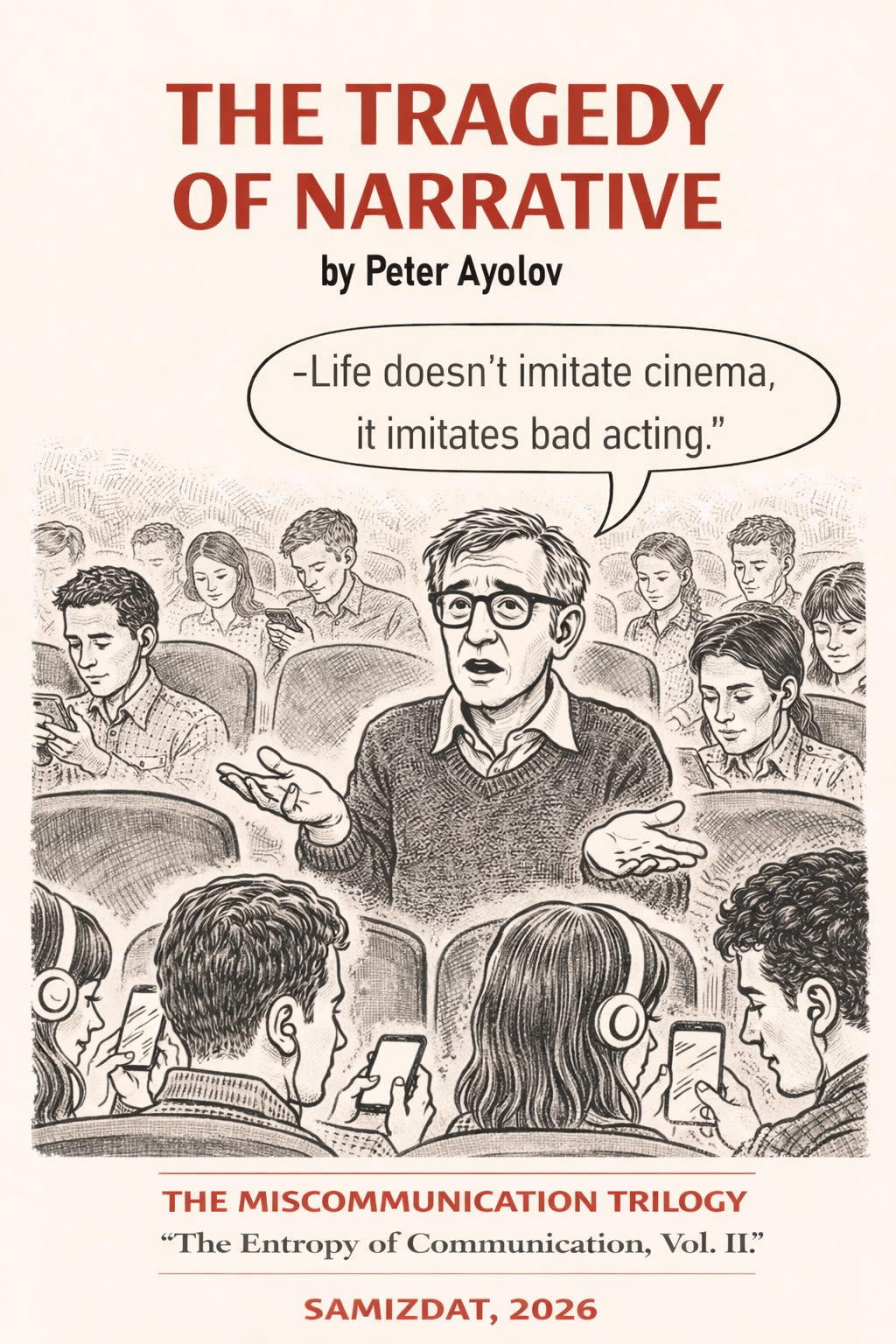
The Machinery of Silence: Narrative, Media, and the Collapse of Meaning
This volume forms part of THE MISCOMMUNICATION TRILOGY “The Entropy of Communication, Vol. II” and continues its philosophical investigation into the instability of language, public opinion, and symbolic reality in the modern world. The central theme of this work is the planned obsolescence of language, where narratives, meanings, and communicative structures gradually lose permanence under the pressures of technological acceleration and media saturation. The book explores how storytelling, public discourse, and digital communication increasingly transform language into a disposable system governed by emotional intensity, conformity, and symbolic manipulation. Through analyses of the spiral of silence, mass media, stereotypes, social conformity, and online hostility, the text examines how human communication becomes fragmented while societies struggle to preserve coherent meaning. Particular attention is given to the relationship between silence, fear of isolation, emotional contagion, and the collapse of stable narrative structures in contemporary civilization. Ultimately, this work argues that the tragedy of modern communication lies not in the disappearance of language itself but in the gradual erosion of its ability to sustain truth, continuity, memory, and collective human understanding.
I. The Architecture of Narrative Decay
The Tragedy of Narrative is an ambitious and philosophically charged exploration of communication, silence, public opinion, and symbolic collapse in the modern age. Expanding far beyond traditional media criticism, the book constructs a sweeping intellectual investigation into the psychological, political, and existential foundations of storytelling itself. Drawing together thinkers such as Elisabeth Noelle-Neumann, Walter Lippmann, David Hume, John Locke, Rousseau, Niklas Luhmann, and contemporary scholars of digital communication, the work presents narrative not merely as an artistic structure but as the central mechanism through which civilizations regulate collective existence.
One of the book’s greatest strengths lies in its ability to synthesize diverse traditions of thought into a unified argument about the entropy of meaning in contemporary society. The author moves fluidly between political communication theory, psychology, philosophy, sociology, media studies, and literary reflection, demonstrating how narrative operates simultaneously as social glue, ideological weapon, emotional regulator, and existential shield. The result is not a conventional academic study but an expansive philosophical meditation on why human beings require stories and why those stories now appear to be collapsing beneath the pressures of technological acceleration.
At the center of the work stands Elisabeth Noelle-Neumann’s spiral of silence theory, which the book transforms from a narrow communication model into a civilizational principle. According to the analysis presented here, public opinion is not simply a reflection of democratic consensus but a mechanism of symbolic pressure through which societies regulate acceptable expression. Human beings continuously monitor the climate of opinion surrounding them because isolation threatens not only social status but psychological survival itself. Silence therefore emerges not as passivity but as a deeply structured response to social fear.
The book’s treatment of the spiral of silence is particularly effective because it avoids reducing the theory to simplistic political conformity. Instead, it expands the concept into a broader reflection on how modern communication systems produce emotional climates that determine visibility, legitimacy, and symbolic existence. The author demonstrates how silence permeates all levels of contemporary life: political discourse, social media behavior, online review systems, institutional structures, and even intimate identity formation. Public expression becomes inseparable from surveillance, social risk, and symbolic punishment.
Another major achievement of the work is its analysis of media as producers of pseudo-reality. Walter Lippmann’s concept of “pictures in our heads” serves as a crucial framework through which the book examines the construction of modern perception. According to the text, individuals increasingly inhabit mediated symbolic environments detached from direct experience. The mass media—and later digital media—filter reality through stereotypes, emotional intensities, agenda-setting mechanisms, and repeated symbolic formulas that gradually replace lived experience itself. The book repeatedly returns to the unsettling possibility that contemporary society no longer experiences reality directly but through continuously circulating narratives engineered by technological and ideological systems.
This argument gains particular force in the chapters dealing with digital communication. The book convincingly demonstrates how social media intensify the spiral of silence while simultaneously destabilizing it. Individuals monitor likes, comments, outrage, hostility, and emotional reactions as indicators of acceptable speech. Visibility itself becomes a form of social survival. Yet the same environments that intensify conformity also produce emotional escalation capable of disrupting silence. Online incivility, outrage culture, and emotional contagion create communicative conditions in which anger overrides caution, compelling individuals toward impulsive expression rather than withdrawal.
The analysis of online hostility is especially compelling because it refuses simplistic moral conclusions. The book does not merely condemn digital aggression; it interprets incivility as symptomatic of deeper communicative instability. Emotional escalation reveals how fragile civilized language truly remains beneath its rational surface. Communication regresses toward instinctive confrontation because technological systems reward intensity, outrage, and symbolic conflict. Under these conditions, public discourse becomes increasingly emotional, fragmented, and performative.
The work’s discussion of narrative entropy further deepens its philosophical scope. Drawing inspiration from Kurt Vonnegut’s reflections on story structures, the book argues that modern civilization itself increasingly resembles a narrative moving not toward heroic resolution but toward slow symbolic decay. Stories no longer provide durable frameworks of meaning because communication systems prioritize immediacy, novelty, and emotional stimulation over continuity and permanence. Narrative becomes disposable. Meaning fragments beneath endless circulation.
This theme of symbolic exhaustion gives the book remarkable coherence. Whether discussing public opinion, media stereotypes, digital hostility, fashion, political polarization, or social conformity, the underlying argument remains consistent: modern communication systems accelerate symbolic instability faster than human beings can psychologically integrate it. Civilization survives through stories while simultaneously destroying the conditions necessary for stories to endure.
II. Language as Ritual, Concealment, and Social Survival
Perhaps the book’s most original contribution lies in its treatment of language not primarily as a transparent medium of communication but as a ritual system of concealment. Beneath the analyses of media theory and public opinion runs a darker anthropological argument: civilization depends upon symbolic disguises that regulate instincts incapable of open expression. Language becomes less a vehicle of truth than a mechanism for masking violence, sexuality, domination, fear, resentment, and mortality beneath acceptable social forms.
This insight gives the work unusual philosophical depth. The author repeatedly suggests that storytelling itself emerged not simply to entertain or preserve history but to mediate unbearable aspects of existence. Myths, ideologies, moral systems, religions, and narratives function as symbolic structures through which societies conceal their instinctive foundations. Human beings cannot live collectively without symbolic mediation because direct confrontation with biological reality would destabilize social order.
The recurring figure of Silenus becomes especially significant within this framework. Traditionally associated with intoxication, satire, obscenity, and hidden wisdom, Silenus represents the disturbing truth concealed beneath civilized appearances. The book interprets the “secret of Silenus” as the recognition that communication itself functions as a protective ritual hiding humanity’s animalistic foundations. Stories civilize instinct by transforming biological drives into symbolic performances acceptable within social structures.
This interpretation of language profoundly reshapes the book’s analysis of media and narrative. Public discourse no longer appears as rational democratic exchange but as an unstable symbolic theater regulating social tensions through controlled expression. Political language conceals power. Moral discourse conceals aggression. Social rituals conceal fear. Narratives themselves become structures of psychological management rather than neutral representations of reality.
The discussion of translation reinforces this perspective brilliantly. The book’s reference to Woody Allen subtitles differing from spoken dialogue illustrates how meaning always escapes complete symbolic capture. Tone, irony, emotional nuance, cultural memory, and unconscious implication resist stable translation. Communication therefore remains fundamentally incomplete. Human beings misunderstand one another structurally rather than accidentally because language itself can never fully stabilize meaning.
This argument becomes even more powerful when applied to digital communication. Online environments intensify fragmentation because communication occurs across incompatible symbolic systems lacking shared interpretive foundations. Different groups inhabit distinct narrative realities governed by conflicting vocabularies, emotional codes, and ideological assumptions. Public discourse fractures into isolated communicative tribes incapable of recognizing one another’s symbolic logic. The internet multiplies expression while weakening shared meaning.
The book’s treatment of silence gains additional force within this context. Silence is not merely absence of speech but a response to communicative exhaustion. Individuals withdraw because public discourse becomes emotionally hostile, performative, fragmented, or meaningless. Endless communication paradoxically generates alienation. The modern individual becomes trapped between compulsive expression and symbolic exhaustion, simultaneously pressured to speak and increasingly uncertain whether communication itself remains meaningful.
Another major strength of the work lies in its historical scope. The author skillfully traces the evolution of public opinion from Plato and Cicero through Locke, Hume, Rousseau, Madison, Tocqueville, Lippmann, and Noelle-Neumann, demonstrating how concerns regarding conformity, reputation, and collective judgment have shaped political thought for centuries. This historical continuity prevents the analysis from collapsing into purely contemporary pessimism. The anxieties surrounding public opinion, symbolic conformity, and social punishment are shown to be deeply rooted within the structure of civilization itself.
At the same time, the book convincingly argues that digital communication transforms these older dynamics qualitatively. Social media systems create unprecedented forms of visibility, emotional acceleration, and symbolic surveillance. Individuals become hyperaware of public judgment because algorithms continuously quantify approval through metrics of visibility and engagement. Public opinion no longer emerges slowly through social consensus but instantaneously through viral amplification, outrage cycles, and emotional contagion.
The work also deserves praise for avoiding simplistic technological determinism. Although deeply critical of digital communication environments, the author recognizes that technology amplifies rather than creates fundamental human tendencies. Fear of isolation, conformity pressures, symbolic violence, and emotional contagion existed long before the internet. Digital systems intensify these forces by accelerating communication and weakening traditional symbolic stabilizers such as shared historical narratives, local communities, and durable institutions.
III. The Tragedy of Communication in the Twenty-First Century
Ultimately, The Tragedy of Narrative succeeds because it understands communication not merely as information exchange but as the symbolic infrastructure of civilization itself. The book argues persuasively that societies survive only insofar as they can maintain coherent narrative structures capable of organizing collective memory, identity, morality, and existential orientation. When these structures decay beneath technological acceleration and symbolic fragmentation, civilization enters a state of communicative entropy.
This concept of entropy gives the work extraordinary philosophical resonance. The author repeatedly emphasizes that modern societies suffer not from a lack of communication but from communicative overload. Information circulates endlessly while meaning weakens. Visibility expands while understanding contracts. Public discourse intensifies emotionally while losing symbolic depth. Civilization becomes trapped within what the book describes as an endless flow of mediated expression incapable of generating lasting coherence.
The discussion of narrative endings provides one of the book’s most haunting insights. Drawing again upon Vonnegut’s reflections on story shapes, the author suggests that civilizations, like stories, possess trajectories determined by their endings. Some narratives culminate in heroic climax while others dissolve through slow decline. Modern civilization increasingly resembles the latter. The collapse of meaning does not occur dramatically but through gradual symbolic exhaustion. Stories survive everywhere, yet they no longer organize existence coherently.
This slow decay mirrors biological aging. Just as the human body weakens gradually through entropy, so too language, institutions, and symbolic systems deteriorate through repetition, fragmentation, and acceleration. The tragedy lies not in sudden collapse but in the endless continuation of communication after meaning itself has weakened. Humanity continues speaking compulsively because silence appears unbearable, yet every new expression carries traces of exhaustion already within it.
The book’s reflections on fashion and social conformity are particularly effective in illustrating how public opinion extends beyond politics into the structure of everyday life. Fashion functions as symbolic integration. Clothing, hairstyles, gestures, slogans, and aesthetic preferences become indicators of belonging and exclusion. Even seemingly trivial social behaviors reveal the underlying pressure of collective judgment. Public opinion governs not merely beliefs but visibility itself.
Equally powerful is the analysis of punishment and social shame. The historical discussion of the pillory demonstrates how societies exploit humanity’s sensitivity to public humiliation. Modern media environments recreate similar mechanisms digitally through outrage, cancellation, ridicule, and symbolic exposure. Public punishment no longer requires physical structures because communication systems themselves function as permanent tribunals of visibility and judgment.
Despite its profoundly critical perspective, the book avoids nihilism. It does not simply lament the collapse of meaning but seeks to understand the structural contradictions shaping contemporary communication. Human beings continue producing narratives because consciousness itself remains inseparable from symbolic construction. Even fragmented stories reveal humanity’s desperate attempt to resist chaos, mortality, and isolation through shared symbolic forms.
The book therefore occupies a fascinating position between pessimism and anthropological realism. It recognizes the instability of modern communication while acknowledging the impossibility of abandoning narrative altogether. Human beings remain storytelling creatures because symbolic order constitutes the condition of psychological survival. The tragedy emerges precisely because stories are both necessary and unstable.
Stylistically, the work sustains a dense philosophical tone appropriate to its subject matter. The prose is intellectually ambitious, often moving between abstract reflection and concrete examples with impressive fluidity. Discussions of online hostility, political polarization, stereotypes, social media behavior, and emotional contagion are integrated successfully into broader philosophical arguments concerning civilization, instinct, and symbolic order. The result is a text that feels simultaneously contemporary and historically expansive.
Most importantly, The Tragedy of Narrative captures a defining anxiety of the twenty-first century: the fear that humanity may be losing the symbolic structures necessary to sustain meaningful collective existence. In a world saturated with communication yet haunted by fragmentation, emotional volatility, and ideological conflict, the book asks whether civilization can survive the collapse of coherent narratives. Its answer remains deliberately unresolved. The final image is not one of catastrophic silence but of endless communication slowly consuming itself through acceleration and symbolic exhaustion.
In this sense, the book succeeds as both philosophical critique and cultural diagnosis. It presents modern communication not as liberation but as a tragic condition in which humanity struggles endlessly to preserve meaning against the very systems designed to transmit it.
About the Creator
Peter Ayolov
Peter Ayolov’s key contribution to media theory is the development of the "Propaganda 2.0" or the "manufacture of dissent" model, which he details in his 2024 book, The Economic Policy of Online Media: Manufacture of Dissent.
Enjoyed the story? Support the Creator.
Subscribe for free to receive all their stories in your feed.
Comments
There are no comments for this story
Be the first to respond and start the conversation.