
The PR of Propaganda, THE MISCOMMUNICATION TRILOGY, “The Entropy of Communication, Vol. II”, Part 12
Book Review

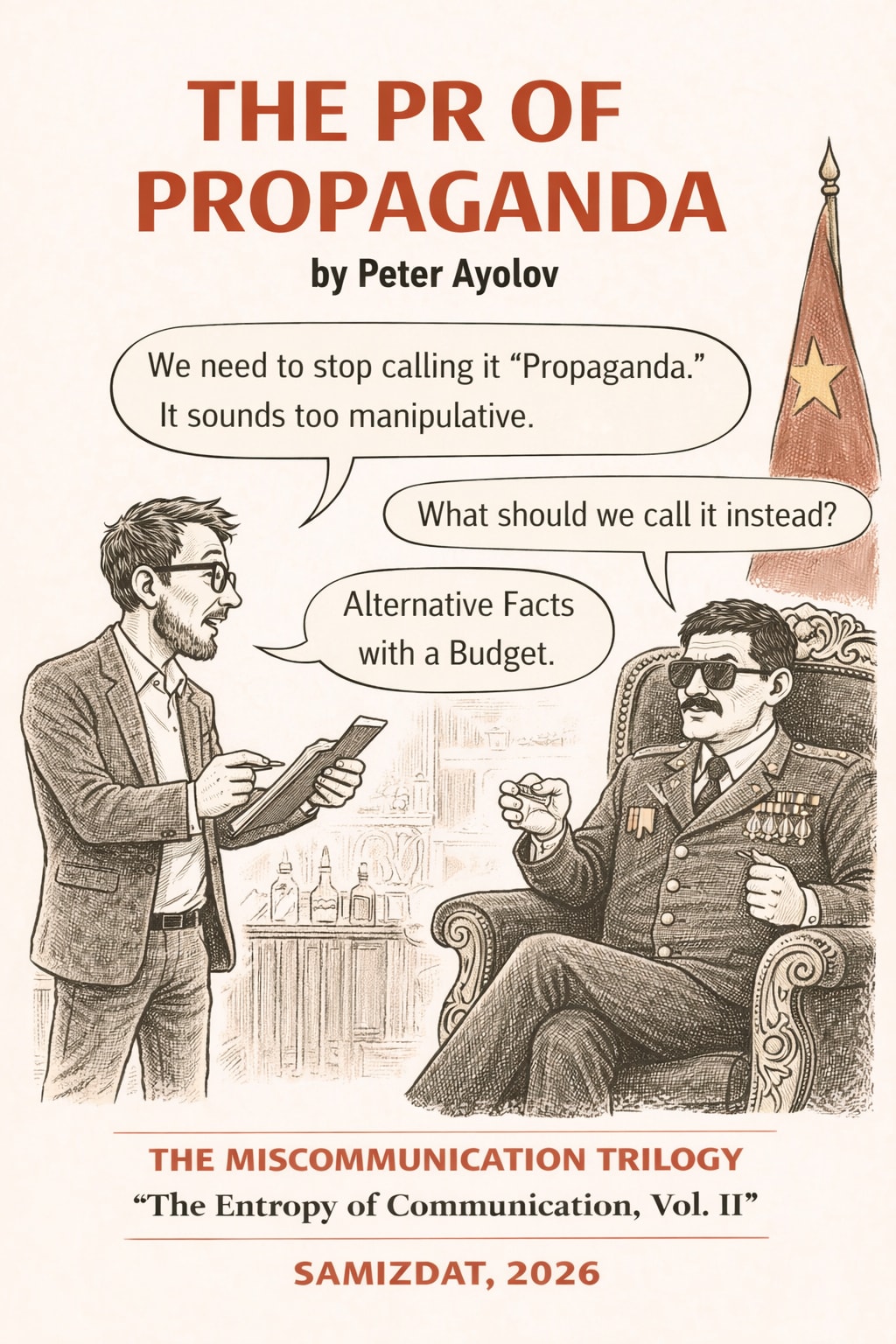
The Machinery of Persuasion and the Collapse of Meaning
The Architecture of Invisible Power
THE PR OF PROPAGANDA stands as one of the most ambitious and philosophically unsettling entries in THE MISCOMMUNICATION TRILOGY “The Entropy of Communication, Vol. II”. Rather than treating propaganda as a narrow political instrument associated solely with dictatorships or wartime censorship, the book presents it as the invisible operating system of modern civilization. What distinguishes this volume from conventional studies of media manipulation is its insistence that propaganda is not an exception to democratic society but one of its permanent structural conditions. Through a dense synthesis of philosophy, communication theory, political history, sociology, rhetoric, and cultural criticism, the work argues that modern communication itself has become inseparable from systems of symbolic management and psychological influence.
The central strength of the book lies in its ability to connect seemingly separate historical developments into a coherent narrative of linguistic and cultural transformation. Wartime propaganda, Cold War cultural diplomacy, advertising, public relations, corporate branding, mass entertainment, television news, celebrity culture, and social media are not treated as isolated phenomena but as stages within the same historical process. The book demonstrates that propaganda evolved gradually from explicit ideological campaigns into a subtle, normalized atmosphere embedded within everyday communication. By tracing this evolution across institutions, technologies, and political systems, the author reveals how modern society slowly transformed persuasion into a permanent condition of existence.
Particularly impressive is the book’s treatment of the First World War as a decisive turning point in the history of communication. The analysis of the Committee on Public Information, George Creel’s propaganda apparatus, and Walter Lippmann’s subsequent disillusionment illustrates how governments discovered the unprecedented power of mass psychological mobilization. The work convincingly argues that the war did not merely produce propaganda techniques but fundamentally altered the relationship between language and reality. Communication ceased to function primarily as a means of transmitting information and instead became an instrument for engineering emotional consent.
The discussion of Walter Lippmann is especially nuanced. Rather than reducing him to either a democratic idealist or an elitist critic of the masses, the book presents him as a tragic figure who recognized too late that the modern citizen experiences political reality almost entirely through mediated representations. Lippmann’s notion of “pseudo-environments” becomes one of the conceptual anchors of the volume. The book repeatedly returns to the idea that modern individuals no longer engage directly with reality but navigate symbolic constructions produced by institutions, media systems, and public relations networks. This insight gives the work a distinctly contemporary resonance, particularly in relation to digital culture and algorithmic communication.
Equally compelling is the book’s treatment of Edward Bernays and the emergence of public relations. Rather than portraying public relations as a neutral professional discipline, the text interprets it as the continuation of wartime propaganda by commercial means. Bernays becomes emblematic of a civilization that redirected techniques of psychological warfare toward consumer culture and political image management. The author persuasively demonstrates that modern advertising and branding are not merely economic activities but systems for organizing desire, identity, and emotional orientation.
The book’s historical breadth is remarkable. It moves fluidly from the propaganda ministries of the Great War to the Cold War networks surrounding the Congress for Cultural Freedom, the Marshall Plan productivity campaigns, Atlanticist intellectual organizations, and the covert collaboration between state agencies and private cultural institutions. These sections are among the strongest in the volume because they reveal how persuasion increasingly operated through unofficial channels disguised as independent cultural activity. The discussion of the “state-private network” effectively dissolves simplistic distinctions between government propaganda and private communication. Foundations, universities, think tanks, artistic movements, and media corporations emerge as interconnected components within a broader system of ideological administration.
What makes these analyses particularly effective is the author’s refusal to embrace simplistic conspiracy narratives. The book does not argue that every intellectual, artist, or institution consciously served hidden political masters. Instead, it shows how individuals operating sincerely within cultural systems could still become participants in broader structures of symbolic influence. This gives the work a degree of philosophical sophistication often absent from critiques of propaganda. The problem is not merely deception but institutional integration itself.
Language as Psychological Territory
The philosophical core of THE PR OF PROPAGANDA lies in its treatment of language not as a stable medium of truth but as contested psychological territory. Throughout the book, words appear increasingly detached from fixed meanings and transformed into flexible instruments of persuasion. Terms such as democracy, freedom, justice, progress, and security no longer function as coherent concepts but as symbolic devices whose meanings shift according to institutional interests and emotional framing.
The author repeatedly returns to the notion of the planned obsolescence of language. This concept serves as the organizing principle of the volume and gives it a distinctive intellectual identity within contemporary propaganda studies. The argument is not merely that language is manipulated, but that modern communication systems actively accelerate the exhaustion of meaning itself. Words circulate with increasing speed and intensity while becoming progressively emptier. Communication multiplies, yet understanding deteriorates. The result is a society saturated with information but deprived of interpretive stability.
The sections devoted to Kenneth Burke are particularly insightful in this regard. Burke’s theories of identification, implicit propaganda, and symbolic action are used to demonstrate how persuasion functions most effectively when it appears natural rather than coercive. The book carefully explains Burke’s insight that propaganda succeeds not by imposing alien ideas but by embedding itself within existing emotional structures, cultural values, and linguistic habits. This emphasis on subtle integration allows the work to move beyond simplistic models of propaganda as mere deception. Propaganda becomes a form of symbolic participation that recruits individuals into systems of emotional and ideological alignment.
The analysis of Jacques Ellul further deepens the philosophical dimensions of the book. Ellul’s concept of sociological propaganda is employed to explain how modern societies generate conformity not only through explicit political messaging but through the ordinary rhythms of social life itself. Cinema, advertising, education, consumer culture, and technological systems all contribute to what the book describes as an immersive environment of psychological integration. Particularly effective is the discussion of Ellul’s distinction between agitation propaganda and integration propaganda. The work argues that contemporary democracies rely far less on overt ideological mobilization than on the gradual normalization of behaviors, assumptions, and emotional responses through media saturation and institutional repetition.
The sections concerning mass society and media culture are among the most disturbing in the volume. Drawing heavily upon C. Wright Mills, the author presents the transition from a society of publics to a society of masses as one of the defining crises of modernity. In earlier democratic models, public life depended upon reciprocal discussion among relatively autonomous citizens. In mass society, however, communication becomes overwhelmingly one-directional. A small number of institutions broadcast symbolic narratives to vast populations whose participation is largely passive and emotionally reactive.
Television occupies a central role within this transformation. The book presents television not simply as a communication technology but as a psychological environment that restructures perception itself. The visual immediacy of television reduces complex political realities into simplified emotional spectacles. News becomes theatrical performance. Public discourse becomes inseparable from entertainment logic. The citizen increasingly relates to political life as a spectator rather than a participant.
The author extends this analysis convincingly into the digital age. Social media platforms, algorithmic recommendation systems, data surveillance, and permanent informational stimulation intensify the tendencies already visible in earlier forms of mass communication. The distinction between producer and consumer collapses as individuals themselves become active participants in the circulation of propaganda. The individual becomes simultaneously audience, product, and propagandist within systems designed to maximize emotional engagement and behavioral predictability.
One of the most intellectually provocative sections concerns Paul de Man and the politics of misreading. Here the book enters more abstract philosophical territory, arguing that propaganda exploits not only ignorance but the inherent instability of interpretation itself. Every act of reading contains the possibility of distortion. Propaganda therefore operates not simply through lies but through the imposition of singular meanings upon inherently ambiguous realities. This argument gives the work unusual theoretical depth, linking literary criticism to political manipulation in a way that recalls broader post-structuralist critiques of meaning and representation.
The Entropy of Democratic Communication
Perhaps the most powerful achievement of THE PR OF PROPAGANDA is its ability to present propaganda not as an isolated pathology but as the defining atmosphere of contemporary democratic life. The book rejects comforting distinctions between authoritarian propaganda and democratic communication. Instead, it argues that modern democracies increasingly rely upon sophisticated systems of perception management, emotional engineering, and symbolic coordination in order to maintain legitimacy within mass societies.
The sections devoted to the American power structure are especially effective in illustrating this point. Drawing on C. Wright Mills’s concept of the power elite, the book demonstrates how economic, military, political, and media institutions gradually converged into interconnected systems of influence. The public sphere becomes dominated by coordinated symbolic narratives produced through overlapping institutional networks. Public relations replaces political philosophy. Marketing logic invades governance. Celebrity culture distracts attention from structural power.
Yet the book avoids simplistic determinism. It does not portray the public as completely helpless victims of manipulation. Instead, it emphasizes the psychological and cultural conditions that make propaganda effective. Individuals seek reassurance, belonging, identity, and emotional stability within increasingly fragmented societies. Propaganda succeeds because it satisfies these needs while simultaneously narrowing the range of acceptable interpretation and political imagination.
The work’s critique of contemporary liberal democracy is particularly sharp. The author argues that democratic systems increasingly depend upon emotional management rather than substantive public deliberation. Citizens are inundated with information yet deprived of meaningful participation in decision-making processes. Communication expands quantitatively while contracting qualitatively. Political language becomes dominated by slogans, branding strategies, public relations techniques, and moral simplifications designed for rapid media circulation rather than reflective analysis.
The book’s treatment of celebrity culture is also noteworthy. Celebrity functions as both distraction and ideological mechanism. Public attention becomes fixated upon personalities, scandals, spectacles, and emotional dramas while structural forms of power remain largely invisible. This analysis recalls earlier critiques of spectacle society yet is updated effectively for the contemporary media environment.
Stylistically, the book maintains a dense and philosophical tone throughout, which suits its subject matter. The prose is highly analytical yet frequently lyrical in its descriptions of communication collapse and symbolic decay. At times the argument risks becoming overwhelming due to the sheer accumulation of theoretical references and historical examples. Yet this density also reinforces the central thesis: that propaganda today operates through saturation rather than isolated interventions.
What ultimately distinguishes THE PR OF PROPAGANDA from many contemporary critiques of media and ideology is its insistence that the deepest crisis is linguistic rather than merely political. The erosion of democratic culture originates in the degradation of communication itself. When language becomes permanently subordinated to persuasion, emotional stimulation, and strategic ambiguity, society loses its capacity for shared reality. Public discourse fragments into competing symbolic tribes incapable of mutual understanding. Information abundance produces interpretive paralysis. Communication enters entropy.
The book concludes not with optimism but with a sober recognition that propaganda cannot simply be abolished. Persuasion is inseparable from collective life. The challenge is therefore not the elimination of propaganda but the defense of spaces where language can still sustain ambiguity, reflection, historical memory, and genuine dialogue. This final insight gives the work its philosophical seriousness. THE PR OF PROPAGANDA is not merely a history of manipulation but a meditation on the fragility of meaning itself in an age dominated by institutional persuasion and technological mediation.
In the end, the book succeeds because it transforms propaganda from a narrow political topic into a comprehensive theory of modern civilization. It reveals how communication, once imagined as the foundation of democratic understanding, has increasingly become the mechanism through which reality itself is administered, fragmented, and controlled. Few contemporary works confront this transformation with such breadth, intellectual ambition, and philosophical intensity.
About the Creator
Peter Ayolov
Peter Ayolov’s key contribution to media theory is the development of the "Propaganda 2.0" or the "manufacture of dissent" model, which he details in his 2024 book, The Economic Policy of Online Media: Manufacture of Dissent.
Enjoyed the story? Support the Creator.
Subscribe for free to receive all their stories in your feed.
Comments
There are no comments for this story
Be the first to respond and start the conversation.