
McLuhan Is The Message, THE MISCOMMUNICATION TRILOGY, “The Entropy of Communication, Vol. II”, Part 17
Book Review

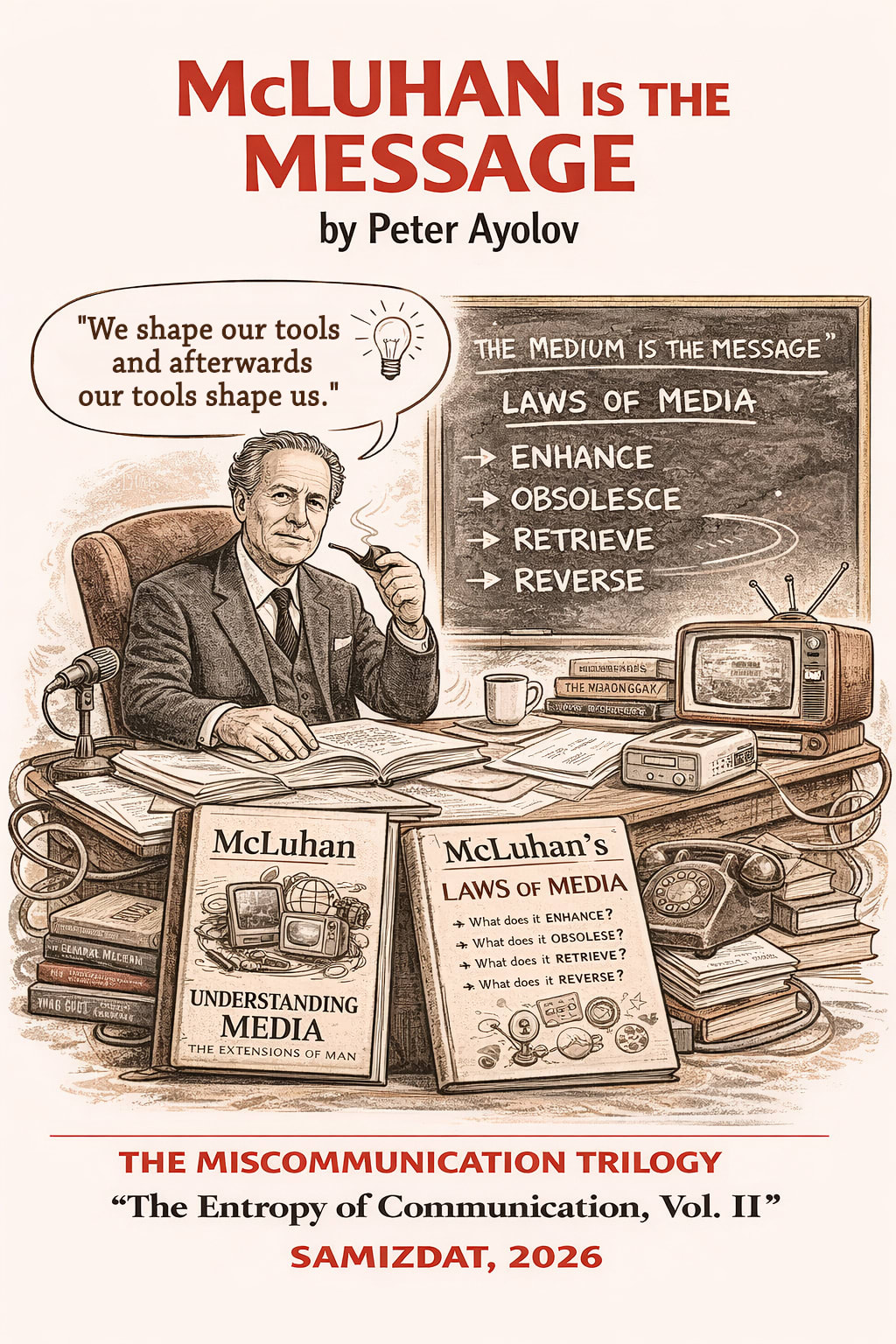
The Medium Of Disappearance: A Review Of McLuhan Is The Message
Media as environments of consciousness
McLuhan Is the Message, part of THE MISCOMMUNICATION TRILOGY: “The Entropy of Communication, Vol. II,” is not a conventional study of communication theory, nor is it merely an intellectual tribute to Marshall McLuhan. Instead, the work attempts something considerably more ambitious: it transforms McLuhan’s central insight into the organizing principle for a broader philosophical investigation concerning language, media, technological systems, and the fate of human consciousness itself. Rather than treating communication as a neutral exchange of information between individuals, the book repeatedly argues that communication environments function as hidden architectures shaping human experience long before any specific content reaches awareness. In this sense the work pushes beyond ordinary media criticism and enters territory traditionally occupied by philosophy, anthropology, and cultural theory.
The central proposition guiding the text is deceptively simple yet profound: language itself may be entering a stage of planned obsolescence. Throughout industrial history planned obsolescence referred to the deliberate construction of products designed to become outdated or disposable. McLuhan Is the Message extends this principle into symbolic culture and asks whether language itself increasingly functions according to similar mechanisms. The question immediately destabilizes traditional assumptions. Human beings have long regarded language as a force of continuity, preservation, and permanence. Through language civilizations sustain memory, communities preserve identity, and individuals transmit values across generations. Yet the contemporary communication landscape increasingly suggests another possibility. Language may no longer function primarily as an instrument of preservation but rather as a rapidly circulating symbolic commodity subject to acceleration, exhaustion, and replacement.
What distinguishes this work is its insistence that communication technologies are never merely external tools. The book repeatedly returns to McLuhan’s proposition that media are environments rather than instruments. Technologies alter human consciousness not because of what they explicitly communicate but because they transform the sensory conditions within which communication occurs. This insight becomes the conceptual foundation upon which the entire project rests. The author demonstrates that modern technological environments reshape attention, memory, perception, and social life while largely escaping conscious observation. Human beings become fascinated by messages while remaining blind to the invisible systems organizing those messages.
The text skillfully reconstructs McLuhan’s major concerns while extending them into contemporary contexts. Digital systems, algorithmic environments, informational acceleration, and symbolic fragmentation emerge not as isolated developments but as interconnected manifestations of a larger transformation. Communication increasingly becomes characterized by simultaneity rather than sequence, circulation rather than permanence, and reaction rather than reflection. Information expands while coherence appears increasingly unstable. Particularly compelling is the argument that contemporary society increasingly inhabits environments of symbolic abundance coupled with existential fragmentation. Human beings possess access to greater quantities of information than any previous civilization, yet this expansion does not necessarily generate deeper understanding. Communication intensifies while meaningful connection often remains elusive. Connectivity expands while symbolic coherence contracts. The paradox identified throughout the text is that greater informational access does not automatically create greater meaning.
The intellectual ambition of this section lies in its refusal to reduce technological transformations to simplistic narratives of progress or decline. Technologies are neither condemned nor celebrated. Instead they are approached as environmental conditions reshaping consciousness itself. This framework allows the work to move beyond technological optimism and technological pessimism toward a more nuanced investigation of the structures governing contemporary communication.
Entropy and the crisis of symbolic life
The strongest sections of McLuhan Is the Message emerge when the discussion turns toward entropy and symbolic deterioration. Here the book develops one of its most original contributions by arguing that communication itself increasingly operates according to entropic principles. Traditionally entropy referred to the tendency of physical systems toward disorder. Within this work entropy becomes a broader cultural concept describing fragmentation, symbolic exhaustion, and the weakening of meaningful continuity.
This framework enables the text to address one of the most pressing conditions of contemporary existence: the apparent paradox whereby communication expands while understanding diminishes. Human beings increasingly inhabit environments saturated with signals, images, notifications, and informational flows. Yet the proliferation of communication often produces experiences not of enrichment but of exhaustion. Meaning itself risks becoming unstable beneath accelerating symbolic circulation. The book argues persuasively that language historically functioned as humanity’s principal resistance against entropy. Through speech and writing individuals transformed transient experiences into enduring symbolic forms. Language enabled memory to survive mortality. Communities sustained continuity through shared narratives. Human beings constructed identities through symbolic structures capable of preserving meaning across time.
Modern communication systems increasingly challenge these conditions. Language now often resembles consumable media rather than enduring cultural inheritance. Expressions emerge rapidly, dominate attention briefly, and disappear beneath new symbolic formations. Trends become obsolete before acquiring historical significance. Words circulate continuously but frequently fail to establish lasting structures of meaning. The work repeatedly returns to the theme of acceleration. Speed no longer merely characterizes technological systems; speed becomes a governing principle organizing social existence itself. Information travels instantly. Reaction becomes mandatory. Reflection increasingly appears inefficient. Human beings encounter a world structured through immediacy rather than duration.
This analysis resonates strongly with broader traditions of twentieth-century critical thought. One detects echoes of thinkers concerned with technological rationalization, symbolic alienation, and the transformation of modern consciousness. Yet the book avoids becoming derivative because it consistently returns these concerns toward communication itself. The primary crisis under investigation is not merely technological but linguistic. Human beings increasingly risk inhabiting symbolic environments where permanence becomes difficult to sustain. Particularly noteworthy is the text’s treatment of silence. Silence appears not as absence but as an essential condition enabling reflection and symbolic depth. Contemporary communication environments increasingly dissolve such spaces through perpetual informational stimulation. Signals continuously compete for attention, leaving little room for contemplation or symbolic consolidation.
The argument suggests that silence historically functioned as an invisible framework supporting human thought. Reflection required intervals separating experience from interpretation. Contemporary communication environments increasingly eliminate these intervals. Human beings risk becoming responders rather than interpreters, reactors rather than thinkers. The significance of this argument extends beyond media theory. The disappearance of silence becomes linked to transformations affecting cognition itself. Human beings increasingly inhabit environments favoring immediacy over contemplation and circulation over understanding. Communication thus risks becoming detached from its deeper symbolic functions.
The future of language and the struggle for meaning
Ultimately McLuhan Is the Message directs its attention toward questions extending beyond communication theory into broader concerns regarding identity, culture, and human existence. Beneath discussions of technology and media lies a deeper anxiety concerning humanity’s symbolic future. The central question becomes whether language itself can continue functioning as a medium of continuity under conditions increasingly governed by acceleration and fragmentation.
The work repeatedly returns to the image of Babel, not as a theological myth but as a symbolic model for contemporary existence. Traditional interpretations portray Babel as a multiplication of languages producing misunderstanding and separation. The contemporary condition appears more paradoxical. Human beings increasingly share technological systems while simultaneously inhabiting divergent symbolic realities. Communication networks unite physical spaces while fragmenting interpretive worlds. This reinterpretation proves especially effective because it captures a defining contradiction of contemporary life. Human beings experience unprecedented forms of connection while simultaneously confronting increasing difficulties sustaining common structures of meaning. Shared environments do not automatically produce shared realities.
The conclusion of the work refuses simple solutions. It does not advocate withdrawal from technology or nostalgic return to earlier communication forms. Instead the book argues for awareness itself. Human beings must learn to perceive communication environments rather than unconsciously inhabit them. Technologies become dangerous not because they exist but because they remain invisible. McLuhan’s enduring significance emerges precisely here. His work redirected attention from content toward environments and from messages toward structures. McLuhan Is the Message extends this insight into a broader reflection concerning symbolic life under contemporary conditions.
One of the most compelling strengths of the text lies in its capacity to synthesize diverse intellectual traditions into a coherent framework. Media theory intersects with philosophy, linguistics, anthropology, mythology, and communication studies without producing conceptual fragmentation. Rather than functioning as isolated references, these disciplines become integrated components within a larger investigation concerning the destiny of language itself. If there exists a challenge for readers, it may lie in the ambitious scope of the project. The text often moves through wide conceptual territories and occasionally privileges philosophical synthesis over empirical specificity. Yet this expansiveness also constitutes one of its principal strengths. The work does not seek merely to describe communication phenomena but to understand their implications for human existence.
McLuhan Is the Message ultimately presents itself as more than an academic exploration of media environments. It becomes a meditation upon humanity’s symbolic condition during an age increasingly governed by technological acceleration. Beneath its discussions of communication lies a more urgent concern: whether meaning itself can endure within environments increasingly structured through impermanence. The result is a philosophically ambitious and intellectually provocative work that transforms McLuhan’s insights into a broader meditation on communication, identity, and cultural survival. It suggests that the future struggle may concern not technological innovation but symbolic preservation itself. Human beings already possess unprecedented capacities for producing signals. The greater challenge may involve preserving the conditions under which meaning continues to survive.
About the Creator
Peter Ayolov
Peter Ayolov’s key contribution to media theory is the development of the "Propaganda 2.0" or the "manufacture of dissent" model, which he details in his 2024 book, The Economic Policy of Online Media: Manufacture of Dissent.
Enjoyed the story? Support the Creator.
Subscribe for free to receive all their stories in your feed.
Comments
There are no comments for this story
Be the first to respond and start the conversation.