
Online Media Ecology, THE MISCOMMUNICATION TRILOGY, “The Entropy of Communication, Vol. II”, Part 18
Book Review

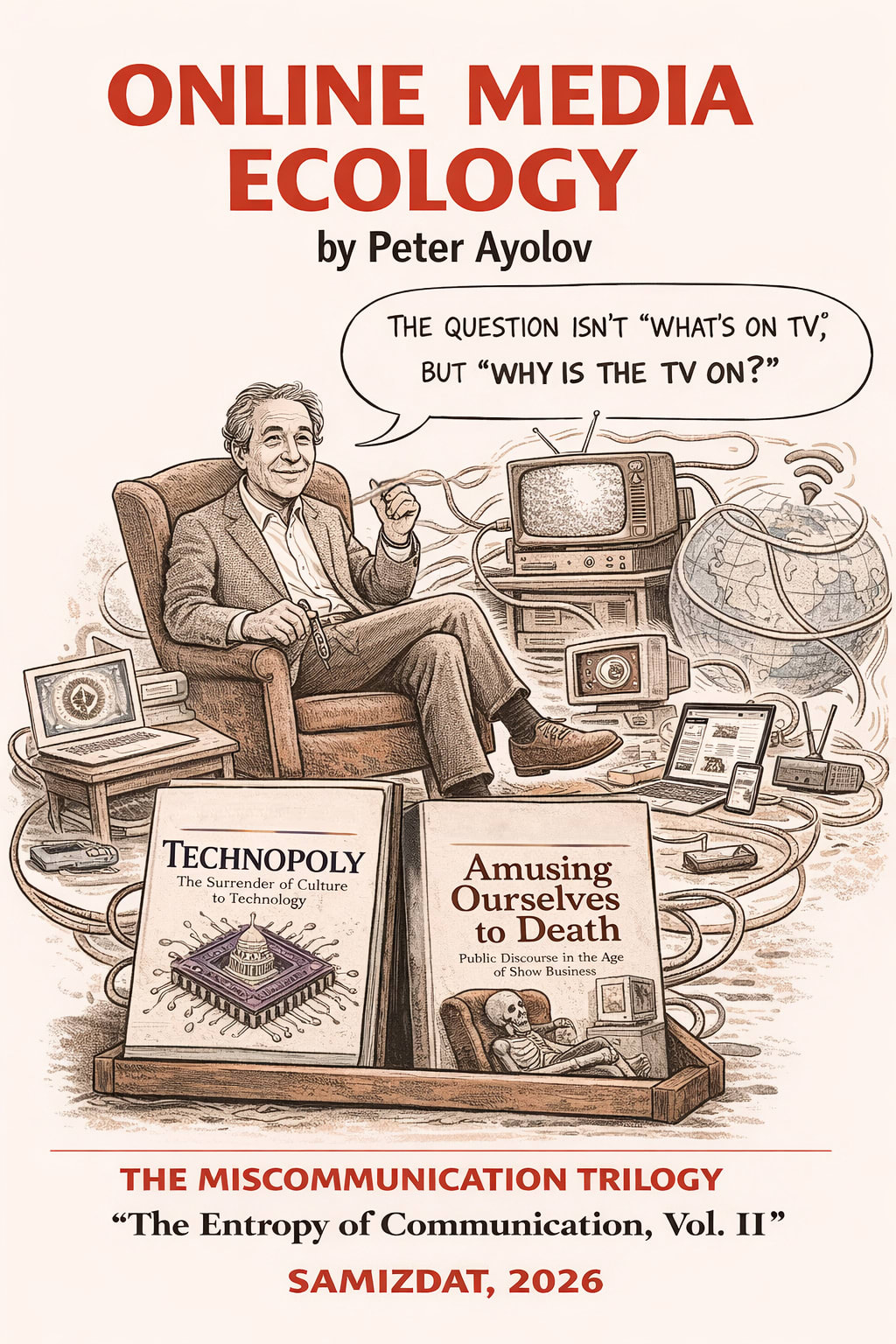
Online Media Ecology: The Entropy of Language
The Collapse of Symbolic Civilization
Online Media Ecology, part of THE MISCOMMUNICATION TRILOGY “The Entropy of Communication, Vol. II,” is an ambitious and philosophically dense examination of the relationship between media, language, technology, and the gradual destabilization of human consciousness in the digital age. Drawing heavily from the traditions of media ecology associated with Marshall McLuhan, Neil Postman, Harold Innis, Walter Ong, Eric Havelock, and related thinkers, the book develops a broad cultural critique centered around one of its most important concepts: the Planned Obsolescence of Language. This idea functions as the central organizing principle of the entire work and gives the book its distinctive intellectual identity. Rather than approaching media simply as neutral technologies that transmit information, the book treats communication systems as environments that restructure perception itself. This perspective allows the author to move beyond conventional criticism of television or social media and instead examine how media reshape memory, morality, political judgment, childhood, identity, and the structure of reality. The work consistently argues that the transition from print culture to electronic and digital media represents not merely technological progress but a transformation in the symbolic foundations of civilization.
One of the book’s strongest achievements lies in its ability to synthesize multiple intellectual traditions into a coherent narrative about the decline of meaningful discourse. The analysis of television culture, semantic confusion, commercialization, fanaticism, propaganda, information overload, and digital fragmentation is unified through the recurring argument that language is increasingly detached from continuity, rationality, and historical memory. The author repeatedly demonstrates that communication technologies do not merely carry messages but actively shape the forms of thought available within a culture. The sections influenced by Neil Postman are particularly effective. Discussions of the disappearance of childhood, the rise of the adult-child civilization, and the transformation of politics into entertainment are integrated into a broader theory of cultural entropy. The book convincingly argues that electronic media dissolve traditional symbolic boundaries between adulthood and childhood, seriousness and entertainment, education and spectacle. In this framework, television and digital media no longer preserve social hierarchies of knowledge but flatten all discourse into emotionally accessible images and simplified narratives.
The critique of modern information culture is another major strength of the book. Online Media Ecology repeatedly emphasizes that modern societies are not suffering from lack of information but from excess information disconnected from context and wisdom. The distinction between information, knowledge, and wisdom becomes central throughout the text. Information without organization becomes noise; knowledge without ethical orientation becomes manipulation; communication without memory becomes entropy. This argument is developed carefully through discussions of news media, commercials, social media, and political discourse. A particularly compelling aspect of the book is its treatment of language itself. Influenced by general semantics, media theory, and linguistic philosophy, the text presents language not as a transparent tool but as a symbolic environment shaping perception and behavior. The long sections devoted to semantic environments, reification, metaphor fixation, and crazy or stupid talk offer a detailed exploration of how language structures reality. These discussions give the work a philosophical depth that separates it from conventional critiques of media culture. The book repeatedly insists that modern civilization is experiencing not simply political or cultural instability but semantic instability—the collapse of shared meaning itself.
The author’s writing style mirrors the seriousness of the themes being explored. The prose is dense, expansive, and highly conceptual, often resembling philosophical cultural criticism more than standard media analysis. The text consistently prioritizes intellectual continuity over fragmented academic specialization. Instead of isolating technology, politics, psychology, and language into separate disciplines, the work treats them as interconnected dimensions of one larger media environment. This gives the book an unusual coherence despite the wide range of topics discussed. At its best moments, Online Media Ecology succeeds in creating a sense of civilizational urgency. The argument that digital culture produces a new Tower of Babble—where communication expands while understanding collapses—is developed with remarkable consistency throughout the work. The image of societies overwhelmed by endless communication yet deprived of meaning functions as both a philosophical warning and a cultural diagnosis. The author’s concern is not simply misinformation or propaganda but the erosion of the symbolic structures necessary for rational civilization itself.
The Adult-Child Civilization
A major theme running through the book is the argument that electronic media have fundamentally altered the distinction between adulthood and childhood. This section of the work, heavily influenced by Neil Postman’s The Disappearance of Childhood, is one of the most powerful and intellectually coherent aspects of the entire volume. The book argues that literacy-based societies created adulthood through the gradual acquisition of symbolic knowledge, discipline, secrecy, and intellectual maturity. Childhood existed because access to adult knowledge required years of education and symbolic initiation. Television and digital media, however, eliminate these barriers by exposing everyone simultaneously to the same symbolic environment. The result is not merely the disappearance of childhood but the collapse of adulthood itself. The author introduces the concept of the adult-child civilization, describing societies in which emotional reaction, entertainment logic, impulsive consumption, and fragmented attention replace the reflective habits cultivated by print culture.
The discussion of television news and commercial media is particularly effective in illustrating this transformation. News becomes spectacle, politics becomes emotional theater, and public discourse increasingly resembles entertainment programming. The author argues convincingly that modern media systems reward emotional immediacy rather than rational reflection, producing populations trained to react continuously without historical or conceptual depth. This argument is reinforced through repeated examinations of commercials, celebrity culture, reenactments, docudramas, and sensationalist news structures. The analysis of advertising deserves special attention because the book treats commercials not merely as economic tools but as symbolic narratives shaping cultural values. Commercials are described as modern parables teaching societies how to desire, consume, and define happiness. This interpretation aligns closely with the broader argument concerning the Planned Obsolescence of Language. In the media environment described by the book, language increasingly functions to stimulate desire and emotional reaction rather than communicate durable meaning.
One of the most striking features of the work is its ability to connect media forms with psychological and political consequences. The argument is not simply that media influence opinions, but that they restructure the conditions under which thought itself occurs. Television and digital media favor immediacy, simultaneity, emotional intensity, and visual stimulation. Print culture favored sequence, abstraction, reflection, and continuity. The book repeatedly returns to this distinction and uses it to explain changes in political discourse, education, morality, and public life. The sections discussing semantic environments and communication theory deepen the book’s philosophical foundation. Drawing from thinkers such as Alfred Korzybski, Edward Sapir, Benjamin Lee Whorf, and George Herbert Mead, the text emphasizes that human beings do not simply inhabit physical environments but symbolic ones. Language organizes perception, defines categories, and structures social reality. This insight becomes essential to the book’s broader critique of digital culture. When symbolic systems become fragmented or commercialized, societies lose the ability to maintain coherent public discourse.
The exploration of fanaticism, role fixation, and ideological systems is also particularly effective. The author consistently argues that media environments encourage simplification and absolutism because simplified narratives circulate more efficiently within accelerated communication systems. Social media platforms amplify emotional certainty and tribal identity while discouraging ambiguity and reflection. Under such conditions, political and ideological discourse increasingly resembles mythology rather than rational debate. At several moments, the book achieves an almost prophetic tone. The description of societies drowning in information while starving for meaning captures one of the defining contradictions of the digital age. The author repeatedly warns that communication technologies designed to connect humanity may instead generate fragmentation, isolation, and semantic collapse. This warning gives the book emotional intensity as well as philosophical seriousness.
The Return of Babble
The final achievement of Online Media Ecology lies in its broader philosophical vision. The book is not merely a critique of media technology but a meditation on the future of civilization under conditions of symbolic instability. Throughout the work, the recurring metaphor of Babble or Babel functions as a powerful organizing image. Humanity becomes increasingly interconnected technologically while simultaneously losing the capacity for shared understanding. Communication expands infinitely while meaning disintegrates.
The concept of the Planned Obsolescence of Language is especially important because it transforms the book from simple cultural criticism into a larger theory of civilizational entropy. The argument suggests that modern communication systems systematically undermine the stability of language itself by privileging novelty, speed, emotionality, and fragmentation. Words lose permanence because media systems reward circulation over reflection. Public discourse becomes increasingly performative rather than meaningful. The author’s discussion of digital media ecosystems is especially persuasive in this regard. Online platforms create conditions where visibility becomes more important than truth, emotional engagement more valuable than intellectual coherence, and reaction more profitable than contemplation. The result is a semantic environment characterized by instability and acceleration. Every discourse competes for attention within systems optimized for distraction.
One of the book’s most important strengths is its insistence on historical continuity. Rather than treating contemporary digital culture as entirely unprecedented, the work traces its origins through television, print culture, oral culture, and earlier communication revolutions. This historical depth allows the book to situate online media ecology within a larger narrative of symbolic transformation extending from the printing press to algorithmic communication systems. The writing style itself contributes significantly to the intellectual atmosphere of the book. The prose is intentionally dense, academic, and philosophical, often resembling the style of twentieth-century cultural critics rather than contemporary journalistic media analysis. This approach may challenge some readers, but it reinforces the seriousness of the themes being explored. The work demands sustained attention and reflection, which aligns with its broader defense of literacy and intellectual continuity against the fragmenting tendencies of digital media.
The strongest sections are those where the author combines philosophical analysis with concrete cultural examples. Discussions of television commercials, news formats, role structures, semantic confusion, and public discourse provide tangible illustrations of the broader theoretical arguments. These examples prevent the text from becoming entirely abstract and ground its philosophical claims within recognizable cultural phenomena. At the same time, the book occasionally risks excessive conceptual repetition, particularly around themes of entropy, fragmentation, and semantic collapse. However, this repetition also contributes to the cumulative force of the argument. The recurring themes create the impression of a civilization trapped within reinforcing cycles of acceleration and symbolic instability.
Ultimately, Online Media Ecology succeeds because it addresses questions larger than media itself. The book is fundamentally concerned with the survival of meaningful discourse, historical memory, rational inquiry, and symbolic continuity within a civilization increasingly dominated by spectacle and informational excess. It argues that the crisis of modern society is not simply political or technological but semantic. When language loses stability, public life loses coherence. When communication becomes detached from memory and reflection, societies drift toward confusion and fragmentation. The book’s conclusion leaves the reader with a profound sense of urgency. The digital age is presented not merely as a technological transition but as a transformation in the conditions of human consciousness itself. Yet the work also offers implicit forms of resistance through literacy, reflection, historical awareness, and critical inquiry. The defense of books, memory, disciplined thought, and semantic precision becomes a defense of civilization against entropy.
Online Media Ecology stands as a serious and intellectually ambitious contribution to media theory and cultural criticism. Combining philosophy, communication studies, linguistics, sociology, and media ecology, the book offers a sweeping examination of how digital civilization reshapes language and consciousness. Its central warning is both simple and profound: a society overwhelmed by communication may ultimately lose the capacity for understanding.
About the Creator
Peter Ayolov
Peter Ayolov’s key contribution to media theory is the development of the "Propaganda 2.0" or the "manufacture of dissent" model, which he details in his 2024 book, The Economic Policy of Online Media: Manufacture of Dissent.
Enjoyed the story? Support the Creator.
Subscribe for free to receive all their stories in your feed.
Comments
There are no comments for this story
Be the first to respond and start the conversation.