
Degeneration of Words, THE MISCOMMUNICATION TRILOGY, “The Entropy of Communication, Vol. II”, Part 19
Book Review

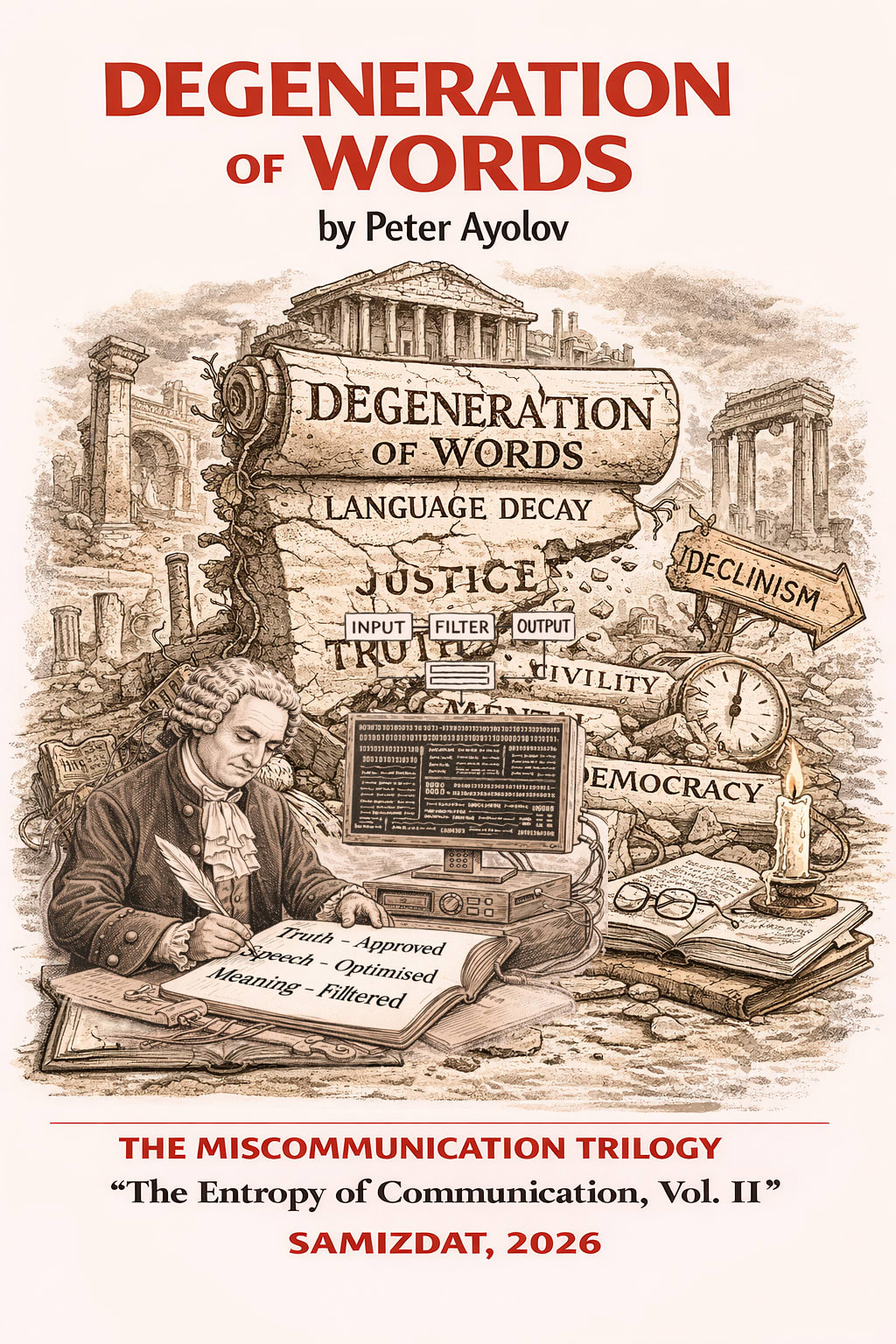
Echoes of Babel: A Review of The Degeneration of Words
The Degeneration of Words, Part 19 of THE MISCOMMUNICATION TRILOGY “The Entropy of Communication, Vol. II,” is an ambitious and intellectually expansive examination of the collapse of language in contemporary society. Positioned at the intersection of philosophy, linguistics, media ecology, critical theory, sociology, and political analysis, the book explores how modern communication systems have transformed language from a medium of understanding into a mechanism of manipulation, fragmentation, and ideological conflict. Rather than approaching language merely as a neutral instrument for transmitting information, the work argues that words themselves have become unstable commodities circulating through systems of mass media, digital technology, and political spectacle. The result is a civilization trapped within what the author repeatedly frames as the entropy of communication—a process through which meaning gradually dissolves under the pressure of technological acceleration and ideological saturation.
One of the book’s greatest strengths lies in its ability to synthesize a vast range of intellectual traditions into a coherent narrative about the degeneration of meaning. Thinkers such as Antonio Gramsci, Herbert Marcuse, Georg Lukács, Max Horkheimer, Theodor Adorno, Jürgen Habermas, Walter Benjamin, Wittgenstein, Baudrillard, and Marshall McLuhan are woven into a broader argument concerning the planned obsolescence of language. Rather than treating these figures as isolated academic authorities, the book demonstrates how their theories collectively illuminate the modern crisis of communication. Particularly compelling is the way the text connects the Frankfurt School’s critique of instrumental reason with contemporary digital culture. The transformation of language into a functionalized and commodified system mirrors the broader transformation of society into a spectacle dominated by algorithmic logic, behavioral contagion, and symbolic manipulation.
The book’s central thesis—that language itself is undergoing planned obsolescence—is especially provocative. Drawing parallels between industrial capitalism’s production of disposable commodities and digital culture’s production of disposable meanings, the author argues that modern societies no longer preserve linguistic continuity. Instead, communication systems constantly generate temporary vocabularies, slogans, hashtags, ideological labels, and emotional signals designed for immediate circulation and rapid replacement. This process creates a society overwhelmed by communication yet increasingly incapable of sustaining shared understanding. In this sense, The Degeneration of Words functions not merely as a critique of language but as a diagnosis of civilizational decline. The text repeatedly returns to the image of a new Tower of Babel, not characterized by silence or linguistic separation, but by excessive communication without comprehension.
Language, Ideology, and the Collapse of Meaning
A major achievement of the book is its detailed exploration of how language functions as a site of ideological struggle. Drawing heavily from Gramsci’s concept of cultural hegemony and Lukács’s notion of reification, the text argues that words are never politically neutral. Language is shown to be embedded within systems of institutional power, media structures, educational systems, and technological networks that shape the boundaries of acceptable discourse. The author convincingly demonstrates how contemporary communication increasingly replaces dialectical reasoning with emotionally charged symbolic performance. Public discourse becomes less concerned with truth and more concerned with signaling identity, loyalty, outrage, or moral superiority.
The discussion of behavioral contagion and linguistic imitation in digital media is particularly insightful. The book carefully examines how social media platforms accelerate the spread of linguistic habits, ideological slogans, and performative communication patterns. Expressions, phrases, and symbols circulate virally across networks, often detached from their original meaning or historical context. In this process, language becomes increasingly reactive and fragmented. The text argues that virtue signaling, online tribalism, and algorithmically amplified outrage are not accidental distortions of communication but structural features of digital environments optimized for engagement rather than understanding.
Equally compelling is the book’s treatment of reification and false consciousness. Drawing from Marxist theory and phenomenology, the text explores how abstractions increasingly replace lived experience in modern societies. Political concepts, identities, and moral categories are transformed into rigid symbolic objects detached from concrete social realities. The book repeatedly warns that societies trapped within reified language lose their ability to distinguish between representation and reality. This insight becomes especially powerful when connected to media theory and hyperreality. The author suggests that digital communication systems create an environment in which simulations of meaning become more influential than direct experience itself.
The engagement with Marcuse’s critique of one-dimensional language further strengthens the book’s analysis. The author argues that contemporary language increasingly suppresses contradiction, ambiguity, and dialectical tension in favor of functional, simplified communication optimized for technological circulation. In such a society, words lose their depth and become operational signals serving bureaucratic, ideological, or commercial purposes. The result is a form of communicative flattening in which critical thought becomes increasingly difficult because language itself no longer supports complexity. This interpretation gives the book a strong philosophical coherence and allows it to move beyond mere cultural criticism into a broader reflection on the conditions of thought itself.
What makes the analysis particularly effective is the way it integrates historical theory with contemporary examples. The text demonstrates how earlier concerns about propaganda, mass culture, and ideological manipulation have evolved into new forms under digital capitalism. Instead of treating social media merely as a technological innovation, the book frames it as a profound transformation in the structure of communication and consciousness. The rapid circulation of fragmented linguistic forms contributes to a collective loss of memory, continuity, and semantic stability. Language no longer preserves historical experience; it becomes disposable, accelerated, and endlessly replaceable.
Critical Theory and the Entropy of Communication
The Degeneration of Words distinguishes itself from many contemporary critiques of media culture by grounding its arguments in an extensive engagement with critical theory and philosophy of language. The book does not simply lament the decline of public discourse in nostalgic terms; rather, it systematically examines the historical, technological, and ideological forces that produce communicative entropy. This gives the work both intellectual depth and theoretical consistency.
Particularly noteworthy is the book’s use of the Frankfurt School tradition to analyze the relationship between reason and communication. Drawing on Horkheimer and Adorno, the text argues that instrumental rationality has transformed language into a tool of administration, efficiency, and social control. Communication becomes subordinated to technical functionality rather than oriented toward truth or understanding. The author effectively demonstrates how this process extends into contemporary algorithmic systems, where visibility, virality, and engagement metrics shape discourse more powerfully than rational deliberation.
The comparison between Habermas and Gramsci is another major strength of the work. Habermas’s vision of communicative rationality is presented as an important but ultimately insufficient attempt to preserve democratic discourse within modern societies. Gramsci, by contrast, offers a more historically grounded perspective that recognizes how language and communication are always embedded within power relations and institutional structures. The author skillfully uses this contrast to show the limits of purely procedural approaches to communication. Rational debate cannot occur independently of the cultural and ideological conditions shaping the participants themselves.
The sections dealing with translation, language-games, and vernacular materialism further expand the scope of the book. Language is presented not merely as a symbolic system but as a historical and material practice shaped by social struggle. This perspective allows the author to critique both rigid positivism and abstract postmodern relativism. Meaning is neither fixed nor infinitely fluid; it emerges through historical praxis and collective experience. Yet in digital culture, this process becomes destabilized as communication fragments into isolated symbolic performances detached from enduring social reality.
One of the book’s most striking contributions is its treatment of communication overload. Modern societies are often described as information societies, yet the book argues that the endless expansion of communication technologies paradoxically undermines understanding itself. The more messages circulate, the harder it becomes to preserve continuity, coherence, and meaning. This idea gives the work a distinctly tragic dimension. The crisis is not simply that people communicate too little, but that they communicate too much without shared frameworks capable of sustaining interpretation. The result is semantic exhaustion—a condition in which words lose both stability and authority.
The Final Crisis of Language and Civilization
Ultimately, The Degeneration of Words succeeds because it presents the collapse of language not as an isolated linguistic issue but as a civilizational crisis. The degeneration of words reflects the degeneration of institutions, collective memory, cultural continuity, and public reason. The book repeatedly suggests that societies cannot survive indefinitely once language loses its capacity to mediate reality, preserve historical consciousness, and sustain meaningful collective dialogue.
The work’s tone is unapologetically critical and at times deeply pessimistic, yet this pessimism is grounded in a sophisticated theoretical framework rather than mere cultural nostalgia. The author does not romanticize earlier eras of communication but instead demonstrates how modern technological systems intensify longstanding tensions within capitalism, ideology, and mass media. In this sense, the book stands within the tradition of critical theory while extending it into the digital age. Perhaps the most powerful aspect of the work is its insistence that language is inseparable from human freedom. If words become entirely instrumentalized, commodified, or destabilized, then the possibility of critical thought itself begins to erode. The collapse of language becomes simultaneously a political, philosophical, and existential problem. Communication systems designed to maximize circulation and engagement ultimately undermine the reflective capacities necessary for democratic life and genuine understanding.
As a contribution to media theory, philosophy of language, and critical social analysis, The Degeneration of Words is remarkably ambitious. It combines dense theoretical discussion with contemporary cultural critique while maintaining a consistent thematic focus on semantic entropy and communicative collapse. The work will likely resonate strongly with readers interested in the Frankfurt School, Marxist cultural analysis, media ecology, linguistics, and digital culture studies. More than a study of language, the book is an inquiry into the condition of modern civilization itself. It asks whether societies can survive once words lose their connection to truth, memory, and shared reality. In confronting this question, The Degeneration of Words offers a powerful and unsettling reflection on the future of communication in the digital age.
About the Creator
Peter Ayolov
Peter Ayolov’s key contribution to media theory is the development of the "Propaganda 2.0" or the "manufacture of dissent" model, which he details in his 2024 book, The Economic Policy of Online Media: Manufacture of Dissent.
Enjoyed the story? Support the Creator.
Subscribe for free to receive all their stories in your feed.
Comments
There are no comments for this story
Be the first to respond and start the conversation.