
Storytelling, Falsification and Belief, THE MISCOMMUNICATION TRILOGY, “The Entropy of Communication, Vol. II”, Part 16
Book Review

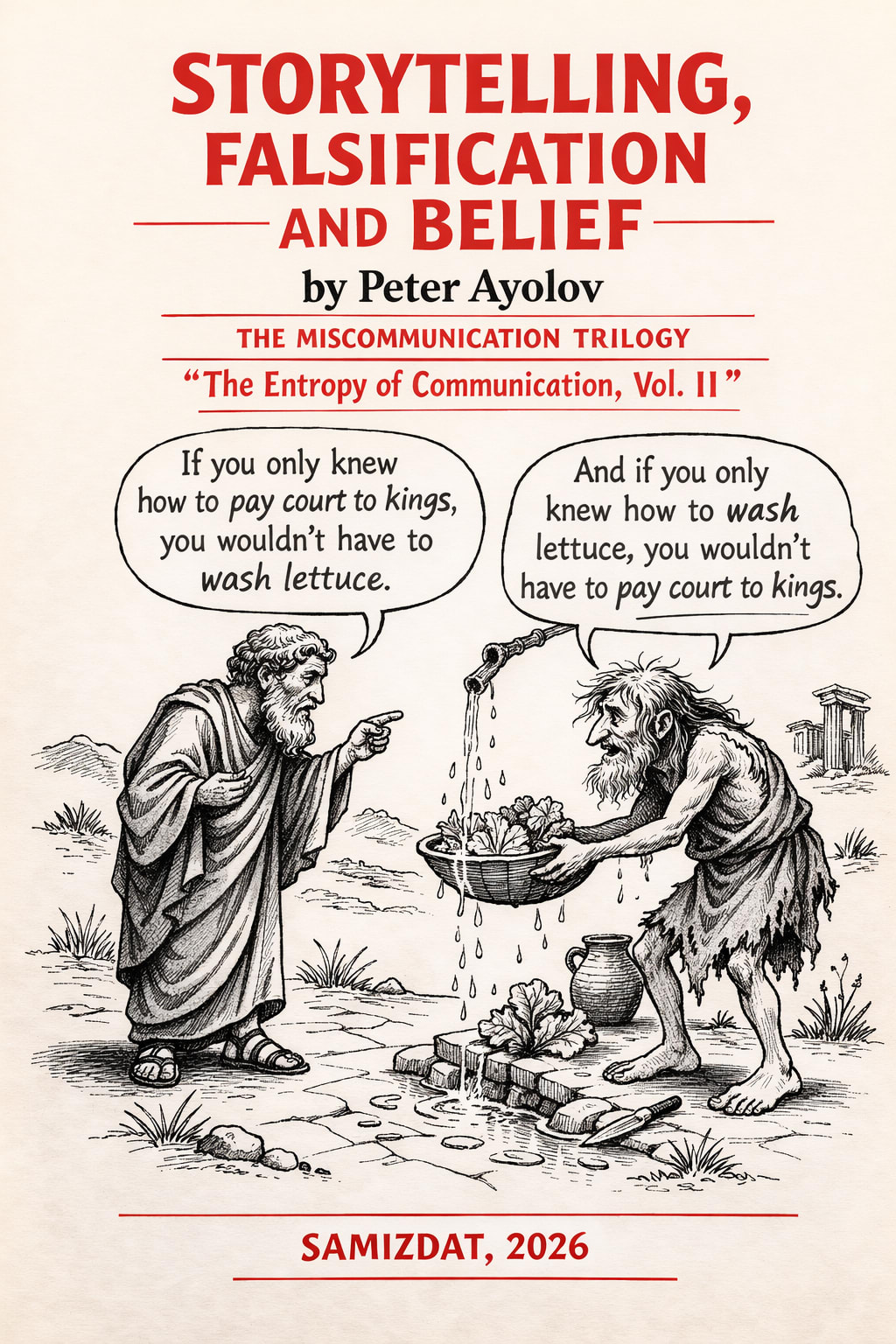
The Empire of Narratives: A Review of Storytelling, Falsification and Belief
The Collapse of Stable Meaning
THE MISCOMMUNICATION TRILOGY “The Entropy of Communication, Vol. II” Part 16, STORYTELLING, FALSIFICATION AND BELIEF stands as one of the most ambitious philosophical investigations within the larger architecture of the trilogy. Rather than treating communication as a transparent process through which information moves from one consciousness to another, this volume proposes a far more unsettling argument: language itself increasingly participates in systems of symbolic construction that shape reality before reality can even be perceived. In a world saturated with narratives, images, and communication technologies, the problem is no longer simply whether statements are true or false. The deeper problem concerns the structures through which truth itself becomes believable. The volume therefore enters territory extending far beyond linguistics or media theory and gradually develops into a larger philosophical reflection on the conditions of human understanding in an age where narratives increasingly replace direct experience. At the center of this investigation lies the concept of the planned obsolescence of language. Unlike technological obsolescence, where material products are intentionally designed to become outdated, linguistic obsolescence refers to the gradual exhaustion and accelerated replacement of meanings. Words circulate with increasing speed. Concepts become unstable. Symbols detach from durable realities and begin to exist independently as floating structures of emotional significance. Under such conditions communication no longer guarantees understanding; rather, communication itself begins producing confusion through excess. The paradox explored throughout the volume is striking: contemporary societies possess unprecedented technological capacities for communication and yet simultaneously suffer from a profound crisis of meaning. Through a synthesis of discourse theory, semiotics, advertising studies, philosophy of language, narrative theory, and media criticism, the book constructs an interdisciplinary framework capable of revealing hidden symbolic structures beneath ordinary experience. Particularly compelling is its refusal to dismiss advertising as a superficial commercial practice. Instead, advertising appears as one of the most sophisticated laboratories of communication in modern society. Advertising reveals how commodities acquire symbolic identities, how narratives produce emotional investment, and how persuasion increasingly depends upon creating worlds rather than delivering facts. The work repeatedly demonstrates that products no longer function merely as objects. They become symbolic centers around which identities, desires, aspirations, and social myths organize themselves. Cars become masculinity, prestige, and freedom. Perfume becomes seduction, personality, and emotional possibility. Consumption itself becomes participation in narratives larger than the objects being purchased. The volume therefore argues that the transformation of communication into symbolic performance may be one of the defining developments of modern civilization. Communication increasingly functions through emotional plausibility rather than empirical evidence. Reality itself becomes narratively mediated.
The Machinery of Belief and Symbolic Life
The greatest strength of STORYTELLING, FALSIFICATION AND BELIEF lies in its sustained examination of storytelling not as entertainment but as one of the primary technologies through which societies organize experience. Stories no longer appear as secondary cultural products existing alongside reality; instead they become mechanisms through which reality itself becomes intelligible. Human beings rarely encounter facts directly. Facts emerge already situated inside narrative structures that assign significance, emotional value, and social meaning. Throughout the volume, narrative is treated not simply as literary form but as an architecture of belief. Stories determine what becomes visible, what becomes memorable, and what becomes imaginable. This argument unfolds through extensive examinations of discourse structures and communication theory. Language is shown not as an isolated collection of words but as a network involving contexts, participants, visual forms, symbolic assumptions, and historical associations. Meaning emerges through relationships rather than through isolated linguistic units. Particularly important is the discussion of participant worlds. Communication frequently operates simultaneously across several realities: the practical world of social life, the fictional world of narratives, the fantasy world of personal desires, and the symbolic world constructed by discourse itself. Advertising becomes effective precisely because it collapses distinctions among these domains. The consumer is not simply offered a product. The consumer is offered participation in a symbolic world where identity becomes achievable through consumption. The individual purchases not objects but narratives. This insight becomes increasingly persuasive as the volume examines ideological language. Rather than treating ideology as explicit doctrine or overt propaganda, the text reveals ideology as a process through which assumptions become naturalized. Certain arrangements of social life come to appear inevitable not because they are logically demonstrated but because they become narratively familiar. The discussion of concepts such as naturalness, gender expectations, social aspiration, and consumer identity illustrates this process particularly effectively. Advertising repeatedly transforms historical arrangements into seemingly timeless truths. Social constructions become mistaken for natural realities. The text's treatment of visual communication further enriches this argument. Images differ fundamentally from language because they lack explicit grammatical structures that anchor meaning to fixed temporal relations. Images remain inherently ambiguous. Yet precisely because of this ambiguity they often become more persuasive. Images suggest rather than declare. They imply rather than argue. Their symbolic power frequently bypasses critical reflection altogether. The analysis of paralanguage contributes further complexity. Typography, layout, gesture, sound, posture, voice quality, rhythm, and visual structure all emerge as dimensions of communication carrying meanings that may exceed verbal content itself. Communication increasingly becomes theatrical performance. Persuasion resides not only in what language says but also in how communication itself appears. Atmosphere begins to overpower argument. Emotional resonance displaces analytical coherence. Yet the volume avoids simplistic moral conclusions. It repeatedly acknowledges that human beings may fundamentally require stories in order to navigate reality. Facts alone rarely sustain social life. Narratives provide emotional orientation and existential continuity. Consequently, the crisis explored throughout the book concerns not storytelling itself but the conditions under which narratives increasingly become detached from shared reality.
Narrative Worlds and the Future of Communication
The final sections of STORYTELLING, FALSIFICATION AND BELIEF move beyond analysis toward broader philosophical questions concerning the future of communication itself. One of the most significant contributions of the volume is its rejection of simplistic oppositions between truth and falsehood, manipulation and authenticity, reality and fiction. Communication is presented instead as a fundamentally dialogic process characterized by instability, multiplicity, and interaction among competing voices. Drawing heavily from theories of discourse and heteroglossia, the book demonstrates that meaning never belongs entirely to speakers or listeners. Words arrive already shaped by previous uses, institutions, expectations, and histories. Communication therefore appears as an ongoing process of negotiation rather than a simple transmission of fixed meanings. This approach allows the volume to avoid deterministic portrayals of audiences as passive victims manipulated by media systems. Receivers actively participate in meaning production. Belief itself emerges collaboratively. Nevertheless, the work remains deeply concerned with contemporary conditions characterized by acceleration, fragmentation, and symbolic overload. Communication systems increasingly reward speed, novelty, emotional intensity, and perpetual reinvention. Narratives circulate faster than reflection. Attention fragments into increasingly shorter cycles. Shared symbolic structures weaken under pressures of constant replacement. Under such circumstances the planned obsolescence of language no longer appears metaphorical but increasingly plausible as a cultural condition. Words lose permanence. Meanings become provisional. Symbols circulate without stable anchors. The consequences extend far beyond media environments into broader questions concerning collective memory, political trust, and social cohesion. Communities depend upon shared symbolic realities, and shared realities depend upon relatively stable systems of communication. When language itself becomes unstable, the foundations of social understanding become increasingly uncertain. Yet despite these concerns the work avoids cultural pessimism. One of its most admirable qualities lies in its recognition that communication remains a site of creativity, play, and imaginative possibility. Advertising itself, despite its manipulations, demonstrates extraordinary capacities for symbolic innovation. Through metaphor, ambiguity, narrative experimentation, and linguistic playfulness, communication continues generating moments of pleasure and surprise. The volume therefore remains suspended between fascination and critique. It neither celebrates nor condemns contemporary communication culture absolutely. Instead it investigates communication as one of humanity's most contradictory achievements. By the end, STORYTELLING, FALSIFICATION AND BELIEF reveals itself not merely as a study of discourse or media but as a broader meditation on symbolic existence in late modernity. It asks whether language can continue sustaining truth within systems increasingly organized around attention and emotional appeal. It asks whether communication can preserve reality while simultaneously transforming it. Most importantly, it asks who constructs the stories through which human beings recognize the world itself. Rather than closing these questions, the book deliberately leaves them unresolved. Its greatest contribution may therefore lie not in offering solutions but in transforming everyday communication into an object worthy of sustained philosophical attention. In an era overwhelmed by messages, perhaps the rarest intellectual act is no longer speaking. Perhaps it is learning how to hear the structures hidden beneath the stories through which reality becomes believable.
About the Creator
Peter Ayolov
Peter Ayolov’s key contribution to media theory is the development of the "Propaganda 2.0" or the "manufacture of dissent" model, which he details in his 2024 book, The Economic Policy of Online Media: Manufacture of Dissent.
Enjoyed the story? Support the Creator.
Subscribe for free to receive all their stories in your feed.
Comments
There are no comments for this story
Be the first to respond and start the conversation.