
The Propaganda of PR, THE MISCOMMUNICATION TRILOGY, “The Entropy of Communication, Vol. II”, Part 14
Book Review

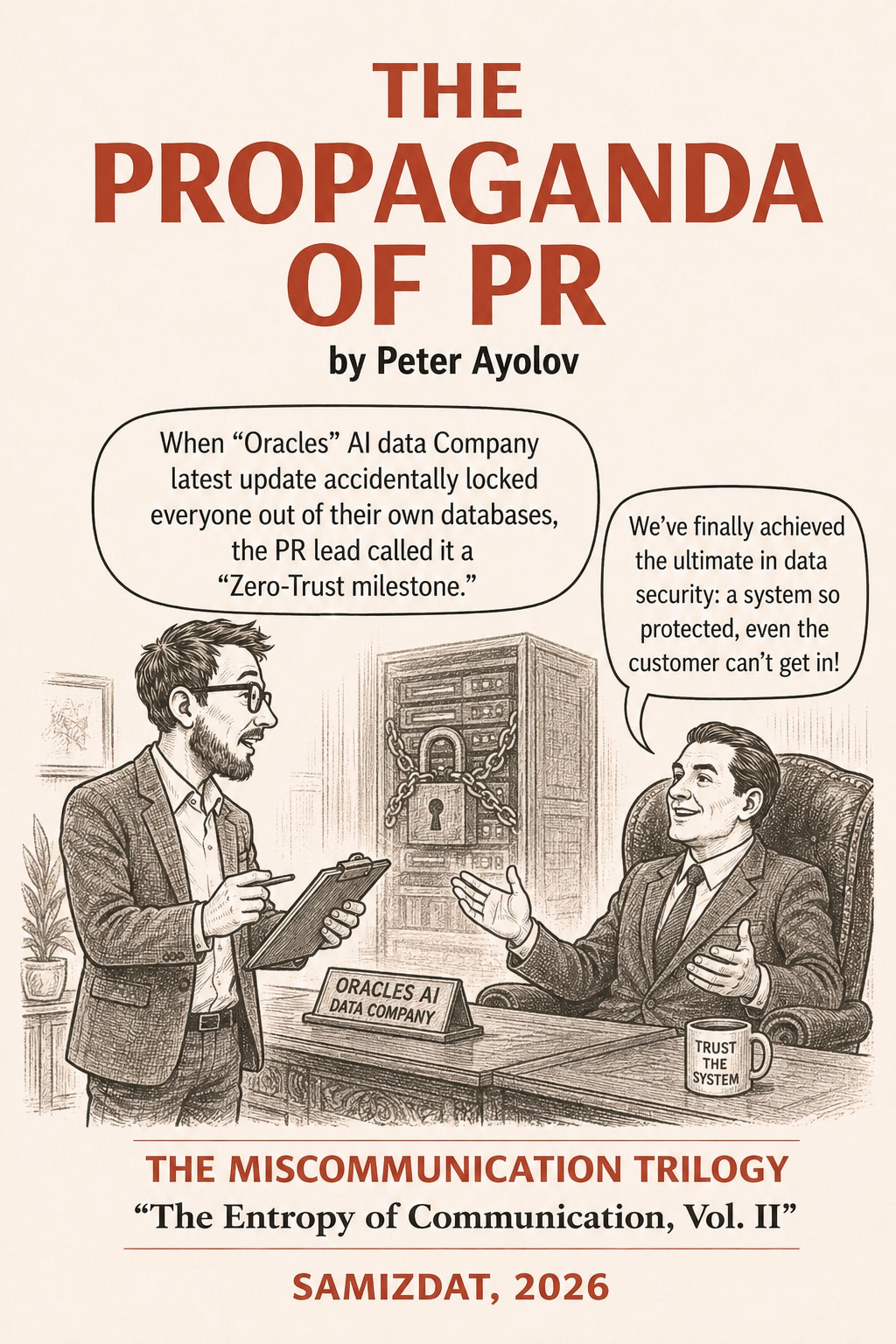
The Architecture of Managed Consent
The Propaganda of PR presents a broad and systematic critique of public relations as one of the central organizing forces of modern communication and political perception. The book argues that PR is no longer a secondary function of corporate communication or political messaging, but a foundational structure embedded within journalism, entertainment industries, digital platforms, and institutional governance. Rather than operating as a visible or isolated practice, PR is described as a continuous system that shapes how reality is constructed, interpreted, and stabilized across modern societies. At the core of this analysis is the extension of the propaganda model tradition associated with Herman and Chomsky. The book builds on the idea that media systems are structured by ownership, advertising, sourcing, flak, and ideology, but argues that these filters are now deeply interwoven with professionalized public relations systems. PR becomes the connective layer that links governments, corporations, think tanks, and media institutions into a coordinated communication environment. In this system, journalism is not fully autonomous but structurally dependent on institutional information flows, press briefings, corporate messaging, and expert networks that are themselves shaped by PR strategies. The result is a media ecosystem in which information is not primarily produced through independent investigation but through the circulation of pre-structured narratives. Journalistic routines, economic pressures, and institutional dependencies reinforce this dynamic, narrowing the space for alternative interpretations. Media concentration and advertising dependence further intensify this structure, ensuring that only certain framings of reality are amplified while others remain marginal. Within this framework, PR does not simply influence content after it is created; it shapes the conditions under which content becomes possible in the first place.
The Erosion of Language and Cognitive Stability
The second major part of the book focuses on the transformation of language under the influence of PR systems. It argues that public relations contributes to a gradual destabilization of meaning, where political and moral language becomes increasingly fluid, strategic, and detached from stable reference points. Key concepts such as democracy, freedom, security, truth, and transparency are repeatedly deployed across contradictory contexts, resulting in semantic inflation and conceptual exhaustion. This process is described as the planned obsolescence of language. Words do not disappear from public discourse but lose their precision through constant repetition, strategic redefinition, and emotional repositioning. PR relies on this instability because fixed meanings would limit the adaptability required for political and corporate communication. As a result, language becomes less a tool for shared understanding and more a flexible instrument for managing perception. The book emphasizes that modern propaganda does not operate primarily through explicit deception or censorship. Instead, it functions through saturation and overproduction of meaning. Competing narratives, frames, and interpretations are continuously circulated, producing an informational environment in which audiences are exposed to overwhelming levels of mediated reality. Rather than being misinformed in a simple sense, individuals experience interpretive overload, where stable judgment becomes increasingly difficult.
Digital platforms intensify this condition. Algorithmic systems prioritize engagement, emotional intensity, and viral potential, rewarding content that provokes reaction rather than reflection. PR adapts to this environment by designing messages optimized for circulation rather than accuracy. Communication becomes governed by attention economies, where visibility replaces truth as the primary measure of influence. The book also highlights the fragmentation of shared reality through personalization and data-driven targeting. Different groups receive different informational inputs, resulting in parallel interpretive environments. This produces a condition in which disagreement is no longer only about interpretation but about the structure of perceived reality itself. Emotional manipulation plays a central role in stabilizing these fragmented realities, with PR increasingly relying on fear, identity, aspiration, and resentment as mechanisms of narrative control
The System of Continuous Persuasion and Invisible Governance
The final part of the book expands the analysis into a broader theory of modern power, arguing that public relations should be understood not as an industry but as a permanent system of persuasion embedded across all major institutions of society. PR operates continuously across political communication, corporate strategy, media production, entertainment culture, and digital infrastructure, forming a unified environment of managed perception. In this system, persuasion is no longer episodic or reactive but anticipatory. Political decisions are shaped in advance through polling, data analytics, behavioral modeling, and predictive communication strategies that anticipate public response before policies are finalized. Governance becomes increasingly pre-emptive, adjusting itself to projected perception rather than responding to actual public debate. Importantly, the book argues that this system does not require centralized coordination. Instead, it emerges from the alignment of institutional incentives. Corporations seek profit stability, political actors seek legitimacy and electoral success, media organizations seek attention and revenue, and digital platforms seek engagement and data extraction. PR provides the shared communicative framework that synchronizes these objectives without the need for explicit conspiracy or unified control.
Crisis communication reveals this system most clearly. In moments of disruption, PR rapidly restructures narratives to stabilize interpretation and restore institutional legitimacy. Crises are not simply reported; they are managed, reframed, and absorbed into existing systems of power. This process often narrows the range of public interpretation, reinforcing dominant perspectives while marginalizing alternative explanations. The book also extends its analysis into entertainment industries, where PR operates through product placement, narrative framing, institutional collaboration, and ideological normalization. Film, television, sports, and digital media are not separate from political communication but integrated components of the same system. These cultural forms shape perception through repetition and emotional engagement rather than explicit messaging. Ultimately, the book concludes that modern communication systems do not primarily function by hiding information, but by organizing attention and structuring perception. Public relations shapes what becomes visible, what is repeated, and what becomes culturally central. In doing so, it establishes the conditions under which reality itself is experienced.
The Propaganda of PR therefore presents a comprehensive account of how contemporary societies are governed less through direct coercion than through continuous symbolic management, where perception itself becomes the primary field of power.
About the Creator
Peter Ayolov
Peter Ayolov’s key contribution to media theory is the development of the "Propaganda 2.0" or the "manufacture of dissent" model, which he details in his 2024 book, The Economic Policy of Online Media: Manufacture of Dissent.
Enjoyed the story? Support the Creator.
Subscribe for free to receive all their stories in your feed.
Comments
There are no comments for this story
Be the first to respond and start the conversation.