
The Media Kitsch, THE MISCOMMUNICATION TRILOGY, “The Entropy of Communication, Vol. II”, Part 15
Book Review

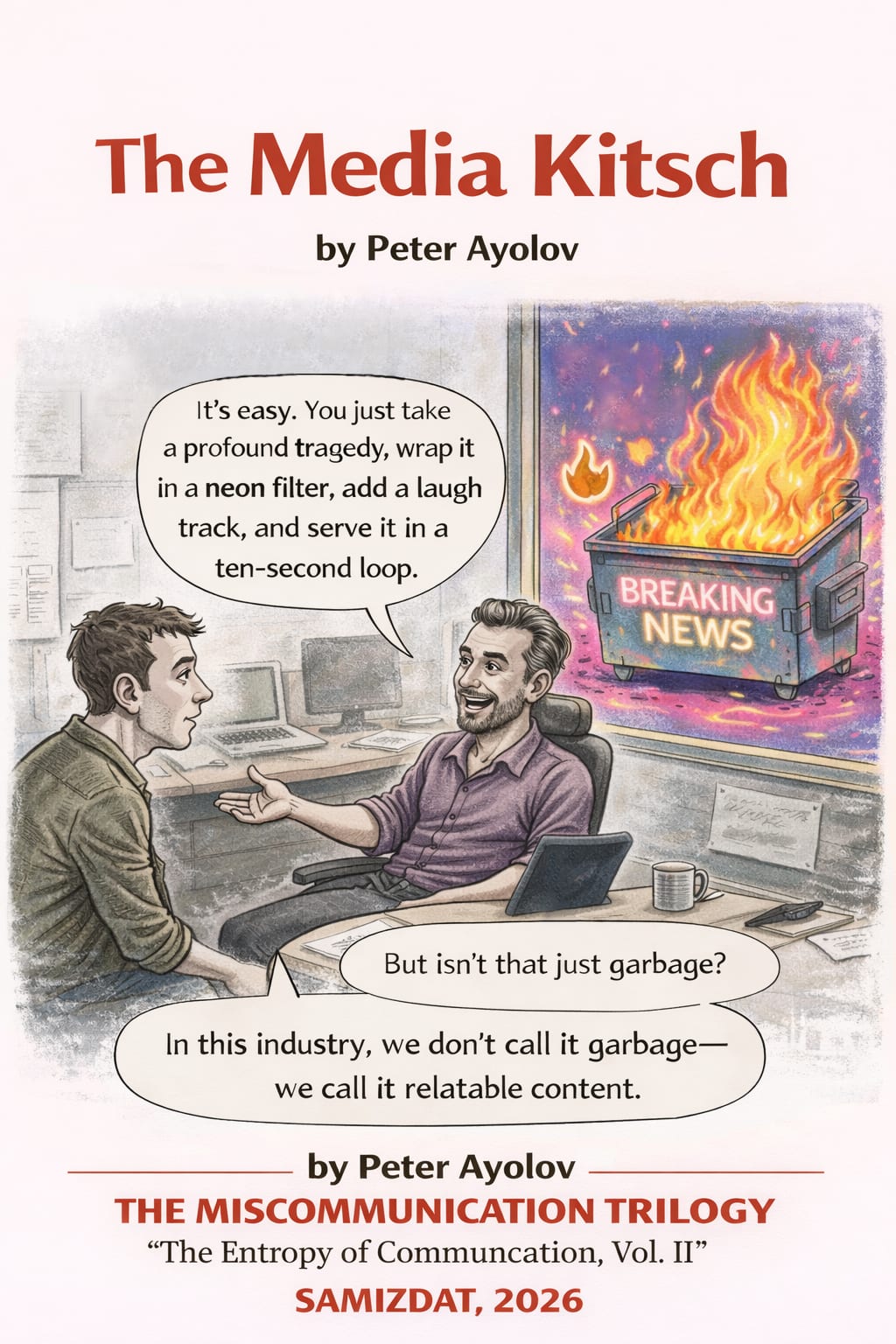
The Mirror of Noise: A Review of The Media Kitsch
The Collapse of Meaning in the Age of Media Excess
The Media Kitsch, Part 15 of THE MISCOMMUNICATION TRILOGY “The Entropy of Communication, Vol. II,” presents itself not simply as a study of media systems but as a philosophical excavation of language under conditions of contemporary symbolic overload. At first glance the work appears to focus on familiar subjects: mass communication, media discourse, buzzwords, doublespeak, political rhetoric, social media language, and contemporary systems of representation. Yet beneath these visible themes the volume gradually reveals a far broader ambition. Rather than examining media merely as institutions transmitting information, the work investigates media as environments that increasingly organize reality itself. The central concern of the volume—the Planned Obsolescence of Language—provides an ambitious conceptual framework through which contemporary communication is interpreted not as progress but as symbolic deterioration hidden beneath abundance.
One of the most striking aspects of the book lies in its refusal to treat communication as neutral. Throughout its extensive discussions the volume repeatedly returns to the argument that communication technologies never merely deliver messages. They establish symbolic architectures that shape perception before reflection becomes possible. The book insists that media systems increasingly determine not only what societies discuss but also how societies imagine reality itself. This movement away from traditional media criticism toward a broader theory of symbolic environments gives the work considerable intellectual scope. Media become less like institutions and increasingly resemble conditions of existence. Communication becomes infrastructure. Visibility becomes power.
The work presents modern societies as immersed within systems of uninterrupted symbolic activity. Screens, notifications, headlines, political narratives, digital platforms, and streams of visual material create immense environments surrounding everyday existence. Reality increasingly appears already interpreted. Individuals awaken into symbolic worlds already speaking before experience itself fully emerges. Such observations may initially appear familiar within discussions surrounding media theory, yet the volume succeeds in extending them toward a more unsettling conclusion. The problem no longer concerns media influence alone. Instead the crisis concerns the life expectancy of meaning itself.
The Planned Obsolescence of Language emerges as one of the work’s strongest conceptual interventions because it transforms economic language into symbolic critique. Earlier industrial systems depended upon products designed to deteriorate in order to sustain consumption. This volume argues that language itself increasingly enters similar cycles. Words become fashionable and disposable. Concepts emerge rapidly and collapse beneath repetition. Meaning increasingly survives only through circulation. Such arguments provide an original interpretive framework through which readers may understand contemporary communication not as expansion but as erosion hidden beneath excess.
The volume also distinguishes itself through its sustained concern with media kitsch. Rather than limiting kitsch to artistic production or questions of aesthetic taste, the book expands the concept into a broader symbolic condition. Media kitsch becomes a communicative structure transforming complexity into emotional familiarity and replacing analytical understanding with symbolic comfort. Public discourse increasingly rewards immediacy over reflection and emotional recognition over conceptual difficulty. News acquires theatrical structures. Politics increasingly resembles performance. Public identity itself becomes increasingly organized through visibility. Such observations contribute to a wider argument suggesting that contemporary societies increasingly confuse symbolic participation with understanding itself.
Throughout these discussions the work displays a tendency toward philosophical escalation. Communication gradually ceases functioning merely as social practice and increasingly appears as an existential condition shaping memory, identity, and perception. The result often produces an atmosphere closer to cultural diagnosis than traditional media criticism. Readers expecting narrow discussions concerning journalism or technological change will encounter something significantly broader: an attempt to examine language standing before the possibility of its own exhaustion.
Babble, Spectacle, and the Architecture of Linguistic Kitsch
Perhaps the most compelling sections within The Media Kitsch emerge from its treatment of buzzwords, doublespeak, and political babble as forms of linguistic kitsch. Here the volume demonstrates considerable analytical power because it refuses to dismiss empty rhetoric merely as poor communication. Instead symbolic vagueness becomes interpreted as a structural feature of contemporary media systems themselves. Babble does not appear accidental. It becomes strategic.
The work argues that contemporary communication increasingly serves symbolic management rather than rational exchange. Such a proposition transforms apparently trivial subjects—buzzwords, slogans, clichés, fashionable terminology—into symptoms of broader cultural transformations. Political expressions such as freedom, values, opportunity, reform, and security become examples of words whose effectiveness frequently depends upon conceptual instability rather than clarity. Their power derives from flexibility. Stable meanings create accountability; ambiguity permits adaptation. Communication increasingly rewards symbolic mobility over precision.
The treatment of babble as linguistic kitsch represents perhaps the book’s most provocative conceptual contribution. Like aesthetic kitsch, babble simplifies complexity and replaces contradiction with emotional familiarity. Communication increasingly becomes symbolic scenery where audiences project fears, desires, and frustrations onto unstable expressions. Media and political language increasingly abandon analytical structures in favor of emotional immediacy and symbolic recognition. Through such observations the volume proposes a systematic movement away from logic itself.
This argument develops with remarkable consistency throughout the work. Rational discourse traditionally depends upon continuity between meanings and concepts. Arguments require distinctions. Thought requires structures preserving coherence. Babble increasingly dissolves such foundations beneath permanent symbolic improvisation. Contradictions coexist effortlessly. Opposing positions merge without resistance. Communication increasingly functions independently from conceptual stability.
The work repeatedly returns to this movement toward fragmentation and irrationality. Yet rather than presenting symbolic instability merely as cultural decline, the volume suggests something more troubling. Communication increasingly escapes logic not accidentally but systematically. Stable meanings create obligations. Rationality creates boundaries. Precision creates opportunities for criticism. Babble removes such restrictions through permanent flexibility. Language increasingly becomes capable of functioning while avoiding responsibilities traditionally associated with communication itself.
One particularly effective aspect of the volume lies in its ability to connect seemingly unrelated phenomena beneath broader theoretical structures. Discussions concerning social media terminology, management jargon, political doublespeak, corporate language, and media discourse gradually reveal common organizational principles. Acceleration, visibility, repetition, emotional immediacy, and symbolic comfort repeatedly appear across different communicative environments. The result creates a sense that contemporary communication increasingly follows identifiable structural patterns rather than random cultural tendencies.
Yet the work occasionally risks becoming almost overwhelmingly totalizing. Media influence appears so extensive that readers may begin wondering whether any symbolic territory remains outside systems of mediated organization. Communication increasingly appears as an all-encompassing structure shaping reality itself. While such expansiveness contributes to the philosophical ambition of the volume, moments occasionally arise where distinctions between institutional influence and total symbolic determination become less clear.
Nevertheless the volume remains intellectually compelling precisely because it refuses moderation. Rather than presenting communication problems as isolated defects requiring technical solutions, the work consistently insists upon examining deeper symbolic conditions shaping contemporary existence itself.
Humor, Irony, and Language After Meaning
Perhaps the most unexpected movement within The Media Kitsch appears toward its conclusion where the work shifts from diagnosis toward something resembling symbolic possibility. After hundreds of pages investigating acceleration, fragmentation, linguistic deterioration, symbolic management, and communicative exhaustion, the volume gradually introduces an argument that appears almost paradoxical. If communication increasingly abandons stable logic, rationality, and even traditional forms of beauty, where might language still preserve meaningful resistance?
The answer proposed by the work arrives through humor, irony, satire, parody, and absurdity.
This movement represents one of the most surprising and philosophically interesting developments within the book because it avoids simplistic optimism while simultaneously refusing complete pessimism. Humor appears not as entertainment but as symbolic interruption. Irony becomes distance. Satire becomes exposure. Kitsch itself eventually becomes vulnerable once individuals recognize its mechanisms.
The argument proves persuasive because it follows organically from the book’s broader concerns. Kitsch depends upon invisibility. Repetition remains effective only while appearing natural. Symbolic authority survives only while escaping scrutiny. Humor interrupts such processes by exposing contradictions hidden beneath seriousness. The moment audiences begin laughing at institutional language, communication changes fundamentally. Familiar expressions become strange again. Official narratives lose inevitability. Symbolic systems reveal their machinery.
The book’s treatment of humor ultimately functions less as aesthetic observation and more as philosophical proposition. Satire becomes one of language’s remaining critical functions precisely because it restores awareness of communication itself. Laughter creates distance. Distance creates perception. Perception creates criticism. Perhaps this explains why contemporary culture increasingly produces communication saturated by memes, absurdity, self-conscious performances, and irony. Beneath such developments the volume identifies language searching for escape routes from environments overwhelmed by spectacle and symbolic exhaustion. Humor survives because seriousness increasingly resembles theatre.
The conclusion arrives at a remarkable reversal. Earlier sections frequently describe communication as approaching exhaustion beneath symbolic acceleration. Yet language unexpectedly discovers possibilities precisely within its apparent collapse. Meaning survives not through certainty but through self-awareness. Not through authority but through absurdity. The final impression left by The Media Kitsch therefore remains unusual. Rather than presenting media criticism merely as institutional critique, the volume ultimately becomes a broader meditation concerning language confronting its own historical limits. It asks whether communication can survive conditions increasingly organized around visibility, spectacle, and acceleration. More importantly, it asks whether meaning itself still remembers how to endure.
The result is an intellectually ambitious, philosophically expansive, and frequently unsettling work. Readers seeking straightforward media analysis may occasionally find themselves overwhelmed by its theoretical scale. Yet those willing to enter its symbolic landscapes will discover something far more substantial than a conventional study of media systems. The Media Kitsch ultimately presents not merely a critique of communication but an exploration of language standing before its own mirror and discovering that beneath endless speech, symbolic abundance, and theatrical noise, its final meaningful act may simply be the ability to laugh at itself.
About the Creator
Peter Ayolov
Peter Ayolov’s key contribution to media theory is the development of the "Propaganda 2.0" or the "manufacture of dissent" model, which he details in his 2024 book, The Economic Policy of Online Media: Manufacture of Dissent.
Enjoyed the story? Support the Creator.
Subscribe for free to receive all their stories in your feed.
Comments
There are no comments for this story
Be the first to respond and start the conversation.