
The Complex Nature of Language, THE MISCOMMUNICATION TRILOGY, “The Entropy of Communication, Vol. II”, Part 24
Book Review

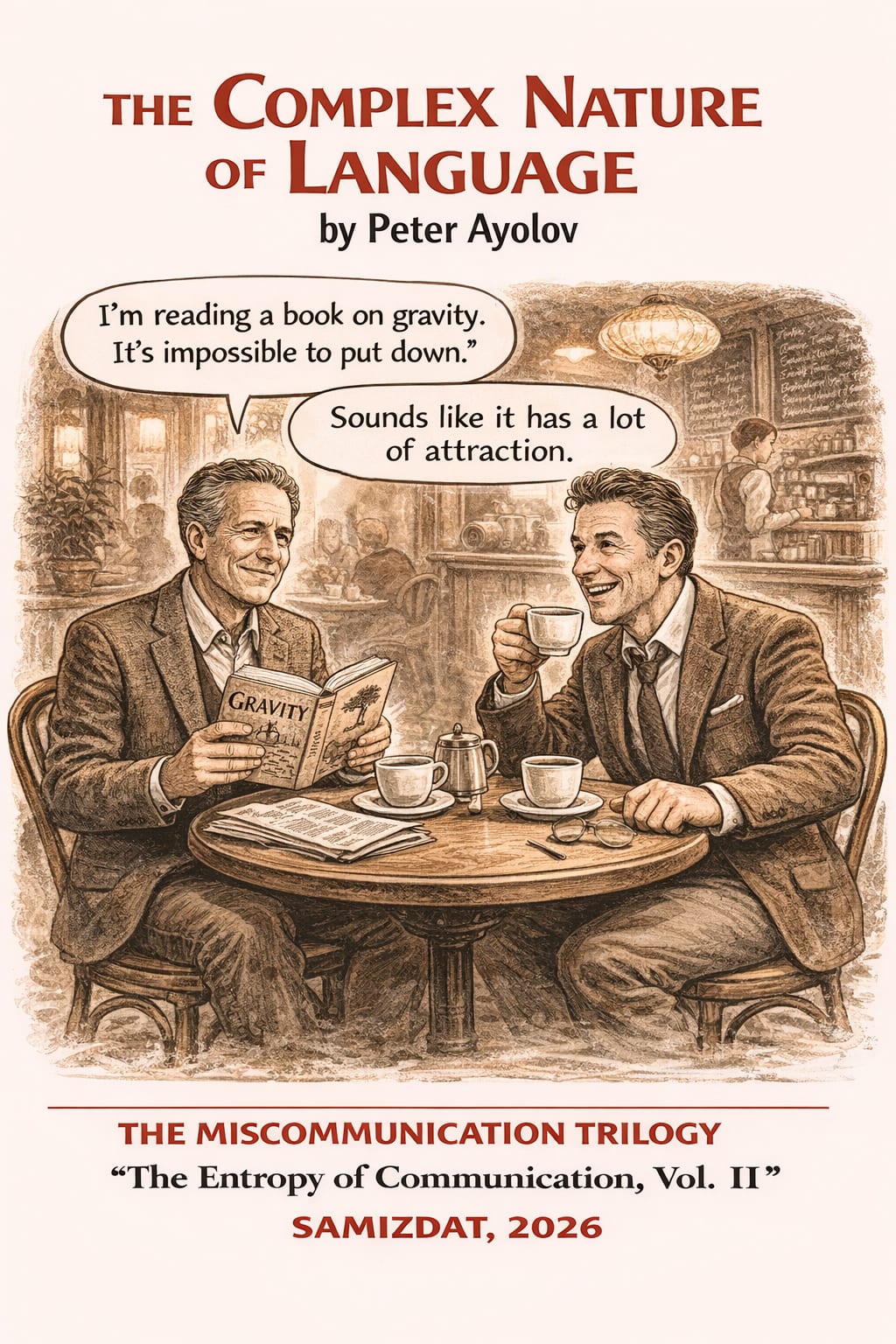
The Labyrinth of Meaning: A Review of The Complex Nature of Language
Mapping the Architecture of Human Communication
The Complex Nature of Language stands as one of the most ambitious and intellectually expansive contributions within The Miscommunication Trilogy: The Entropy of Communication, Vol. II. Rather than approaching language as a narrow technical subject reserved for linguists, the volume presents it as one of the central organizing forces of human civilization. Throughout its chapters, language emerges not merely as a means of communication but as a vast cognitive, cultural, historical, and philosophical system through which human beings create, preserve, and transform reality. One of the book’s greatest strengths lies in its refusal to reduce language to a single explanatory model. Instead, it presents language as a phenomenon that must be examined from multiple perspectives simultaneously. Grammar, semantics, cognition, logic, social organization, cultural evolution, and historical change are woven together into a coherent exploration of linguistic complexity. This interdisciplinary approach allows the volume to move beyond traditional introductions to linguistics and engage with deeper questions concerning meaning, knowledge, and human understanding. The discussion of linguistic diversity forms a particularly compelling foundation for the volume. The reader is repeatedly reminded that languages do not merely label a pre-existing world. They organize experience according to different principles, highlighting certain distinctions while minimizing others. Demonstrative systems, evidential categories, kinship structures, gender systems, and grammatical classifications reveal that every language reflects a unique solution to the challenges of communication. This perspective encourages a greater appreciation of linguistic diversity while challenging simplistic assumptions regarding linguistic superiority or inferiority.
The book is equally effective in demonstrating that complexity is not a defect but an inherent characteristic of successful communication systems. Through discussions of grammatical structures, phonological systems, word formation processes, and semantic categories, language appears as a delicate balance between efficiency and richness. The examination of grammatical universals alongside language-specific innovations illustrates how languages can differ dramatically while still fulfilling the same fundamental communicative functions. A particularly valuable aspect of the volume is its treatment of linguistic theory itself. Rather than presenting theoretical frameworks as unquestionable truths, the text reveals them as evolving attempts to understand an extraordinarily complex phenomenon. The reader encounters structuralism, semantic approaches, descriptive linguistics, historical reconstruction, cognitive theories, and philosophical analyses as complementary perspectives rather than mutually exclusive alternatives. This intellectual openness gives the volume a breadth that is often absent from more narrowly specialized works. The result is a book that successfully introduces the reader to the astonishing complexity of language while maintaining a clear sense of intellectual purpose. Language is revealed as a living architecture that simultaneously reflects and shapes the societies that depend upon it. By the end of the first major sections, it becomes evident that understanding language requires understanding humanity itself.
Meaning, Vagueness, and the Limits of Explanation
The central intellectual achievement of The Complex Nature of Language lies in its exploration of meaning. Rather than treating meaning as something fixed and self-evident, the volume presents it as a dynamic process emerging from the interaction between linguistic structures, cognitive mechanisms, and social contexts. This approach allows the book to engage with some of the most difficult philosophical questions surrounding language without losing sight of practical linguistic realities. The discussions of semantics reveal the extent to which grammar and meaning are inseparable. Words are shown not merely to possess meanings but to participate in broader networks of relationships. The examination of semantic types, grammatical categories, and syntactic roles demonstrates how linguistic structures arise from patterns of meaning and how those structures subsequently influence communication. In this respect, the volume offers a persuasive alternative to theories that prioritize formal grammatical mechanisms while neglecting semantic foundations. Particularly impressive is the book’s engagement with vagueness. Many discussions of language assume that precision is the ideal toward which communication should strive. This volume challenges that assumption by demonstrating that vagueness is often a rational and necessary feature of human cognition. Through analyses of categorization, prototypes, conceptual spaces, and decision-making, vagueness emerges not as a defect but as an adaptive solution to the complexity of reality. Human beings inhabit a world filled with gradual transitions rather than sharp boundaries, and language reflects this condition.
The incorporation of philosophical discussions concerning rationality, credence, categorization, and regret further enriches the analysis. These topics might initially appear distant from linguistic inquiry, yet the volume successfully demonstrates their relevance. Questions concerning how people form concepts, make decisions, assign probabilities, and interpret ambiguous situations all intersect with language. Meaning cannot be separated from the cognitive processes that generate and interpret it. The treatment of twentieth-century linguistic and philosophical theories is equally noteworthy. The discussions of Frege, Wittgenstein, Saussure, Chomsky, and other influential thinkers provide a valuable historical perspective on contemporary debates. Rather than presenting these figures as isolated intellectual monuments, the book situates them within ongoing efforts to understand the relationship between language, thought, and reality. Wittgenstein’s emphasis on language games, Saussure’s structuralism, and Chomsky’s focus on competence are presented as important but incomplete contributions to a much larger conversation.
Perhaps the most significant contribution of the volume is its persistent emphasis on context. Meaning is shown to depend not merely on words or sentences but on the situations in which they occur. Language functions within networks of social relationships, cultural expectations, historical experiences, and cognitive assumptions. By emphasizing this contextual dimension, the book avoids the formalist fallacies that have often limited linguistic analysis. Communication emerges as a dynamic process of negotiation rather than a simple transmission of information. These discussions collectively transform the reader’s understanding of language. Meaning appears not as a stable object waiting to be discovered but as an evolving field of relationships shaped by context, culture, cognition, and history. The complexity of communication becomes a reflection of the complexity of human existence itself.
Language, History, and the Future of Human Communication
The final strength of The Complex Nature of Language lies in its historical and evolutionary perspective. Throughout the volume, language is presented not as a static system but as a living process shaped by countless generations of human activity. This emphasis on change allows the book to connect linguistic structures with broader questions concerning culture, history, and civilization. The discussions of language evolution challenge simplistic family-tree models while introducing more dynamic frameworks such as punctuated equilibrium. These perspectives encourage readers to think about linguistic history in relation to environmental transformations, technological innovations, political upheavals, migrations, and cultural interactions. Languages do not evolve in isolation. They develop within complex ecosystems of social and historical forces that continuously reshape their structures and functions. The treatment of proto-languages and linguistic reconstruction is particularly valuable because it balances appreciation for historical linguistics with a recognition of its limitations. The book repeatedly reminds readers that reconstructed languages are approximations rather than direct recoveries of historical realities. Real languages contain irregularities, borrowings, superstrata, substrata, and countless complexities that cannot be fully captured through reconstruction. This intellectual humility strengthens rather than weakens the book’s analysis.
The volume also addresses one of the most pressing issues confronting contemporary linguistics: the decline of linguistic diversity. The discussion of language extinction moves beyond sentimentality and demonstrates why linguistic diversity matters. Languages preserve unique systems of knowledge, conceptual distinctions, ecological understandings, and cultural memories. Their disappearance represents a reduction in humanity’s collective intellectual resources. In a world increasingly dominated by a small number of global languages, this concern acquires particular urgency. Another significant contribution is the book’s exploration of modern communication technologies and their impact on language. Although the primary focus remains theoretical, the implications for contemporary communication are clear. Digital media, algorithmic systems, and global information networks are transforming linguistic practices at unprecedented speeds. The volume encourages readers to consider not only how language changes but also how those changes affect cognition, culture, and social organization. From a broader perspective, the book succeeds because it consistently connects linguistic questions with larger philosophical concerns. The nature of meaning, the structure of knowledge, the limits of rationality, the dynamics of cultural transmission, and the future of communication all become part of a single intellectual landscape. Language serves as the thread connecting these diverse themes, revealing its central role in human life.
Ultimately, The Complex Nature of Language is far more than a study of linguistic systems. It is an exploration of the mechanisms through which human beings create worlds of meaning. By combining linguistic theory, philosophy, cognitive science, cultural analysis, and historical reflection, the volume offers a comprehensive examination of one of humanity’s most powerful creations. It demonstrates that language is not merely something people use. It is the medium through which societies remember, reason, imagine, and evolve. As a contribution to The Entropy of Communication, Vol. II, this work stands as a profound reflection on the foundations of communication itself and on the fragile yet resilient structures through which meaning continues to shape the human condition.
About the Creator
Peter Ayolov
Peter Ayolov’s key contribution to media theory is the development of the "Propaganda 2.0" or the "manufacture of dissent" model, which he details in his 2024 book, The Economic Policy of Online Media: Manufacture of Dissent.
Enjoyed the story? Support the Creator.
Subscribe for free to receive all their stories in your feed.
Comments
There are no comments for this story
Be the first to respond and start the conversation.