
The Absurdity of Abstract Words, THE MISCOMMUNICATION TRILOGY, “The Entropy of Communication, Vol. II”, Part 26
Book Review

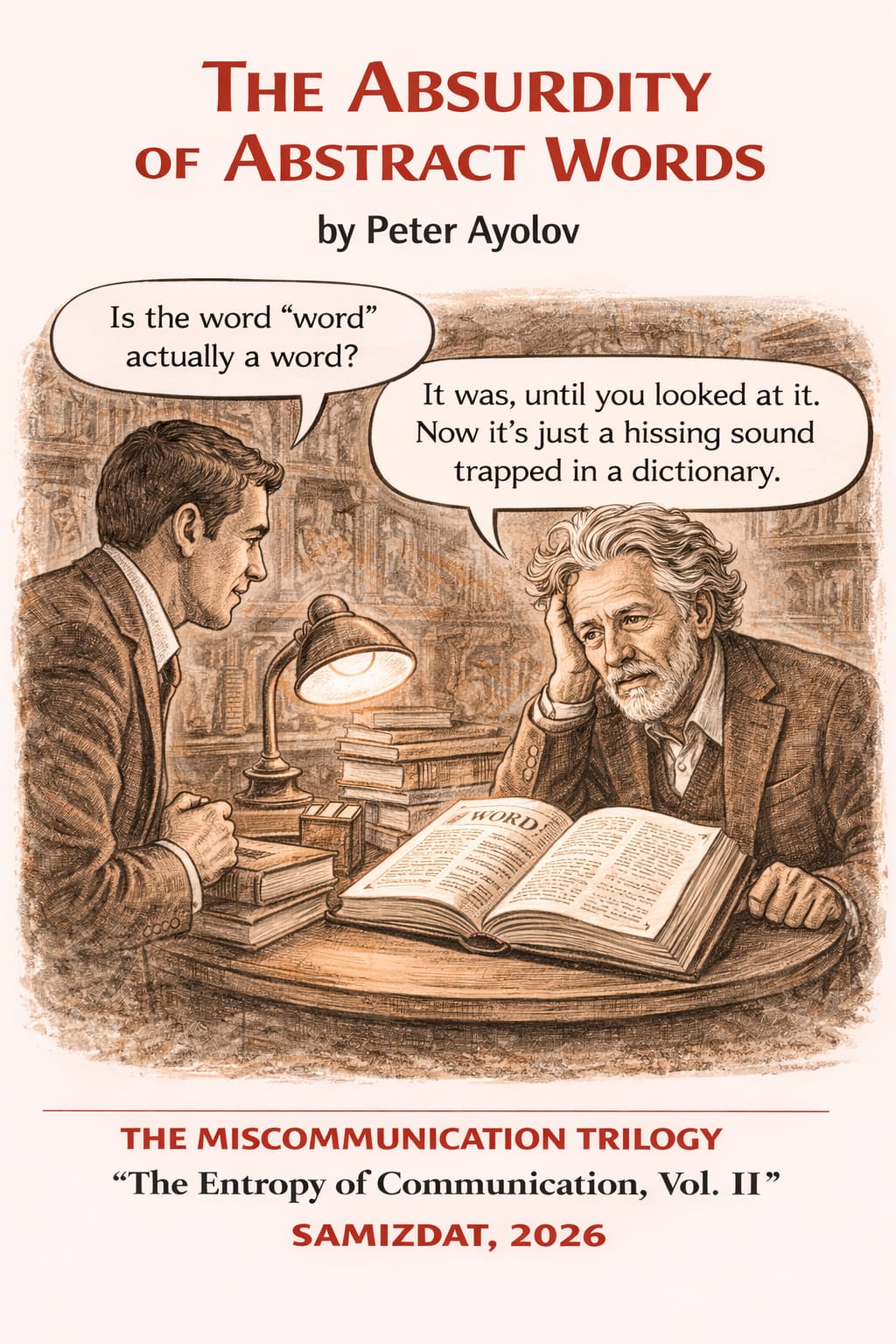
The Expiration of Meaning: A Review of The Absurdity of Abstract Words
A Cartography of Linguistic Decay
The Absurdity of Abstract Words is one of the most ambitious contributions to the ongoing examination of communication in contemporary society. Situated within a broader investigation of linguistic entropy, the book explores a question that appears deceptively simple but proves increasingly difficult to answer: what happens when words become detached from the realities they were originally intended to describe? Through an interdisciplinary approach that draws upon philosophy, linguistics, cognitive science, rhetoric, psychology, communication theory, media studies, and artificial intelligence research, the book constructs a compelling account of how abstraction shapes modern communication and why abstract language has become one of the defining features of contemporary culture.
One of the book's greatest strengths lies in its ability to connect diverse intellectual traditions into a coherent narrative. Rather than treating abstract language as a narrow linguistic phenomenon, the work demonstrates how abstraction permeates every aspect of human communication. Political discourse, institutional rhetoric, media narratives, technological systems, academic language, and everyday conversation all reveal the increasing dominance of concepts that operate at a distance from direct experience. The book argues that this development is not accidental but reflects broader transformations in the communicative environment.
A central theme running throughout the volume is the concept of the planned obsolescence of language. Borrowing a metaphor from consumer culture, the book suggests that words increasingly resemble products designed for rapid replacement. Meanings become unstable. Terminologies change continuously. Concepts are redefined with increasing frequency. Communication becomes characterized by perpetual revision rather than cumulative understanding. The result is a linguistic environment where novelty often receives greater value than clarity.
The author's treatment of abstraction is particularly effective because it avoids simplistic conclusions. Abstract language is not portrayed as inherently harmful. On the contrary, abstraction is recognized as one of humanity's greatest intellectual achievements. Without abstract concepts there could be no philosophy, science, law, morality, or political organization. Yet the book simultaneously demonstrates how abstraction becomes problematic when concepts lose contact with the experiences that originally gave them meaning.
Throughout its chapters, the volume repeatedly returns to the tension between language and reality. This tension provides the organizing principle for the entire work. The reader gradually comes to understand that the absurdity under examination is not located within words themselves but within the conditions under which words increasingly circulate. Concepts become autonomous. Symbols acquire authority independent of experience. Communication begins referring to previous communication rather than to observable realities. By framing abstraction as a problem of distance rather than falsehood, the book offers a sophisticated analysis that avoids both linguistic nostalgia and technological determinism.
From Sensory Experience to Symbolic Autonomy
One of the most impressive aspects of the book is its extensive engagement with contemporary research on cognition and language. The discussion of metaphor, metonymy, embodied cognition, visual thinking, naming practices, and conceptual abstraction creates a rich intellectual framework through which readers can understand how language constructs reality. Rather than presenting abstract concepts as detached intellectual entities, the book demonstrates that even the most sophisticated ideas remain rooted in sensory, emotional, social, and cultural experiences.
The chapters examining metaphor and visual cognition are particularly illuminating. The exploration of expressions that equate thinking with seeing reveals how deeply perception shapes abstract reasoning. Similarly, the discussion of metonymy demonstrates that communication frequently relies upon fragments standing for wholes, details representing systems, and symbols replacing complex realities. These analyses provide powerful evidence for the book's broader argument that abstraction emerges from experience rather than existing independently of it.
Equally noteworthy is the treatment of abstract language in relation to power. The book skillfully synthesizes research showing how abstract communication often functions as a signal of authority, expertise, and status. Leaders, institutions, and influential actors frequently communicate through broad conceptual language because abstraction creates an impression of distance from immediate circumstances and proximity to overarching truths. The result is a communication environment in which conceptual vagueness can acquire persuasive power precisely because it allows multiple interpretations.
The discussion of naming practices further enriches the analysis. By examining name-dropping, cultural references, symbolic identities, and the transformation of personal names into conceptual categories, the book illustrates how language continually converts concrete realities into abstract representations. Figures, events, and places become symbols carrying meanings that extend far beyond their original contexts. These symbolic transformations reveal how language constructs social memory and collective understanding.
Perhaps the most intellectually provocative sections involve the relationship between abstraction and artificial intelligence. The examination of model collapse introduces a striking parallel between linguistic entropy and technological systems. Just as language risks becoming detached from experience through excessive abstraction, generative systems risk becoming detached from reality when trained upon their own outputs. The analogy is developed with remarkable effectiveness. Both processes involve increasing self-reference, decreasing diversity, and growing distance from original sources of information. The inclusion of these contemporary concerns demonstrates the book's relevance to emerging technological debates while reinforcing its central philosophical themes.
By the end of these discussions, the reader gains a deeper appreciation of abstraction as both a cognitive necessity and a communicative danger. The book consistently resists simplistic binaries. It neither celebrates abstraction uncritically nor condemns it outright. Instead, it examines the conditions under which abstraction contributes to understanding and the circumstances under which it generates confusion.
A Warning for the Age of Infinite Communication
The lasting significance of The Absurdity of Abstract Words lies in its diagnosis of a broader cultural condition. Beneath its discussions of language, cognition, and symbolism lies a profound concern about the future of communication itself. The book argues that modern societies increasingly produce unprecedented quantities of language while simultaneously experiencing growing difficulties in maintaining shared understanding. Information expands. Communication accelerates. Symbolic systems become more complex. Yet clarity often appears to diminish.
This paradox forms the emotional and intellectual center of the work. The reader is repeatedly confronted with the possibility that communication may become a victim of its own success. The more sophisticated linguistic systems become, the greater the danger that they lose contact with the realities they were designed to describe. In this sense, the book serves not only as an analysis of language but also as a critique of contemporary culture.
The strength of this critique derives from its breadth. Rather than focusing exclusively on politics, technology, media, or academia, the book identifies a structural tendency operating across all communicative domains. Abstract language becomes increasingly autonomous because modern societies reward symbolic production. Concepts circulate rapidly. Narratives compete for attention. Institutions manage perception through language. Digital systems amplify existing communicative patterns. Within such an environment, words acquire lives of their own.
Yet the conclusion reached by the book is not pessimistic. Despite its critical observations, the work ultimately defends language as humanity's most powerful instrument of understanding. The solution proposed is not the abandonment of abstraction but its continual reconnection with experience. Words must remain linked to the realities from which they emerge. Concepts must remain accountable to observation, perception, and lived experience. Communication must function as a bridge between human beings and the world rather than as an autonomous system of self-referential symbols.
As a contribution to communication studies, linguistic philosophy, and cultural criticism, the book succeeds remarkably well. It combines theoretical depth with conceptual accessibility, drawing connections between classical philosophical questions and contemporary technological challenges. Its interdisciplinary approach allows readers from multiple backgrounds to engage with its arguments, while its central theme provides coherence across a wide range of topics.
Ultimately, The Absurdity of Abstract Words offers more than an analysis of language. It presents a meditation on the relationship between symbols and reality in an age increasingly dominated by communication. It challenges readers to reconsider the words they use, the concepts they inherit, and the symbolic systems that shape their understanding of the world. In doing so, it provides an important contribution to ongoing discussions about meaning, knowledge, and the future of human communication. Few contemporary works examine these issues with comparable scope, intellectual rigor, and philosophical ambition. The result is a thought-provoking and timely exploration of one of the defining challenges of the modern age: preserving meaning in a world overflowing with words.
About the Creator
Peter Ayolov
Peter Ayolov’s key contribution to media theory is the development of the "Propaganda 2.0" or the "manufacture of dissent" model, which he details in his 2024 book, The Economic Policy of Online Media: Manufacture of Dissent.
Enjoyed the story? Support the Creator.
Subscribe for free to receive all their stories in your feed.
Comments
There are no comments for this story
Be the first to respond and start the conversation.