
Dark Times of Language, THE MISCOMMUNICATION TRILOGY, “The Entropy of Communication, Vol. II”, Part 20
Book Review

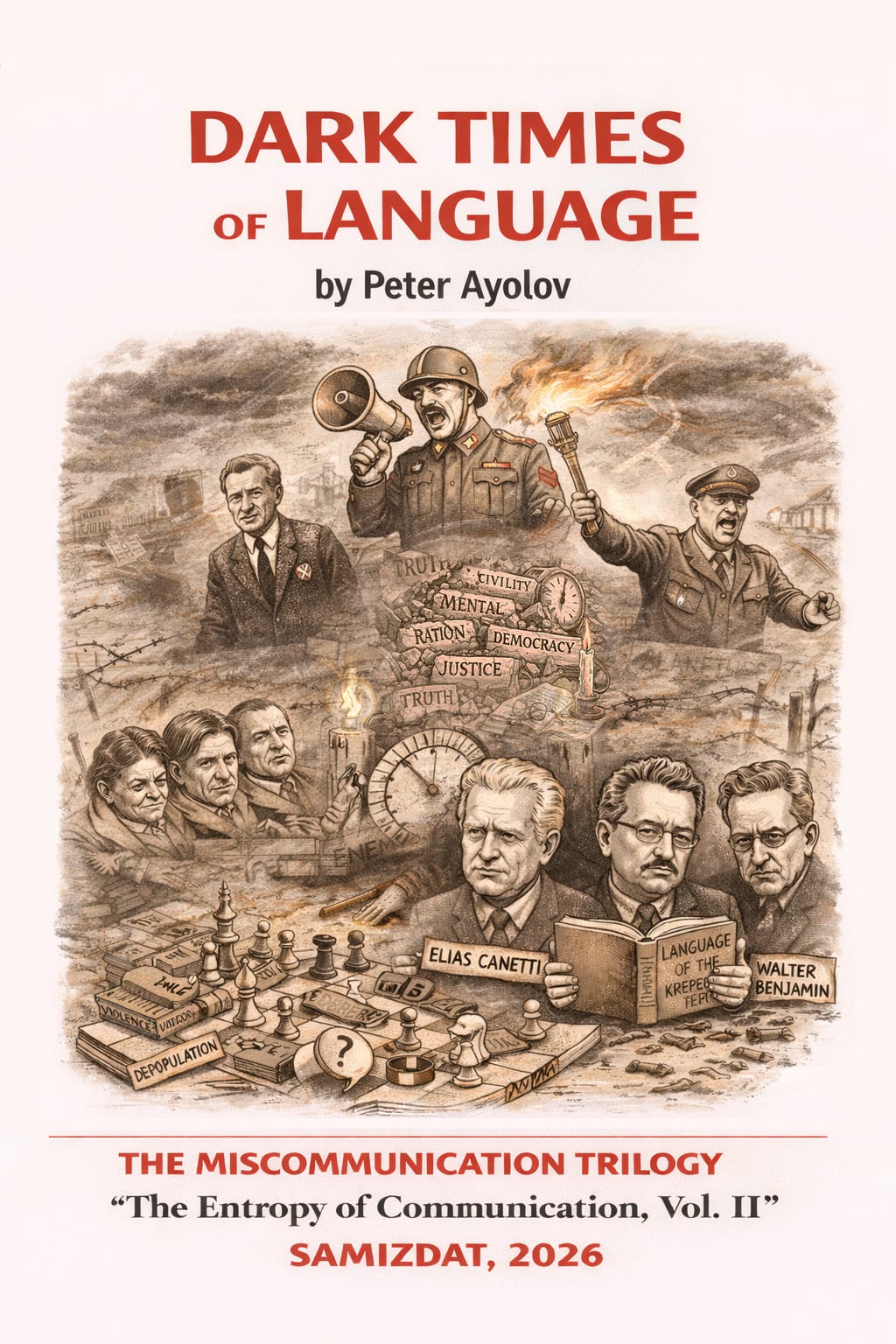
The Second Collapse of Meaning: A Review of Dark Times of Language
I. Civilization in the Age of Symbolic Exhaustion
Dark Times of Language, Part 20 of The Miscommunication Trilogy: “The Entropy of Communication, Vol. II”, is an ambitious philosophical and cultural study examining the relationship between civilizational decline and the degradation of language. Rather than presenting history as a sequence of purely political or economic transformations, the book approaches civilization through the lens of communication itself, arguing that societies often begin collapsing symbolically long before they collapse materially. The result is a wide-ranging and intellectually provocative work that combines media theory, historical analysis, philosophy, sociology, technological criticism, and cultural reflection into a unified exploration of the modern crisis of meaning. The central thesis of the book revolves around the idea of the planned obsolescence of language. According to this argument, modern technological civilization increasingly produces forms of communication designed not for continuity, truth, memory, or reflection, but for acceleration, emotional stimulation, ideological performance, and rapid symbolic replacement. In this framework, words become disposable products consumed within digital systems dominated by spectacle, outrage, visibility, and algorithmic circulation. Communication expands endlessly while genuine understanding deteriorates.
One of the book’s greatest strengths lies in its ability to connect historical collapse with modern technological culture. Dark Times of Language repeatedly demonstrates that periods of civilizational instability are often accompanied by symbolic fragmentation and communicational exhaustion. The discussion of the Late Bronze Age collapse, the Greek Dark Ages, the decline of Rome, medieval upheavals, apocalyptic movements, and religious eschatologies creates a broad historical backdrop against which contemporary crises appear not as isolated anomalies but as part of a recurring historical pattern. The work suggests that civilizations depend not only on military power or economic structures but also on stable symbolic systems capable of preserving memory, identity, legitimacy, and continuity. The book is especially effective when analyzing the paradox of modern communication systems. Contemporary civilization possesses unprecedented technological capacities for producing and distributing information, yet this informational abundance has not produced greater collective understanding. Instead, the acceleration of communication generates fragmentation, emotional overload, ideological polarization, and symbolic instability. The author repeatedly emphasizes that modern society suffers not from a lack of communication but from a collapse of meaningful communication. The problem is no longer silence or illiteracy but permanent informational saturation.
This idea gives the book its distinctive philosophical force. Unlike conventional critiques of media or technology that focus only on misinformation or propaganda, Dark Times of Language explores a deeper symbolic crisis affecting the foundations of reality itself. Public discourse increasingly becomes theatrical, performative, and emotionally manipulated. Political language functions less as a means of understanding reality and more as a mechanism of mobilization and control. Words lose stability as meanings shift according to ideological trends, media narratives, and digital amplification. Under these conditions, language no longer preserves civilization; it accelerates its fragmentation. The tone of the book is consistently serious and intellectually dense, yet it remains accessible because of its broad historical references and cultural examples. The volume moves fluidly between discussions of ancient collapse, medieval darkness, technological dystopias, conspiracy movements, artificial intelligence, industrial society, and digital communication. This interdisciplinary structure allows the work to present the modern world as part of a larger historical continuum rather than as a uniquely isolated moment. The book’s argument ultimately suggests that every civilization must confront the problem of symbolic continuity, and that the modern world increasingly fails to preserve the linguistic foundations necessary for sustaining collective meaning.
II. Technology, Apocalypse, and the Engineering of Human Consciousness
One of the most compelling dimensions of Dark Times of Language is its examination of technological civilization and its psychological effects. Throughout the volume, technology is treated not simply as a collection of tools but as an environment that reshapes human consciousness itself. The book repeatedly argues that modern communication systems alter attention, memory, identity, emotion, and social behavior, gradually transforming human beings into products of technological acceleration. The sections dealing with John Calhoun’s behavioral sink experiments, apocalyptic movements, industrial society, Bill Joy’s technological warnings, Ray Kurzweil’s singularity theories, and Theodore Kaczynski’s anti-technological critique form some of the strongest and most provocative parts of the work. Rather than presenting these figures as isolated intellectual curiosities, the book interprets them as symptoms of a civilization increasingly anxious about its own technological trajectory. Whether optimistic or pessimistic, all of these thinkers reveal fears surrounding the future of human autonomy within increasingly complex technological systems.
The treatment of apocalypticism is particularly noteworthy. The book explores religious eschatologies, failed prophecies, doomsday cults, conspiracy movements, and technological singularity narratives as symbolic responses to civilizational instability. In this interpretation, apocalyptic thinking emerges whenever societies lose confidence in their institutions, identities, and communicational systems. Humanity repeatedly attempts to restore coherence during periods of symbolic fragmentation by constructing narratives of collapse, purification, transformation, or redemption. This approach gives the work a strong philosophical continuity. Ancient religious visions, medieval fears, millenarian movements, technological dystopias, and modern conspiracy cultures are all interpreted as manifestations of the same underlying symbolic crisis. The book therefore avoids treating modern technological anxieties as entirely new phenomena. Instead, it situates them within a recurring historical pattern in which civilizations confronted uncertainty through apocalyptic narratives capable of transforming chaos into meaningful drama.
The analysis of industrial society and technological control also contributes significantly to the book’s intellectual impact. The discussions surrounding Theodore Kaczynski’s critique of technological civilization are presented carefully and analytically rather than sensationally. The book does not endorse violent methods, but it recognizes that technological systems increasingly reshape social organization, human psychology, and individual autonomy. Kaczynski’s concepts of the “power process,” surrogate activities, and technological control are interpreted as symptoms of a broader crisis in modern civilization where human beings become increasingly dependent upon systems operating beyond their understanding or control. At the same time, the book contrasts anti-technological pessimism with the optimism of transhumanist and singularity theories represented by Ray Kurzweil. This tension creates one of the work’s most interesting dynamics. On one side stand visions of technological transcendence promising liberation from biological limitations; on the other stand fears that technological systems will ultimately subordinate humanity entirely. Dark Times of Language does not fully resolve this tension, but instead presents it as one of the defining contradictions of the twenty-first century.
The psychological dimension of the book is equally important. The work repeatedly argues that modern communication environments produce fragmented identities, shortened attention spans, emotional volatility, and symbolic exhaustion. Individuals increasingly live inside systems designed for stimulation rather than reflection. Under these conditions, coherent identity itself becomes unstable, constructed through rapidly shifting ideological performances and digital interactions rather than through stable cultural continuity. One of the book’s strongest insights lies in its understanding of communication as a form of power. Modern societies are not controlled merely through economics or politics but through symbolic management. Algorithms shape visibility, media systems shape emotional responses, and communication technologies organize public perception. The control of language becomes inseparable from the control of reality itself. In this sense, Dark Times of Language presents technological civilization as a system increasingly governed through psychological and symbolic engineering rather than direct coercion alone.
III. The Future of Language and the Fate of Civilization
The final achievement of Dark Times of Language lies in its broader philosophical implications. Beyond its discussions of history, technology, media, and apocalyptic thought, the book ultimately asks a fundamental civilizational question: can human societies survive once language itself loses coherence? This question gives the work its enduring significance and transforms it from a cultural critique into a meditation on the future of humanity itself. The book argues persuasively that civilizations depend upon symbolic continuity in order to survive. Institutions require legitimacy. Communities require shared meanings. Historical memory requires stable forms of language capable of transmitting culture across generations. Once communication becomes entirely fragmented into emotional reactions, ideological performances, algorithmic signals, and disposable narratives, societies lose the symbolic foundations necessary for long-term continuity. The entropy of communication therefore becomes inseparable from the entropy of civilization itself.
The work’s title, Dark Times of Language, becomes increasingly meaningful as the argument develops. The “darkness” described throughout the book is not simply ignorance in the traditional sense. Modern civilization is flooded with information. Instead, darkness emerges through symbolic overload, fragmentation, and the inability to preserve coherent meaning within systems designed for permanent acceleration. This reinterpretation of the concept of dark ages is one of the book’s most original contributions. Unlike older historical narratives that associated darkness with illiteracy or technological decline, the book suggests that modern civilization may be entering a new kind of dark age defined precisely by informational excess. The historical sections concerning the Middle Ages, the Greek Dark Ages, and the Late Bronze Age collapse reinforce this interpretation effectively. The book does not romanticize earlier civilizations, nor does it simply repeat Enlightenment prejudices regarding historical decline. Instead, it presents periods of collapse as moments of symbolic transformation in which societies struggled to preserve continuity amid fragmentation and uncertainty. The implication is that contemporary civilization may now be confronting a similar threshold.
Stylistically, the work maintains a dense academic tone while remaining accessible through its use of recognizable historical examples and contemporary cultural references. The language is consistently philosophical and reflective, often emphasizing broad civilizational patterns rather than narrow technical arguments. Some readers may find the repetition of themes such as entropy, fragmentation, symbolic exhaustion, and technological acceleration somewhat relentless, but this repetition also reinforces the book’s central thesis: that modern civilization is trapped inside communicational systems producing permanent instability and repetition themselves. The scope of the book is remarkably broad. It moves from ancient eschatologies to modern artificial intelligence, from medieval famine to digital propaganda, from religious apocalypses to technological singularities. At times this ambitious structure risks becoming overwhelming, yet it also gives the work its unique intellectual identity. Dark Times of Language attempts nothing less than a unified theory of civilizational decline centered on communication and symbolic systems.
Importantly, the book does not conclude in complete despair. Although deeply critical of technological civilization, it leaves open the possibility of renewal through the restoration of meaningful communication, memory, reflection, and symbolic continuity. The work suggests that resistance to the entropy of communication begins with the preservation of language itself as a medium for truth, philosophical inquiry, and authentic human connection. In this sense, the book ultimately functions not only as a diagnosis of crisis but also as a warning intended to preserve the possibility of cultural survival. As a whole, Dark Times of Language stands as a provocative and intellectually ambitious contribution to contemporary cultural criticism. It combines philosophy, history, sociology, media theory, political critique, and technological analysis into a coherent meditation on the collapse of meaning in modern civilization. Whether one fully agrees with its conclusions or not, the book succeeds in raising urgent questions about the future of communication, human autonomy, historical memory, and the survival of civilization within increasingly technological environments.
In an age dominated by digital acceleration, ideological fragmentation, symbolic overload, and informational chaos, Dark Times of Language offers a powerful reminder that civilizations survive not merely through technological innovation or economic power, but through their ability to preserve coherent systems of meaning. The book’s central warning is therefore both philosophical and civilizational: when language itself becomes disposable, civilization risks becoming disposable as well.
About the Creator
Peter Ayolov
Peter Ayolov’s key contribution to media theory is the development of the "Propaganda 2.0" or the "manufacture of dissent" model, which he details in his 2024 book, The Economic Policy of Online Media: Manufacture of Dissent.
Enjoyed the story? Support the Creator.
Subscribe for free to receive all their stories in your feed.
Comments
There are no comments for this story
Be the first to respond and start the conversation.