
THE MISCOMMUNICATION TRILOGY, “The Entropy of Communication, Vol. II”, Part 22
Book Review

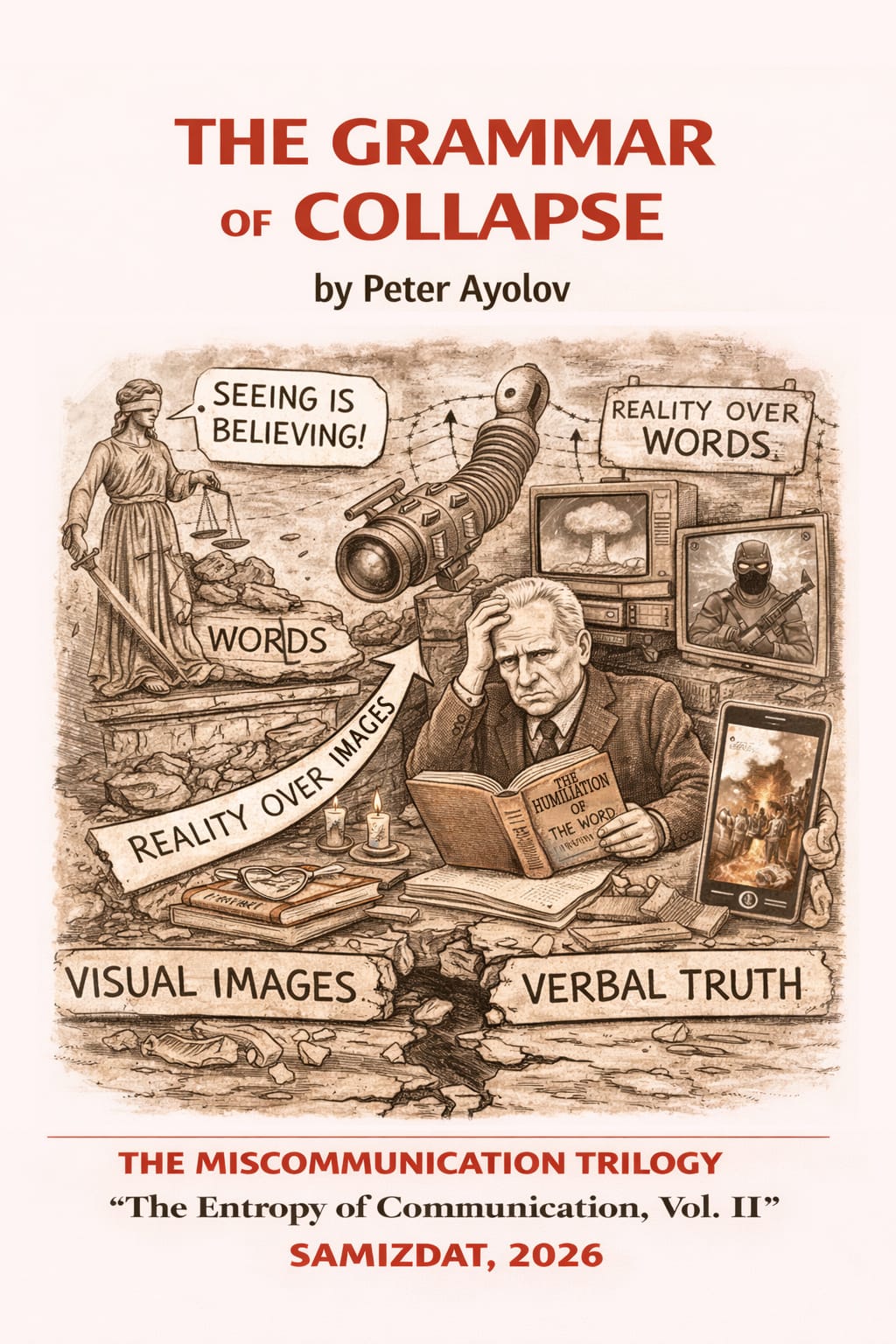
The Grammar Of Collapse: Language After Breakdown, Meaning After Stability
The Grammar Of Collapse And The End Of Linguistic Stability
The Grammar Of Collapse operates as a sustained interrogation of what happens to language when the assumption of stable meaning is no longer viable. Across THE Miscommunication Trilogy, Vol. II, language is no longer presented as a neutral system of communication but as a field under structural pressure, where coherence is constantly produced and simultaneously undermined. What distinguishes this work is not simply its focus on miscommunication, but its claim that miscommunication is no longer an exception to meaning—it is its operational base. In this sense, The Grammar Of Collapse describes a condition in which language continues to function while losing the conditions that once made function intelligible. Words still circulate, sentences still form, and discourse still expands, but the stability that would allow these elements to settle into shared understanding has eroded. Meaning does not disappear; it becomes unstable in real time, shifting faster than interpretation can stabilise it.
The book’s central gesture is to displace the idea of linguistic failure. Traditional models assume that communication breaks down when signals are distorted or when interpretation fails. Here, however, breakdown is not an interruption but a constant background condition. Language does not fall into confusion; it operates through it. The grammar in question is therefore not a set of rules governing clarity, but a set of conditions that allow instability to persist without resolution. What emerges is a model of language in which coherence is no longer primary but secondary, a temporary effect generated within a larger field of fluctuation. The collapse described is not dramatic or sudden; it is incremental, distributed, and ongoing. It occurs within the very processes that sustain communication.
The Grammar Of Collapse And The Economy Of Linguistic Exhaustion
In its second movement, The Grammar Of Collapse shifts from diagnosis to systemic description, situating linguistic instability within broader cultural and informational economies. Language is no longer treated as a self-contained structure but as part of an environment shaped by acceleration, repetition, and continuous revision. Within this framework, linguistic forms behave according to principles similar to economic systems under pressure. Words are circulated, repeated, modified, and rapidly depleted of specificity. Meaning is not erased but eroded through overexposure. The more frequently a term is deployed, the more it detaches from its original referential density, becoming a flexible but weakened unit of exchange.
The Grammar Of Collapse reads this process as a form of linguistic obsolescence. Not planned in a strict mechanical sense, but structurally produced through the conditions of constant communication. Expressions do not survive long enough to stabilise; they are replaced before sedimentation can occur. The result is a system in which language is permanently updated but never consolidated. This produces a temporal compression in which linguistic events occur in rapid succession without accumulation. The present becomes overloaded with articulation, while the past loses its capacity to anchor meaning. Language functions as continuous output rather than accumulated structure, generating a condition in which repetition replaces reflection. In this sense, collapse is not the failure of language but its mode of endurance. Communication persists precisely because it cannot stabilise itself.
The Grammar Of Collapse And Afterlanguage
The final movement of The Grammar Of Collapse develops its most radical implication: that miscommunication is not external to language but constitutive of it. Language does not degrade into misunderstanding; it is structured through it. Every attempt to produce clarity introduces further layers of instability. This leads to the notion of afterlanguage, a condition in which linguistic systems continue operating after the erosion of stable reference. In afterlanguage, meaning no longer depends on fixed relations between sign and object but on circulation itself. Words function as residual carriers of prior interpretations rather than as stable conveyors of meaning.
Within this condition, communication becomes structurally open-ended. No statement achieves final closure, and no interpretation exhausts the potential of what is said. Meaning is continuously displaced across chains of response, correction, and repetition. The system remains functional precisely because it cannot complete itself. The Grammar Of Collapse does not propose a return to linguistic stability. Instead, it suggests that such stability is no longer recoverable within the current conditions of communication. What remains is a system that operates through its own instability, generating temporary forms of coherence that dissolve as soon as they appear. As a synthesis of The Miscommunication Trilogy, Vol. II, the work reframes language not as a stable medium disrupted by error, but as a collapsing structure that produces meaning through continuous undoing. Collapse, in this sense, is not an endpoint but the ongoing condition of linguistic existence.
About the Creator
Peter Ayolov
Peter Ayolov’s key contribution to media theory is the development of the "Propaganda 2.0" or the "manufacture of dissent" model, which he details in his 2024 book, The Economic Policy of Online Media: Manufacture of Dissent.
Enjoyed the story? Support the Creator.
Subscribe for free to receive all their stories in your feed.
Comments
There are no comments for this story
Be the first to respond and start the conversation.