
The Counter-Enlightenment Dictionary, THE MISCOMMUNICATION TRILOGY, “The Entropy of Communication, Vol. II”, Part 21
Book Review

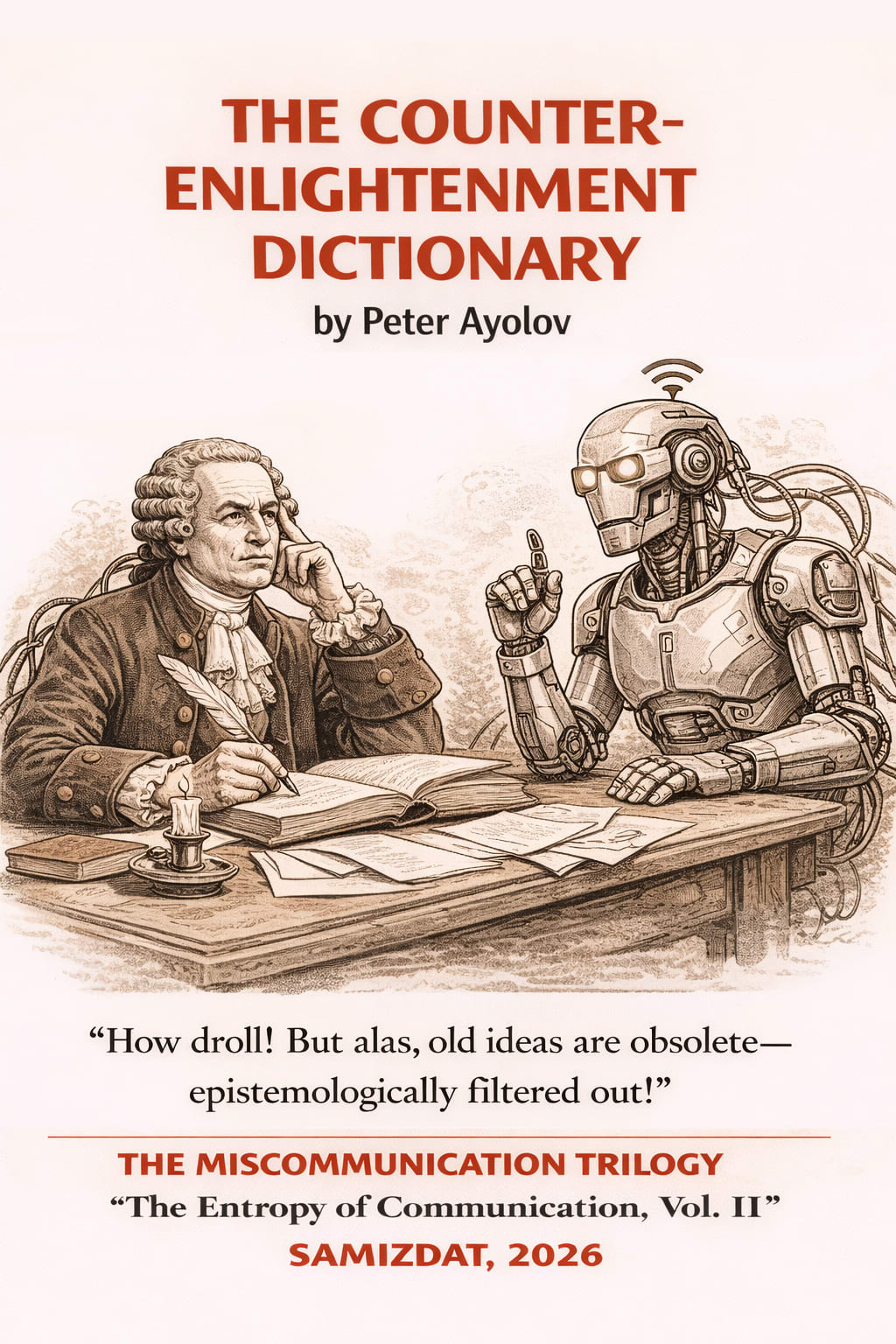
The Counter-Enlightenment Dictionary: The Ruins of Meaning in the Age of Informational Empire
I. The Collapse of Enlightenment Certainty
The Counter-Enlightenment Dictionary, Part 21 of THE MISCOMMUNICATION TRILOGY “The Entropy of Communication, Vol. II,” is a dense philosophical and cultural investigation into the gradual collapse of modern civilization’s symbolic foundations. The book functions simultaneously as political critique, media archaeology, civilizational diagnosis, and linguistic autopsy. Rather than presenting a traditional linear argument, the work constructs a conceptual map of intellectual decay, examining how modern societies have transformed communication into a mechanism of confusion, ideological management, and permanent instability. Through discussions of libertarian theory, neo-reactionary philosophy, accelerationism, democracy, technocracy, and anti-modern thought, the book argues that contemporary civilization no longer produces clarity but entropy.
The central achievement of the work lies in its treatment of language not merely as a neutral instrument of communication but as the primary battlefield of modernity. Political systems, technological systems, and media systems increasingly compete for control over definitions, symbols, narratives, and emotional associations. In this process, words lose permanence and become endlessly mutable tools of persuasion. Concepts such as democracy, freedom, equality, justice, and progress no longer possess stable philosophical meanings but function as rhetorical weapons deployed by competing institutions, ideological movements, corporations, governments, and media structures. The result is a society in which communication expands quantitatively while collapsing qualitatively.
One of the most compelling aspects of the book is its examination of the Enlightenment itself as an unfinished and internally contradictory project. Rather than treating modernity as the triumph of rational progress, the text presents modern civilization as increasingly trapped inside bureaucratic abstraction, technological acceleration, and ideological fragmentation. The Enlightenment promise of universal rationality gradually mutates into systems of centralized administration, mass propaganda, algorithmic governance, and informational overload. Rational discourse becomes replaced by emotional signaling, media spectacle, and symbolic polarization. The citizen becomes transformed into a permanent consumer of narratives rather than an autonomous participant in political or philosophical life.
The work draws extensively from controversial thinkers such as Hans-Hermann Hoppe, Nick Land, Murray Rothbard, and Aleksandr Dugin, not necessarily to endorse them uncritically but to demonstrate the emergence of intellectual systems reacting against liberal modernity. The book treats these ideological formations as symptoms of civilizational exhaustion rather than isolated political curiosities. Anti-democratic theory, accelerationism, neo-reactionary thought, and critiques of egalitarianism emerge here as intellectual consequences of a society increasingly incapable of sustaining coherent cultural meaning. By placing these movements within the wider crisis of communication, the book avoids simplistic moralism and instead investigates the structural conditions producing such philosophical reactions.
The prose itself mirrors the atmosphere it describes. The text moves through political theory, media critique, economic analysis, and philosophical pessimism with an intentionally overwhelming density that reflects the informational saturation of contemporary life. The reader experiences not only arguments about entropy but entropy itself as a communicative condition. This stylistic approach transforms the book into more than a political analysis; it becomes a simulation of informational collapse within late modern civilization.
At its core, The Counter-Enlightenment Dictionary argues that modern societies are increasingly unable to preserve semantic continuity across generations. Every technological cycle accelerates the destruction of linguistic permanence. Media systems reward immediacy over reflection, emotional intensity over conceptual precision, and visibility over truth. Public discourse becomes detached from historical memory and philosophical depth, resulting in a civilization trapped inside perpetual reinterpretation without stable foundations. In this sense, the book expands the trilogy’s central concept of the planned obsolescence of language into a broader theory of civilizational instability itself.
II. Democracy, Technology, and the Entropy of Civilization
A major strength of The Counter-Enlightenment Dictionary is its ability to synthesize political philosophy and media theory into a unified analysis of civilizational decline. Rather than examining democracy, capitalism, technological acceleration, or ideological extremism separately, the book treats them as interconnected components of a single communicative transformation. Modern democracy is not portrayed merely as a political system but as an informational structure dependent upon symbolic manipulation, emotional mobilization, and the continuous production of mass narratives.
The book repeatedly returns to the argument that democratic societies generate incentives for short-term thinking, spectacle politics, and rhetorical simplification. Electoral systems reward emotional immediacy rather than long-term civilizational planning. Political legitimacy increasingly depends on media performance, public relations management, and symbolic visibility rather than philosophical coherence or institutional stability. The result is a political order governed less by rational deliberation than by narrative competition between ideological factions operating inside fragmented media ecosystems.
This analysis becomes especially powerful when connected to the book’s treatment of technology and accelerationism. Drawing from Nick Land and accelerationist philosophy, the work explores how capitalism and digital technologies no longer merely shape culture but actively dissolve traditional forms of social organization. Technological systems accelerate communication while simultaneously destabilizing the interpretive frameworks necessary for understanding reality. Information circulates faster than societies can cognitively process it. Political ideologies mutate into internet aesthetics. Philosophical traditions become fragmented into memes, slogans, and algorithmically amplified emotional reactions.
The text carefully traces how digital culture transforms intellectual life itself. In earlier historical periods, philosophical systems developed slowly across generations through stable institutional frameworks. In contrast, contemporary communication systems reward fragmentation, novelty, and ideological volatility. Intellectual movements rise and collapse at extraordinary speed, often detached from rigorous theoretical foundations. The internet produces permanent ideological recombination, where concepts from libertarianism, postmodernism, nationalism, cybernetics, nihilism, and occultism merge into unstable hybrid systems. The Dark Enlightenment and accelerationism are presented as prime examples of this process.
One of the book’s most important contributions lies in its treatment of ideology as a media phenomenon rather than purely a philosophical one. Political extremism is not explained simply through economic conditions or psychological motivations but through transformations in communication itself. Media saturation creates conditions where radical narratives flourish because complexity becomes cognitively exhausting. Simplified worldviews offering certainty, hierarchy, or technological destiny gain appeal within societies overwhelmed by informational chaos.
The work also presents a striking analysis of the relationship between centralization and communication. Modern states increasingly rely on bureaucratic systems, surveillance technologies, educational institutions, and mass media to maintain symbolic authority. However, the more communication expands, the more difficult centralized narrative control becomes. This paradox produces escalating informational conflict, where governments, corporations, ideological groups, and digital subcultures compete to monopolize symbolic legitimacy. The fragmentation of authority creates conditions where conspiracy theories, ideological extremism, and civilizational pessimism flourish.
At the same time, the book avoids presenting technological development as purely negative. Instead, it portrays technological acceleration as historically ambiguous. Technology expands human capability while simultaneously destabilizing traditional structures of meaning, morality, and identity. Modern civilization becomes trapped between unprecedented communicative power and declining interpretive coherence. The result is a paradoxical society in which humanity possesses more information than ever before yet experiences growing confusion regarding truth, value, and reality itself.
The book’s discussion of anti-modern political thought is especially provocative. Rather than dismissing reactionary critiques of democracy outright, the text investigates why such critiques emerge repeatedly during periods of technological and cultural instability. Thinkers like Hoppe and Dugin are treated as intellectual products of civilizational anxiety, responding to perceived failures of liberal modernity, globalization, and democratic fragmentation. Whether one agrees with these thinkers or not, the book argues that their growing influence reflects deeper crises within contemporary communication systems and political legitimacy.
Ultimately, the second section of the work transforms political philosophy into a theory of informational civilization. Democracy, capitalism, media systems, and technological acceleration are revealed as mutually reinforcing processes contributing to the destabilization of language and meaning. Civilization itself becomes increasingly governed by entropy: the tendency toward symbolic fragmentation, institutional exhaustion, and communicative overload.
III. The Planned Obsolescence of Language
The Counter-Enlightenment Dictionary reaches its greatest philosophical depth in its treatment of language as the central casualty of modern civilization. Throughout the trilogy, the concept of the planned obsolescence of language functions as the foundational diagnosis of communicative decay, but in this volume the idea achieves its fullest expression. The book argues that modern societies systematically destroy linguistic continuity in order to sustain political, technological, and economic systems dependent on perpetual novelty, ideological reinvention, and informational circulation.
Language no longer serves primarily as a medium for preserving collective memory or transmitting stable meaning across generations. Instead, words become temporary commodities shaped by media cycles, political campaigns, technological platforms, and bureaucratic institutions. Concepts are constantly redefined, emptied of historical content, and reinserted into public discourse with altered meanings. The speed of communicative change prevents stable interpretation from emerging. Semantic instability becomes not an accidental byproduct of modernity but one of its central operating principles.
The book’s analysis of informational capitalism is particularly compelling in this regard. Just as industrial capitalism depends upon the planned obsolescence of physical commodities to sustain economic growth, informational capitalism depends upon the planned obsolescence of meanings to sustain communicative circulation. News cycles, social media trends, ideological controversies, and technological innovations all require continuous symbolic disruption. Stability becomes economically and politically undesirable because stable meanings reduce informational consumption.
This process produces profound psychological and cultural consequences. Individuals increasingly experience reality through fragmented symbolic systems lacking historical continuity. Identity itself becomes unstable, shaped by fluctuating media narratives and digital environments rather than durable communal traditions or philosophical structures. Public discourse fragments into isolated informational tribes, each operating within its own symbolic vocabulary. Communication persists quantitatively while mutual understanding collapses qualitatively.
The book also presents a powerful critique of modern education and intellectual life. Universities, media institutions, and bureaucratic systems increasingly prioritize ideological conformity, administrative management, and informational production over philosophical inquiry and civilizational continuity. Intellectual culture becomes professionalized, fragmented, and detached from broader existential questions. Knowledge expands technically while wisdom declines culturally. In this sense, the crisis of language becomes inseparable from the crisis of civilization itself.
Stylistically, the work reflects the traditions of media theorists such as Marshall McLuhan, Jean Baudrillard, and Neil Postman while incorporating the darker civilizational pessimism associated with contemporary accelerationist and neo-reactionary thought. Yet the book remains distinct in its attempt to synthesize these influences into a broader theory of communicative entropy. Rather than merely criticizing media systems or technological modernity, it presents a total philosophical framework for understanding how informational societies destabilize their own symbolic foundations.
The Counter-Enlightenment Dictionary is ultimately less a conventional political text than a philosophical anatomy of communicative collapse. It examines how modern civilization, despite unprecedented technological sophistication, increasingly loses the ability to sustain coherent narratives, stable meanings, and durable cultural memory. The book portrays contemporary society as trapped within a self-accelerating informational machine that simultaneously expands communication and destroys the conditions necessary for meaningful understanding.
As a contribution to THE MISCOMMUNICATION TRILOGY “The Entropy of Communication, Vol. II,” this volume stands as one of the project’s most ambitious and philosophically expansive works. It transforms debates about democracy, accelerationism, anti-modernity, and technological change into components of a larger civilizational diagnosis centered on language itself. The result is a dark but intellectually provocative portrait of a world where communication no longer guarantees understanding and where the future of civilization may ultimately depend upon whether language can survive its own acceleration.
About the Creator
Peter Ayolov
Peter Ayolov’s key contribution to media theory is the development of the "Propaganda 2.0" or the "manufacture of dissent" model, which he details in his 2024 book, The Economic Policy of Online Media: Manufacture of Dissent.
Enjoyed the story? Support the Creator.
Subscribe for free to receive all their stories in your feed.
Comments
There are no comments for this story
Be the first to respond and start the conversation.