
The Babbling Ape, THE MISCOMMUNICATION TRILOGY, “The Tower OF Babble, Vol. III”, Part 1
Book Review

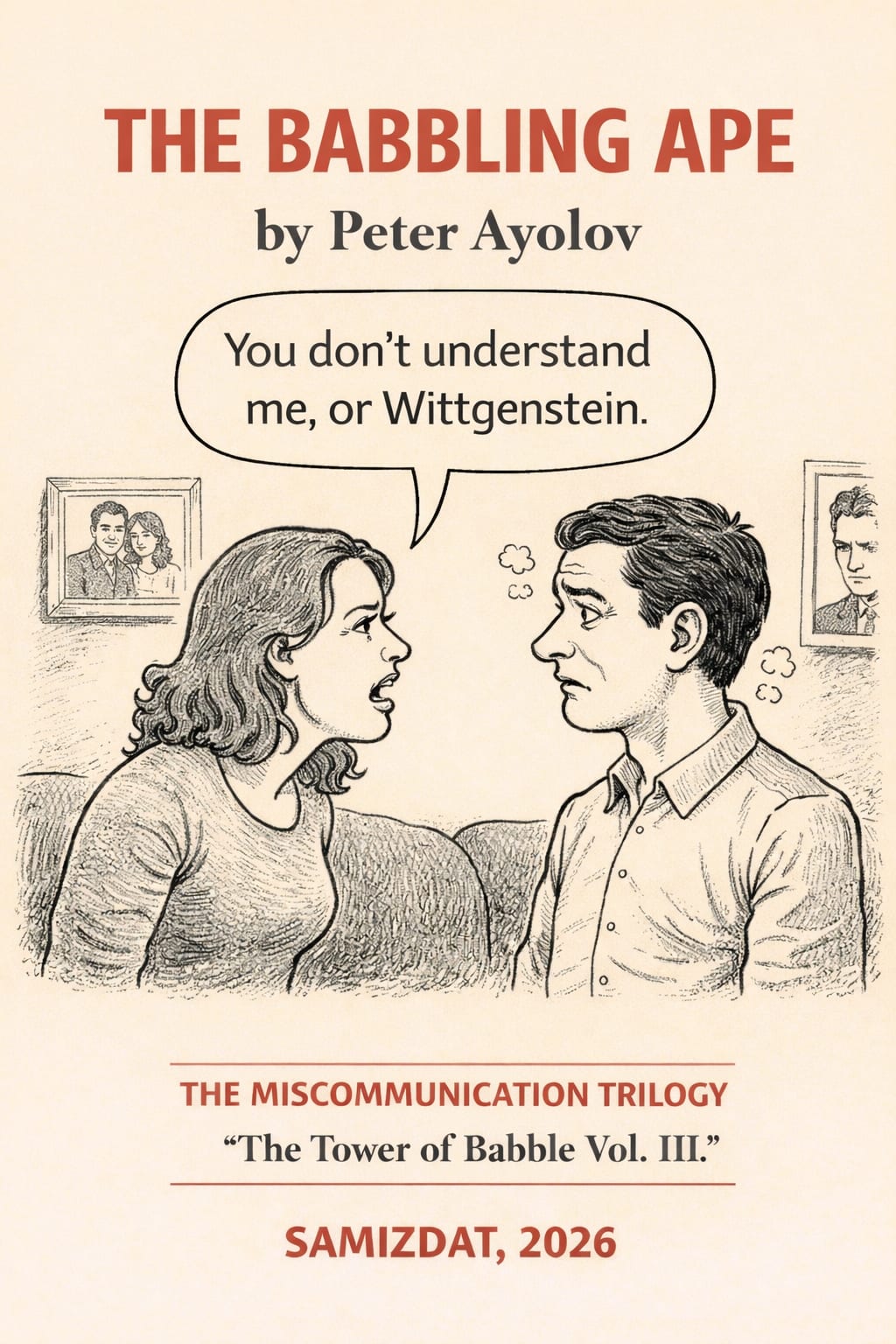
The Animal of Endless Speech: A Review of The Babbling Ape
The Linguistic Animal and the Problem of Civilization
The Babbling Ape is one of the most ambitious contributions to contemporary philosophical reflections on language, communication, and civilization. Positioned at the intersection of philosophy, linguistics, anthropology, media theory, semiotics, and cultural criticism, the work develops a comprehensive argument concerning the role of language in shaping human existence. Rather than treating language as a neutral instrument for transmitting information, the book presents it as the central force responsible for the emergence of civilization itself. The fundamental claim running throughout the text is that humanity does not merely use language but increasingly inhabits linguistic environments that mediate perception, identity, memory, power, and social organization. The result is a civilization that exists simultaneously within reality and within symbolic constructions that often obscure the reality they claim to describe.
One of the greatest strengths of the work is its refusal to approach language from a single disciplinary perspective. The book moves confidently between evolutionary theory, linguistic relativity, philosophy of language, semiotics, media studies, and political communication. Thinkers such as Nietzsche, Korzybski, Bateson, Borges, Baudrillard, McLuhan, Musil, Klemperer, Huxley, Eco, Habermas, and many others are woven together into a remarkably coherent narrative. Despite the diversity of sources, the book maintains a consistent focus on a central problem: the growing gap between direct experience and symbolic representation. The argument develops gradually, beginning with language as an adaptive biological tool and expanding into an analysis of civilization as a system of accumulated linguistic abstractions.
The discussion of speech and language provides one of the most original dimensions of the work. The distinction between speech as an immediate practical activity and language as a vast symbolic inheritance allows the author to reinterpret the development of civilization itself. Speech appears as a tool for coordination, cooperation, and survival, while language emerges as a mechanism for preserving collective memory across generations. Civilization becomes less a material phenomenon than a linguistic one. Institutions, laws, religions, ideologies, and scientific traditions exist because symbolic systems preserve and transmit them. This insight allows the book to move beyond traditional debates concerning communication and instead examine the deeper structures through which social reality is produced.
Particularly noteworthy is the book's treatment of linguistic inheritance. Biological evolution transmits genes, but civilization transmits symbolic structures. Through language, each generation inherits not only knowledge but also assumptions, classifications, narratives, and systems of interpretation. The book repeatedly demonstrates that language functions as an environment rather than a mere instrument. Human beings are born into symbolic systems they did not create and spend their lives navigating meanings they only partially understand. This perspective gives the work a distinctly anthropological character. The human species appears less as a rational actor directing language and more as a biological organism adapting to symbolic environments of increasing complexity.
The Babel Condition and the Crisis of Meaning
The most compelling contribution of The Babbling Ape is its reinterpretation of the Tower of Babel. Rather than treating Babel as a historical event or theological myth explaining linguistic diversity, the book transforms it into a permanent condition of civilization. Babel becomes a metaphor for the inevitable consequences of symbolic accumulation. Every generation adds new layers of abstraction, representation, and interpretation. The symbolic structure grows continuously until it exceeds the understanding of those who inhabit it. Human beings find themselves living within conceptual architectures whose complexity makes complete comprehension impossible.
This reinterpretation allows the author to address some of the most pressing problems of contemporary society. Information overload, political polarization, media manipulation, ideological fragmentation, and the crisis of public discourse are all examined as manifestations of the same underlying phenomenon. Modern communication technologies have increased the quantity of communication without necessarily increasing understanding. The book argues that contemporary societies suffer not from a lack of information but from an excess of symbolic production. The challenge is no longer acquiring knowledge but navigating overwhelming quantities of representations competing for attention.
The treatment of propaganda is particularly effective. The book rejects the common assumption that propaganda represents a corruption of language. Instead, it suggests that propaganda emerges naturally from the symbolic capacities embedded within language itself. Communication is never neutral. Every symbolic system organizes attention, establishes categories, and shapes perception. The analysis of war propaganda, peace propaganda, ideological language, and political persuasion demonstrates how language functions as a technology of social organization. The discussion is especially persuasive when examining why narratives of conflict often prove more emotionally compelling than narratives of reconciliation. The book suggests that language evolved primarily as a social adaptation rather than an instrument for discovering objective truth. Consequently, communication frequently serves identity, loyalty, coordination, and status before it serves understanding.
Another significant strength lies in the author's engagement with semiotics and theories of representation. The progression from Korzybski's distinction between map and territory to Baudrillard's theory of simulation is handled with remarkable clarity. The book traces the historical evolution of representation from simple symbolic tools to contemporary media environments in which representations increasingly precede reality itself. The analysis of maps, models, simulations, and media systems provides a powerful framework for understanding modern life. Human beings become inhabitants of symbolic worlds whose relationship to direct experience grows increasingly uncertain. The result is a civilization organized around representations that often acquire greater authority than the realities they supposedly describe.
The chapters dealing with quotation, cliché, and inherited speech deserve special attention. Drawing upon Nikola Georgiev and Pierre Bayard, the book develops the provocative idea that most people speak language in much the same way they discuss books they have never fully read. Speakers rely upon fragments, inherited expressions, clichés, and cultural assumptions. Participation becomes possible without mastery. Communication becomes performative. The implications of this argument are far-reaching. Much of what appears to be understanding may actually be participation in symbolic systems whose foundations remain invisible. The book's central metaphor of the "babbling ape" emerges from this realization. Human beings become creatures capable of extraordinary symbolic performances while remaining uncertain about the meanings they reproduce.
The Fate of the Babbling Ape
The final achievement of The Babbling Ape lies in its ability to connect these diverse themes into a broader reflection on the human condition. The book ultimately argues that language did not fundamentally transform human nature. It expanded human capacities without abolishing the biological foundations from which those capacities emerged. Human beings remain subject to evolutionary pressures, social instincts, status competition, tribal loyalties, and cognitive limitations. Civilization magnifies these tendencies through symbolic systems rather than replacing them. The ape acquires language, institutions, technologies, and ideologies, but it remains an ape.
This conclusion gives the work a distinctive philosophical orientation. Unlike optimistic accounts of progress that celebrate language as humanity's liberation from nature, The Babbling Ape presents a more complex picture. Language appears simultaneously as humanity's greatest achievement and its greatest source of confusion. It enables civilization while generating misunderstanding. It preserves knowledge while preserving error. It creates communities while creating divisions. The symbolic world becomes both a blessing and a burden. The book is especially effective in resisting simplistic solutions. It does not advocate abandoning language, rejecting civilization, or returning to some imagined pre-linguistic condition. Instead, it calls for greater awareness of the limitations of symbolic systems. The recurring emphasis on silence, skepticism, direct experience, and intellectual humility functions not as mysticism but as a corrective to symbolic excess. The proposed solution is not the destruction of language but the recognition that language remains a tool rather than reality itself.
Perhaps the most important contribution of the work is its diagnosis of modern civilization as a civilization of representation. Human beings increasingly interact with descriptions, narratives, models, and simulations rather than with direct experience. The symbolic world has become so extensive that many individuals rarely distinguish between reality and its representations. The book argues that the future challenges facing humanity will emerge less from material scarcity than from symbolic saturation. The crisis of the twenty-first century is not a lack of information but an excess of language. As a philosophical synthesis, The Babbling Ape succeeds remarkably well. It brings together a vast range of thinkers and traditions while maintaining conceptual coherence. Its central metaphor is memorable, its arguments are provocative, and its implications extend across disciplines. The work stands as both a critique of contemporary communication and a broader meditation on civilization itself. By examining language as humanity's defining environment rather than merely its defining tool, the book offers a compelling reinterpretation of what it means to be human. The result is a challenging, ambitious, and intellectually stimulating work that invites readers to reconsider the relationship between speech, reality, culture, and power. Whether one ultimately accepts all of its conclusions or not, The Babbling Ape succeeds in demonstrating that the most important questions concerning civilization may ultimately be questions about language itself.
About the Creator
Peter Ayolov
Peter Ayolov’s key contribution to media theory is the development of the "Propaganda 2.0" or the "manufacture of dissent" model, which he details in his 2024 book, The Economic Policy of Online Media: Manufacture of Dissent.
Enjoyed the story? Support the Creator.
Subscribe for free to receive all their stories in your feed.
Comments
There are no comments for this story
Be the first to respond and start the conversation.