
Your Tattoo Starts a Fight Your Immune System Never Finishes
A Swedish study of nearly 12,000 people links tattoo ink to lymphoma risk. Laser removal showed the strongest signal.
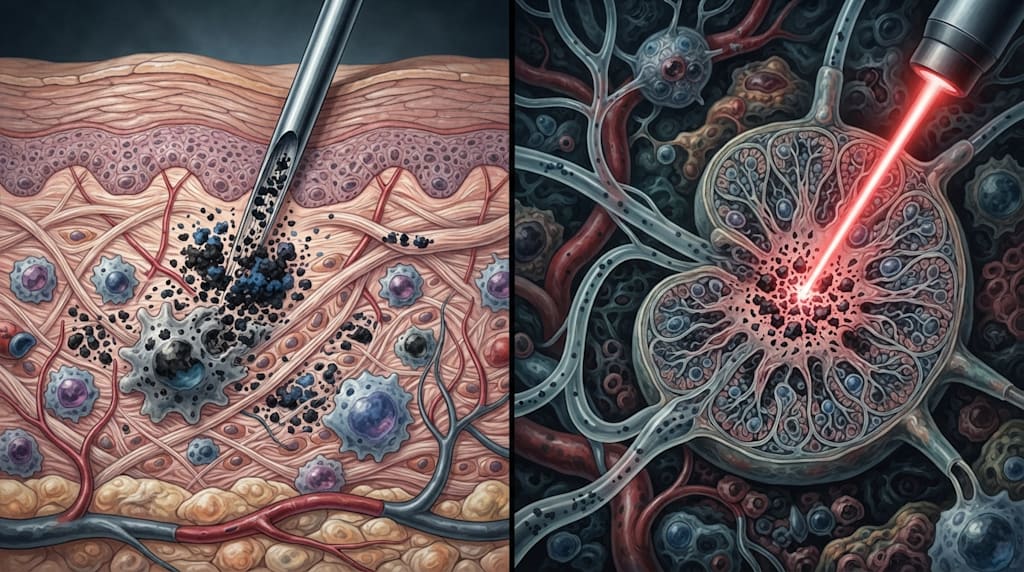
A tattoo needle punctures the skin hundreds of times per minute. It delivers pigment into the dermis. The dermis is not the epidermis. It does not shed on a regular cycle. Once pigment gets in, it stays.
The immune system detects something wrong. Macrophages leave blood vessels, cross tissue spaces, and arrive around the pigment particles. They extend pseudopodia, wrap the particles inside the cell membrane, and form phagosomes. Normally, phagosomes fuse with lysosomes, and enzymes break down the contents. Tattoo pigment is not bacteria. Carbon black, titanium dioxide, azo dyes. These particles have stable chemical structures. Lysosomal enzymes cannot do much with them.
Macrophages swallow the pigment but cannot digest it. They become engorged. They turn into so-called pigment cells, which remain in the dermis. Some pigment particles enter lymphatic vessels with these cells and eventually deposit in lymph nodes. One study estimated that about 32% of injected pigment is transported away within six weeks. Over time, that proportion may reach as high as 99%.
From an immunological standpoint, the phrase “a tattoo is a lifelong battle for immune cells” holds up. The battle is silent. You cannot feel it. It keeps going.
Swedish study: tattoos and lymphoma
In 2024, a Swedish nationwide case-control study appeared in the Lancet subjournal eClinicalMedicine. Researchers identified all cases of malignant lymphoma diagnosed between 2007 and 2017 in people aged 20 to 60 from the Swedish National Cancer Register. They matched three random controls by age and sex from the total population register. Nearly 12,000 people entered the final analysis.
The main results:
Tattooed people had an overall lymphoma risk about 21% higher than non-tattooed people (risk ratio 1.21, confidence interval 0.99–1.48). The confidence interval crossed 1. The matched analysis did not reach statistical significance.
In the unmatched analysis, the risk ratio was 1.18, with a confidence interval of 1.01–1.39. That was significant.
People who got their first tattoo within two years before diagnosis had the highest risk. Their risk was 81% higher than non-tattooed people (risk ratio 1.81, confidence interval 1.03–3.20).
Between 3 and 10 years, the risk fell.
After 11 years, the risk rose again to about 1.19.
Researchers explained the “high, then low, then high again” curve this way: recent tattooing triggers an acute period of immune disturbance. The later rise in risk is tied to chronic stimulation from long-term pigment deposition in lymph nodes.
The study did not find that larger tattoo area meant higher risk. The highest risk appeared in people whose tattoo area was smaller than one palm (risk ratio 1.29). People with an area larger than one palm had a risk ratio of only 1.18. Researchers said area was assessed during the survey and could not accurately reflect the actual area at diagnosis. Small tattoos may also have dense lines, which means more pigment per unit of skin.
For color, people with only black or gray tattoos had a risk ratio of 1.23. Those with black-gray plus color had 1.21. The difference was small. In the unmatched analysis, the risk ratio for black-gray only reached 1.32 and was significant.
Laser removal: the highest-risk option
The study’s sharpest signal was laser tattoo removal.
People who had undergone laser tattoo removal had a lymphoma risk ratio of 2.99, with a confidence interval of 1.37–6.52. The sample was small, only 13 cases. The number still makes you pause.
The mechanism is chemical. Azo dyes commonly used in tattoo inks break down under laser irradiation. The breakdown products include o-toluidine, diaminonitrotoluene, and dichlorobenzidine. These are known carcinogenic aromatic amines. The laser breaks up the pigment. It also turns relatively stable large molecules into smaller, more active, more easily absorbed carcinogens.
Not everyone who has laser tattoo removal will get lymphoma. A high risk ratio does not equal inevitable causation. But laser tattoo removal is not a zero-risk eraser.
Other effects
Long-term deposition of tattoo ink in lymph nodes may cause persistent low-grade inflammation. This inflammation usually has no obvious symptoms. It means the immune system is constantly working overtime.
Animal studies have found that tattoo ink may modulate immune responses in a vaccine-specific way. It reduced antibody responses to mRNA COVID-19 vaccines. It enhanced responses to inactivated influenza vaccines. This research still needs more human data. It suggests tattoos are not completely neutral decorations.
Tattoos may also cause local allergic reactions, especially to colored pigments such as red and yellow. They can cause granulomas, keloids, and skin infections. They can cause localized heating or stinging during MRI scans. They can interfere with the diagnosis of certain skin diseases.
What to do if you already have a tattoo
There is no need to panic. This study reports a statistical association. It is not a verdict that tattoos inevitably cause cancer. Lymphoma is the result of multiple factors. Tattoos may be only one very small risk factor.
Concrete steps:
Pay attention to body signals. Unexplained lymph node swelling, persistent fever, night sweats, or weight loss should get medical attention promptly.
Avoid unnecessary laser removal. If a tattoo is not causing health problems, there is no need to rush into laser treatment out of fear of cancer. Laser itself may introduce new risks.
Choose reputable studios. If you plan to get another tattoo, choose a studio with good hygiene and a legitimate pigment source.
Special populations should be cautious. People with autoimmune diseases, keloid tendencies, a history of skin cancer, or those receiving immunosuppressive treatment should consult a doctor before getting a tattoo.
The battle between immune cells and pigment particles begins the moment the needle enters the skin. It does not end.
About the Creator
Jin
Writer of reamstories
https://reamstories.com/jin
Enjoyed the story? Support the Creator.
Subscribe for free to receive all their stories in your feed. You could also become a paid subscriber, letting them know you appreciate their work.
Comments
There are no comments for this story
Be the first to respond and start the conversation.