
While You Were Doomscrolling, These 9 Things Got Better
The EU moved to ban social media for under-13s, England approved a life-extending breast cancer drug, and solar got so cheap it’s being called “offensively cheap.” Here are the wins you missed.
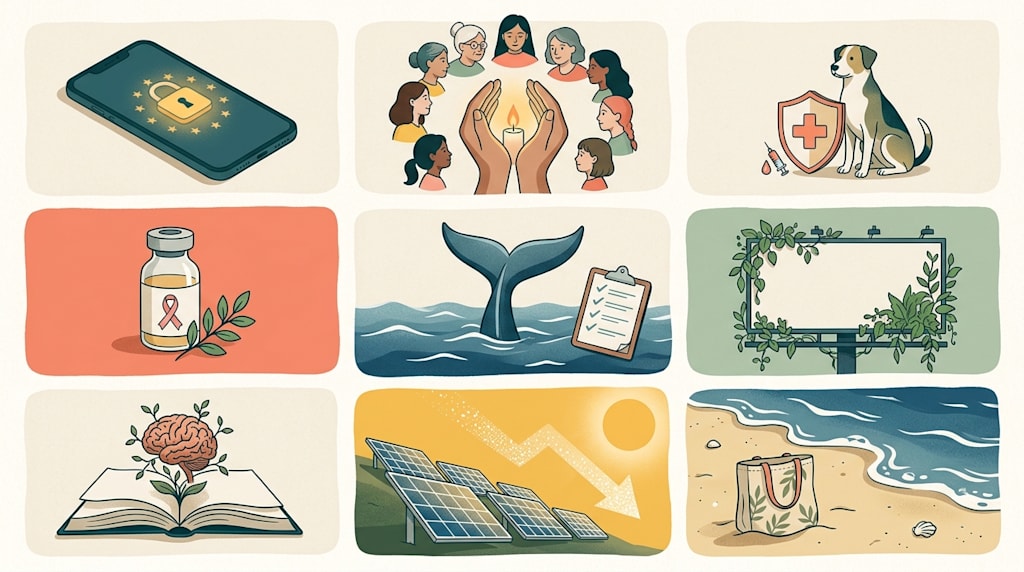
Nine specific things that improved this week
1. EU: under-13s cannot use social media
On Wednesday, European Commission President Ursula von der Leyen announced the plan. She said: “Many perceive the power of big tech as overwhelming and impossible to roll back. I disagree. We do not have to accept addictive social media designs. We do not have to accept children being drawn into ever more extreme content. It is us who decide our rules, not tech companies.”
The proposal would set up an EU verification system. App stores, not platforms, would police the gate. Children aged 13 to 15 could only use platforms for one hour a day through “mini accounts” tied to a parent or guardian’s social media account.
Tech policy expert Patrick Grady told Positive News: “Teens will find it much harder to circumvent these bans. The EU will succeed where Australia has so far failed.”
Critics worry about privacy. Everyone would have to submit personal information to access platforms. Leanda Barrington-Leach of 5Rights said: “The days of tech exceptionalism and their systematic exploitation of children for profit are numbered.”
2. $15 million goes to the front line to end FGM
A new $15 million fund has launched to help end female genital mutilation (FGM). An estimated 4.4 million girls are at risk of being cut each year globally. The United Nations hopes to end FGM by 2030, but donor funding is falling.
The fund is called the Her Horizon Fund. The Wallace Global Fund provided $14 million in seed funding. An anonymous donor added $1.5 million. Susan Gibbs of the fund told the Guardian: “We’re at this critical inflection point. Most frontline organisations have been absolutely starved for resources. More direct funding would allow them to sustain and scale up their work.”
3. Chile: first South American country to eliminate dog-transmitted rabies
Chile has become the first country in South America to eliminate dog-transmitted rabies as a public health problem. Last week, Bhutan received the same recognition from the World Health Organization.
The achievement follows more than five decades of canine vaccination, disease surveillance, and access to post-exposure medication for people who are bitten. WHO Director-General Tedros Adhanom Ghebreyesus called it a “historic achievement” and said it “demonstrates the impact of sustained investment in public health.”
4. England: Enhertu approved, seven extra months
Enhertu has been approved in England. The drug can give patients with incurable breast cancer an average of seven extra months to live. Some live up to three years longer. Scotland and 26 EU countries already made it available on their health services. England’s National Institute for Health and Care Excellence declined to approve it in 2024, saying it was too expensive.
After a two-year campaign by patients and charities, that decision was overturned. Campaigner Kathryn Hulland said: “This decision brings a renewed sense of hope, not only for me but for thousands of other women living with incurable HER2-low metastatic cancer. Hope of more precious time with our loved ones, hope I may still be here to support my nine-year-old daughter into high school.”
5. Iceland: commercial whaling may be coming to an end
Iceland’s government announced that a review of the country’s whaling legislation would take place next February. It could lead to a permanent ban on commercial whaling. Iceland, Japan, Norway and the Faroe Islands are the only countries that still allow commercial whaling, despite the 1986 global moratorium.
Some 80 adult fin whales have already been hunted this season in Icelandic waters, according to the nonprofit Humane World for Animals. Wendy Higgins, its director of media, said: “This is a really significant milestone in efforts to consign to history Iceland’s cruel and needless whale hunts. There is considerable political and public support for this bill to ban commercial whaling, and compelling ethical, veterinary, legal and conservation reasons to hope it succeeds.”
6. Bristol: council billboards no longer serve polluters
On Monday, the Green-led council in Bristol voted to ban ads for fossil fuels, flights, SUVs and, in a UK first, ultra-fast fashion on council-run billboards.
Deputy leader Heather Mack said: “We don’t want Bristol to be a billboard for polluters while we’re working hard to improve health, air quality and nature in the city.” Amsterdam, Cardiff and Edinburgh have taken similar measures. Corporations have criticised such moves, saying they curb commercial freedom. Nicola Wilks, co-founder of campaign group Adfree Cities, said: “Ad bans are a catalyst for healthy change. Removing tobacco ads saved lives by reducing levels of smoking. It feels like common sense.”
7. Reading: 15 minutes a day, and the brain benefits
New research from the University of Cambridge links reading with better mental health, greater empathy and a lower risk of dementia. The report analysed data from existing studies involving thousands of adults and children. One study linked reading to a 33% reduction in the risk of Alzheimer’s disease.
Study lead Prof Barbara Sahakian said: “Reading is a great way to support our brain health, develop important cognitive skills and boost our wellbeing. It’s something we ought to be encouraging from an early age. But really, it’s never too late to start.”
Singapore has launched the Read SG platform. It lets residents track their reading habits and earn rewards for reading. Melissa Tam, chief of the national library board, told the Straits Times: “We live in a world of extraordinary abundance, of content, information and stimulation. At any moment, we can scroll through hundreds of headlines, watch a video or get a summary of almost anything.” She hopes the new strategy will encourage deeper reading. “We know that habits are built through small, consistent actions. So, we are starting with a simple goal – just read for 15 minutes a day. On the bus, before bed or over lunch.”
8. Solar: 12 cents per watt
The cost of solar power hit new lows. Chinese-made photovoltaic panels now cost around $0.12 per watt. In 2000, the cost was $6. In 1975, it was $100. The Financial Times quoted an expert from energy thinktank Ember describing solar as “offensively cheap.”
No other energy technology has fallen that fast. As prices dropped, many countries set new records for installations. The conflict in the Middle East pushed up fossil fuel prices, which made solar more attractive. Ember’s latest research finds that 97% of the world’s population live in countries where solar and wind potential is more than 10 times current electricity demand.
9. UK beaches: 80% fewer plastic bags
The Marine Conservation Society reported that the number of plastic bags washing up on UK beaches has fallen by 80% since charges for single-use carriers were introduced. Data collected by volunteers shows the share of beach rubbish made of plastic rose from 75% in 1995 to 87% in 2025. Targeted policies can work.
Catherine Gemmell of the MCS said: “Simple policies can make a big difference. The number of plastic carrier bags recorded on UK beaches has fallen by 80%. We’re looking forward to a similar drop in drinks container litter with the introduction of deposit return scheme in October 2027.” She said plastic bottles were the “tip of the iceberg” and called for stronger legislation to tackle single-use plastic.
Iceland’s review is next February. The UK’s deposit return scheme is in October 2027. Singapore’s reading target is 15 minutes a day. On Bristol’s council billboards, fossil fuel ads have already been taken down. What comes down next, the council minutes will record.
About the Creator
Jin
Writer of reamstories
https://reamstories.com/jin
Enjoyed the story? Support the Creator.
Subscribe for free to receive all their stories in your feed. You could also become a paid subscriber, letting them know you appreciate their work.
Comments
There are no comments for this story
Be the first to respond and start the conversation.