
The “Healthy” Mooncake That Sent Dozens of Employees to the Bathroom
Inside the Huawei Mid-Autumn gift box that turned a shared spreadsheet into a symptom log, and exposed the sugar alcohol trap hiding in “sugar-free” food.
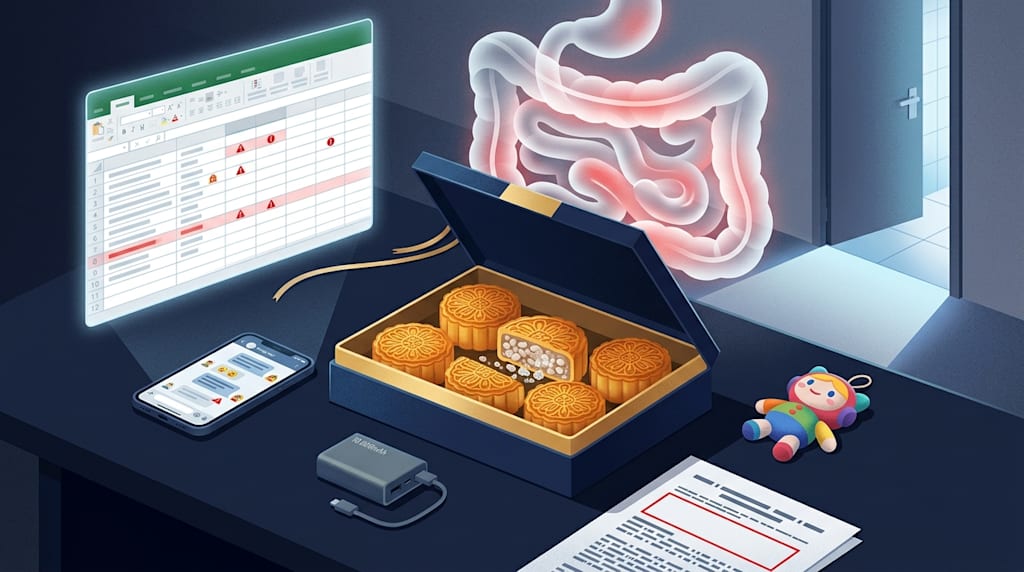
The physiological ledger of a mooncake
On September 21, 2026, a post appeared on Huawei’s Car BU employee forum. The poster said that after eating the Mid-Autumn mooncakes distributed by the company, he had made three trips to the bathroom. Comments followed: “I got hit too.” “You’re late.” “I thought it was just me.”
By the afternoon, a shared Excel spreadsheet was circulating in an internal WeLink group. The columns were simple: Name, Department, Which Flavor, Symptoms, Duration. Someone filled in “maltitol one, diarrhea twice.” Someone else wrote “white kidney bean, bloating plus diarrhea.” Another person wrote one line: “Ate all of them. Gone.”
A screenshot later reached social media, captioned “the most ‘laxative’ Mid-Autumn gift box.” It trended. The discussion grew. The ingredient list that leaked out was more useful.
The first five ingredients
Six mooncakes. Three used maltitol syrup and sorbitol syrup instead of white sugar. On the ingredient list, the sugar alcohols appeared after wheat flour and before vegetable oil. Food labeling rules put ingredients in descending order by weight. In those three mooncakes, sugar alcohol content was second only to flour.
Sugar alcohols are sweeteners with a sweetness close to sucrose and far fewer calories. They do not spike blood sugar. They do not cause cavities. Traditional mooncakes are high in sugar and oil, out of step with modern health anxiety. Replacing sucrose with sugar alcohols makes logical sense.
Your gut does not care about logic.
Sugar alcohols are barely absorbed in the small intestine. What is not absorbed stays in the gut and creates a high-osmotic environment. Water is drawn from the intestinal wall into the lumen. Stool becomes loose. This is osmotic diarrhea. The unabsorbed sugar alcohols then enter the large intestine, where gut bacteria ferment them and produce gas. Bloating, borborygmi, flatulence, then diarrhea.
Human tolerance for sugar alcohols is low. For a 60-kilogram adult, the tolerance for maltitol is around 20 grams. Above that, the probability of diarrhea rises sharply. One study found that at 15 grams of maltitol, some subjects started running to the bathroom. At 45 grams, 85 percent of subjects had diarrhea.
A 100-gram mooncake, if all its sweetness comes from sugar alcohols, can contain 20 to 30 grams. One mooncake puts you at the line. Two put you over it.
The assist from white kidney beans
If sugar alcohols were the only problem, the story would be simpler. The ingredient list had something else: white kidney bean paste.
White kidney beans have become popular in health food products. They are high in dietary fiber, high in protein, and low in fat. They appear in meal-replacement bars, diet cookies, and sugar-free pastry fillings. Their selling points are strong satiety and a low glycemic index. The other side of those virtues: dietary fiber is fermented by gut bacteria and produces gas. Large amounts speed up intestinal transit, causing bloating and diarrhea.
The osmotic diarrhea from sugar alcohols, plus the gas and transit effects of white kidney beans, creates a double irritation. One pulls water into the intestine. The other pushes the intestine to move faster. For a sensitive gut, the outcome is almost unavoidable.
One employee wrote in the spreadsheet: “Half a piece and I started bloating. Diarrhea an hour later.” Half a piece. Fifty grams. Sugar alcohol intake around 10 to 15 grams, plus some white kidney bean paste. For a sensitive gut, that was enough.
Not the first time
In September 2021, mooncakes that Zhihu sent to its users caused widespread diarrhea. Zhihu issued a public apology. The company admitted that “due to insufficient procurement experience, we overlooked that maltitol, used to replace sucrose, could cause intolerance in some people.” It announced a recall.
Media estimates at the time suggested the maltitol content in the offending mooncakes may have been as high as 50 percent. Five years later, the same formulation logic, the same health narrative, and the same gastrointestinal reaction have been almost perfectly replicated. The only difference is the source: not a gift box for users of an internet platform, but an employee benefit from a technology company known for its “striver” culture.
The same pit swallowed people five years later.
One reason is regulation. Under China’s National Food Safety Standard for Food Additives (GB 2760), maltitol is permitted as a sweetener with no quantity limit. It is used “as needed for production.” The Codex Alimentarius Commission stated as early as 1991 that if the daily intake of sugar alcohols in a food may exceed 20 grams, the label should note the possible laxative risk. The EU, the U.S. FDA, the European Food Safety Authority, and Australian and New Zealand food regulations all have similar mandatory warning requirements.
China does not have this requirement.
Without regulatory pressure, research and development priorities are unlikely to focus on whether eating too much causes diarrhea. Manufacturers calculate the calorie ledger. Sugar alcohols are low in calories, do not spike blood sugar, and meet the standard for “sugar-free.” The physiological ledger, what happens to the gut when a person consumes 20 or 30 grams of sugar alcohols at once, is not a core consideration in formulation design.
Another cost of “sugar-free”
Consumers are drawn to “sugar-free” and “low-sugar” labels. They believe they have found a way to balance health and appetite. “Sugar-free” only means sucrose content is below 0.5 grams per 100 grams. It does not mean you can eat without limit. The crust of a mooncake is made of flour. Carbohydrate content is generally 50 to 70 grams per 100 grams. A two-ounce mooncake has about 400 calories, equivalent to three bowls of rice.
After sugar alcohols replace sucrose, the “health attribute” of the mooncake is amplified. The side effects of the sugar alcohols themselves are ignored. The ingredient list says “maltitol syrup.” Consumers see a chemical name. They do not see that two pieces may send them to the bathroom.
After the Zhihu mooncake incident, some nutritionists suggested that sugar-alcohol foods should be labeled with a recommended single serving and a caution for people with sensitive stomachs. Five years later, such warnings are still rare.
Details in the spreadsheet
Back to that shared Excel spreadsheet. One employee wrote in the “Symptoms” column: “Diarrhea three times, with bloating.” Another wrote in “Duration”: “Four hours.” Another wrote: “Ate half. Fine.” That was probably someone with a more tolerant gut.
There was no anger in the spreadsheet, no accusation. More than anything, there was a tired kind of joking. “The most ‘laxative’ Mid-Autumn gift box” is itself a way of defusing the situation. Beneath the defusion, the problem remains. A mooncake that advertised health turned into a collective gastrointestinal protest.
The reason sits in the ingredient list, in the formulation logic of replacing sucrose with sugar alcohols, in the research habit of calculating only the calorie ledger, and in the regulatory gap where risk warnings are not required.
A mooncake goes from “health food” to “laxative kit.” The cause is a formulation that ignored physiological rules, a regulation that is silent on sugar alcohol risks, and a health illusion amplified by the “sugar-free” label.
No one knows who deleted that Excel spreadsheet. Every row said the same thing: some ledgers cannot be calculated by a calorie table.
About the Creator
Jin
Writer of reamstories
https://reamstories.com/jin
Enjoyed the story? Support the Creator.
Subscribe for free to receive all their stories in your feed. You could also become a paid subscriber, letting them know you appreciate their work.
Comments
There are no comments for this story
Be the first to respond and start the conversation.