
She Signed Every Consent Alone. Then the Smart Ring and the $9,999 Mattress Arrived
A 23-year-old with osteosarcoma spent five years signing her own surgical and chemotherapy forms. The same week, a founder launched two hardware products. The distance between those stories is the story.
I
“Miracle Xiaxia (Health Bar 40%),” diagnosed at 18, gone at 23. In between: five years, six or seven major surgeries, 25 rounds of chemotherapy, an amputation.
Her grandmother, whom she had always wanted to see, was too old to come to Shanghai. For that video call, she stayed up for two days.
This is what she left behind:
I met so much love along the way. I’ve seen the sea, crossed Mount Tai, seen the flowers of Lijiang in Yunnan. This world online, I’m logging off first. I’m very sorry I broke the deal. I’ll be buried somewhere with trees, with flowers and grass nearby, sleeping quietly, with no pain and no trouble.
During those five years, she signed the papers herself: surgical consent forms, chemotherapy informed consent. In other families, relatives usually sign these. On every one of hers, there was only her own name. A person from 18 to 23 signed her way through a process that many adults could not carry. In the end, she got to hear her grandmother’s voice.
For many people, the first time they hear the word “osteosarcoma” is in someone else’s obituary.
II
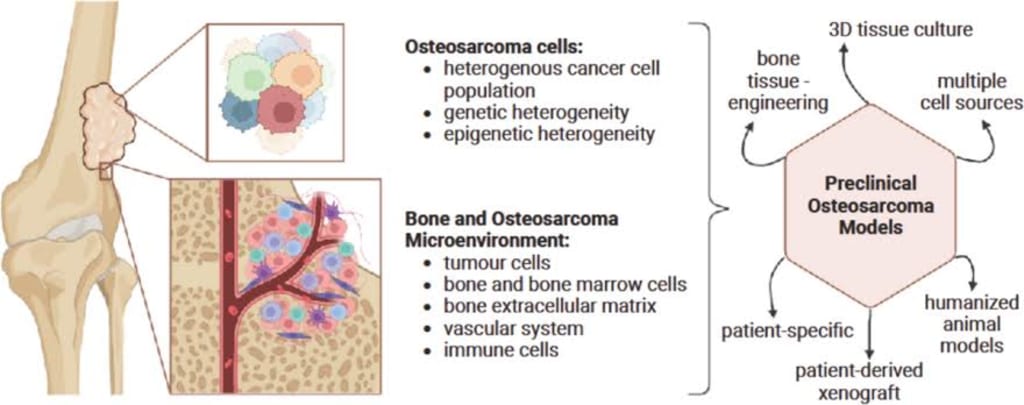
The surface of bone is laid down by a group of cells called osteoblasts. They first build osteoid tissue, then fill it with calcium, and it slowly hardens. Osteosarcoma is what happens when these cells go wrong. What they build cannot calcify. It stays forever at the half-finished stage, and it does not stop.
It likes to grow where growth is fastest. More than half occur near the knee, the two ends where the femur and tibia meet, plus the shoulder end. Together, these three sites account for 85% of limb osteosarcoma (National Health Commission 2019 diagnostic and treatment guidelines). This area is called the “wider ends of long bones” in the patient-facing version from the U.S. NCI, which is easier to understand than “metaphysis.”
Why 10 to 20 years old? That is the decade when bone grows fastest. The growth plates at both ends of the knee are dividing at high speed. The more divisions, the more chances for errors.
The first symptoms may be only two: pain and swelling. No fever, no weight loss, and a complete blood count will not show it. For children and teenagers aged 10 to 20, leg pain is far too common. Growing pains, sports strains, a knock from playing soccer: parents and children are used to enduring it.
But osteosarcoma hurts even at rest, and worse at night. Growing pains hurt at tendon insertions. Osteosarcoma pain is in the bone. Children often do not want to straighten the knee, and over time it becomes a flexion deformity. The skin near the mass may feel warm, and veins may bulge. If the same spot hurts repeatedly, does not ease with rest, and does not match a sports injury, it is time to see an orthopedic doctor. Just get an X-ray (Chinese Anti-Cancer Association osteosarcoma popular science).
For an 18-year-old, the cost of that delay is especially high.
III
Osteosarcoma does not start in the lungs, but the lungs are where it goes first. It travels through blood.
Once the tumor grows, it invades nearby blood vessels. Cancer cells travel back with the blood and stop first in the capillary bed of the lungs. From day one, this disease has to be treated as a systemic disease. Limb salvage versus amputation decides whether the local tumor can be removed cleanly and whether the leg can still be used. Limb salvage can now be done in 80% to 90% of patients, but it does not tell you whether cancer cells have reached the lungs. When the tumor wraps around blood vessels and nerves and no safe margin can be achieved, amputation is still the standard answer.
Broadly, two things determine the course: whether chemotherapy is given according to standard, and whether the metastases in the lungs can be cleared.
A retrospective study of 479 cases by seven bone tumor centers in China (2000 to 2016; mean age 21.4 years; 82.7% around the knee; Chinese Journal of Bone and Joint, 2018, Vol. 7, No. 1, pp. 7–13; some older statistics are for reference only):
5-year overall survival 60.0%, 5-year disease-free survival 46.0%;
Standard chemotherapy group vs nonstandard group: 73.0% vs 55.9%;
Tumor necrosis rate after chemotherapy ≥90% vs <90%: 93.3% vs 40.3%;
5-year survival for those with no recurrence or metastasis after surgery: 93.5%; lung metastasis only: 20.7%; multiple metastases: 10.1%.
The National Health Commission’s 2019 Diagnostic and Treatment Guidelines for Osteosarcoma in Children and Adolescents states: after neoadjuvant chemotherapy, 5-year survival can reach 60% to 70%, with leading centers reporting above 80%; if distant metastasis is already present at diagnosis, it drops to 20% to 30%.
Before the 1970s, amputation was the only option for this disease, with 5-year survival of 5% to 23%. Today, with standard treatment, the same disease has 60% to 70% survival, mainly because of chemotherapy.
On pulmonary metastasectomy: the Rizzoli Institute in Italy studied 463 children and adolescents who underwent resection of lung metastases from 1973 to 2014, with a median follow-up of 18.6 years. Five-year survival was 34.0%, and 20-year survival was 29.7%. The difference between 20 years and 5 years was only 4 percentage points. Of the 138 survivors, 42 (30.4%) were saved by repeated thoracotomy to remove metastases.
The West China Hospital-led ALTER-S002 (2024 ASCO abstract) added anlotinib to chemotherapy for newly treated stage IIB limb osteosarcoma: 24-month event-free survival 73.43%, 24-month overall survival 95.92%. At the 2025 ASCO Annual Meeting, its combination with toripalimab showed durable efficacy in patients with advanced soft tissue sarcoma and osteosarcoma. These references still need updating to keep up with the research frontier. This is just a starting point.
Diagnosed at 18, then multiple metastases, five years. She is not a number. The numbers still show how hard her road was.
IV
Back to Wang Teng. He launched two products at once: a smart ring benchmarked against RingConn and Oura, and iFlow, a temperature-controlled mattress benchmarked against 8Sleep.
First, the ring.
The poster is strange. Your ring cannot be opened, so this shape does not work. If it is a creative exploded view, label it “structural diagram.” Otherwise consumers will mistake it for something that can be opened and adjusted. Smart rings are most vulnerable to misunderstandings about sizing and wearing experience. This kind of visual suggestion increases returns and customer service costs.
The product comes in two versions. The 1,799 yuan version has no charging case and fewer sensors. It does not support tracking of CO2, temperature, humidity, light, or noise. The 2,199 yuan version costs 400 yuan more and gives you a charging case and more sensors.
I think this price gap is too small to support differentiated pricing for two products. Four hundred yuan is a 22% price difference, close to 2/9, which is not small. The gap can hold up only if the page explains the value. How do you charge the 1,799 version without a charging case? If the 1,799 version is a “stripped-down experience version” and the 2,199 version is the “complete version,” then pushing the 1,799 version will get you criticized. If the 1,799 version is the volume model and the 2,199 version is the anchor SKU, that can work. Do not let different sensors across the two versions split the algorithm experience.
CO2, temperature, humidity, light, and noise look more like environmental sensors. They are not something the ring body can accurately measure. If they are in the charging case or dock, then the difference between 1,799 and 2,199 is not two versions of the ring. It is with or without an environmental monitoring dock. Product naming and the page must make this clear. Otherwise it is cognitive confusion.
So you still want people to buy the 1,799 version directly. The price difference is as high as 2/9, which is a lot. But the simpler the SKU, the better. Either call them Standard and Pro, or make one version with an optional charging case. A smart ring is not a phone. Splitting the algorithm experience across two versions is not worth it.
Now iFlow. It is a temperature-controlled mattress. It also comes in Standard and Pro versions. Starting price 9,999 yuan, which is not cheap. The Pro adds waist and abdomen heating and high-temperature mite removal.
Waist and abdomen heating has use cases, especially for women during menstruation and people with cold lower backs. Zoned heating adds complexity. I agree that high-temperature mite removal should be handled cautiously. The mattress’s internal materials, sensors, and tubing may not withstand high temperatures. The effectiveness and uniformity of high-temperature mite removal are hard to verify. It easily becomes a marketing concept.
The hard part in this category is delivery, not specs. The core of a temperature-controlled mattress is water circulation or semiconductor cooling, noise, condensation, leaks, and installation and after-sales service. At 9,999 yuan, it has entered the high-end mattress price band. Users will ask why they should not just buy a good mattress plus an air conditioner or an electric blanket. Category education costs are high, after-sales is heavy, and you cannot sell it just by stacking specs.
V
Let me jump out and play prophet.
If isho does well, Xiaomi will very likely pay attention and enter. The more likely route is ecosystem-chain investment or competition from ecosystem-chain companies, not acquisition. Temperature-controlled mattresses are bulky and after-sales-heavy. Xiaomi may not develop them in-house. If isho does poorly, Xiaomi will not acquire it. That counts as avoiding a potential risk pit.
I changed “definitely” to “very likely” because whether Xiaomi enters depends on market size, patents, channels, and after-sales models. Xiaomi may not be in a hurry on smart rings. Bands and watches already cover that. Mattresses are more likely to be tried through the ecosystem-chain model.
Wang Teng is strong at marketing, but these two products are too far apart. A ring is precision wearables. A mattress is bulky home goods. Supply chain, channels, and after-sales are two completely different playbooks. For the ring, first solve the poster, the SKU, and the environmental sensors. For the mattress, first solve installation, after-sales, and the value users get.
VI
Products can be redone. Launch events can be held again. Posters can be redesigned. SKUs can be cut. Life cannot.
That girl from 18 to 23 signed the surgical consent forms and chemotherapy informed consent herself. In the end, she got to hear her grandmother’s voice. In the words she left behind, she said, “This world online. I’m logging off first.” People who make products should at least be worthy of the word “online.” Say what needs to be said. Label what needs to be labeled. Do not cut costs that should not be cut from users.
The words she signed weigh far more than any product poster.
About the Creator
Jin
Writer of reamstories
https://reamstories.com/jin
Enjoyed the story? Support the Creator.
Subscribe for free to receive all their stories in your feed. You could also become a paid subscriber, letting them know you appreciate their work.
Comments
There are no comments for this story
Be the first to respond and start the conversation.