
My Patient Asked for a Dialysis Tune-Up. I Told Her No.
Why a machine that saves lives in kidney failure cannot make working kidneys better, and what the trials show about losing residual function faster.
My patient asked if she could come in for dialysis "just once a month, like a tune-up."
She had kidneys. They were working. Not perfectly, but enough. Her creatinine sat at 2.1, stable for a year. Her urine output was normal. She'd read something online about "blood cleaning" and thought it made sense. Flush the system. Start fresh.
I told her no. I told her the machine doesn't work that way.
She didn't believe me at first. I understand why.
The word "dialysis" sounds like "cleaning." Like a car wash for blood. You go in dirty, you come out clean, you go home. That's the mental model. It's wrong in a way that takes about ten minutes to explain and about ten years to fully understand.
Here's the shortest version I know.
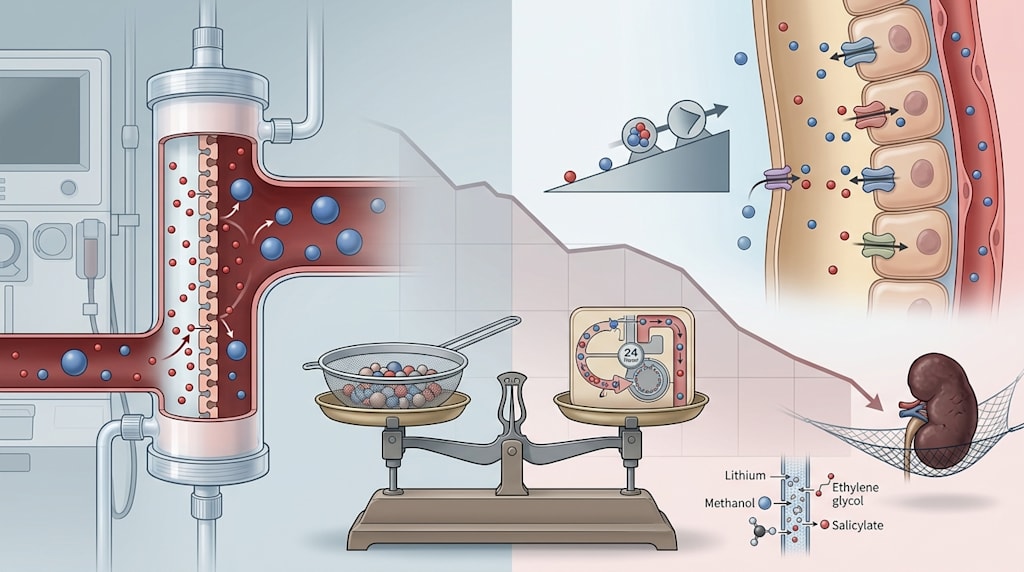
A hemodialysis machine pushes blood through a bundle of hollow fibers. The fiber walls have pores. Blood runs inside the fibers. Dialysate — a salt solution — runs outside, in the opposite direction. Small molecules drift down their concentration gradient and cross into the dialysate. Urea. Creatinine. Potassium. Phosphate. They leave.
That's it. That's the whole mechanism. Size and protein binding decide what crosses. If a molecule is small and floating free in the blood, the membrane can remove it. If it's large, or stuck to albumin, it stays.
A kidney doesn't work like that.
The glomerulus filters. Size matters there too. But then the tubules do the real work. They reabsorb water, glucose, bicarbonate, amino acids — pulling back what the body needs. They secrete. Transport proteins on the blood side grab specific waste molecules and haul them into the tubule cells. Other transporters push them into the urine. Both steps burn energy.
The tubule can keep moving waste into urine even when the urine is more concentrated than the blood. It works against a gradient. It works for twenty-four hours a day.
The membrane cannot do that. The membrane is a sieve. The tubule is a pump.
A sieve catches what falls through. A pump goes and gets what it wants.
I've watched patients on conventional dialysis for years. Three sessions a week, four hours each. Twelve hours of filtering per week. That's the math. Twelve hours to replace what a kidney does in 168.
And even those twelve hours only handle the easy stuff.
Indoxyl sulfate and p-cresyl sulfate are small molecules. You'd think the membrane could clear them. But they travel bound to albumin. Albumin doesn't fit through the pores. So when the albumin flows past the membrane, the toxins flow past too.
A tubule handles this differently. It pulls the free fraction of the toxin out of the blood. As the free concentration drops, more toxin dissociates from albumin to restore the balance. The tubule keeps pulling. The whole pool clears, slowly, continuously.
The membrane has no continuous pulling action. Blood stays next to it for a few hours, then goes back into the body. Dissociation can't replenish the free fraction fast enough. Only a tiny sliver crosses.
A 2014 review in Toxins listed these protein-bound toxins as one reason cardiovascular complications stay high in dialysis patients. The easy molecules get removed. The hard ones accumulate.
So no — dialysis is not a stronger detox. It's a targeted sieve. It goes after a specific set of molecules. A person with working kidneys doesn't have that set waiting to be removed.
But here's the part that changed my patient's mind. The part I should have led with.
More dialysis can make native kidney function worse.
The Frequent Hemodialysis Network ran a nocturnal trial. Randomized patients to six sessions per week or three. At baseline, 63 patients still had residual kidney function. Mean urine volume was 0.76 liters per day. Urea clearance was 2.3 mL/min.
At twelve months, the follow-up in Kidney International showed this: 67% of the six-session group had zero urine output.
Zero.
In the three-session group, 36% had zero.
At four months, the numbers were 52% versus 18%.
The machine didn't train the kidney. It didn't strengthen it. The patients who got more dialysis lost their remaining kidney function faster.
The daytime trial from the same network appeared in the New England Journal of Medicine in 2010. The six-session group had a higher risk of vascular access interventions. Hazard ratio 1.71. Confidence interval 1.08 to 2.73. More needle sticks. More clotted accesses. More repairs on the same fistula.
More dialysis went past the point of benefit.
Why residual kidney function falls faster is not fully understood. One hypothesis: repeated drops and rises in blood volume and osmotic pressure disturb kidney perfusion. Another: lowering solute concentrations too far removes the workload the tubules were still handling.
Both remain hypotheses. But the trial shows the pattern. More frequent nocturnal dialysis and faster loss of residual kidney function occurred together.
For my patient, that was enough. The machine doesn't make the kidney healthier. In the available human data, it shows up alongside kidney function going downhill.
If early dialysis doesn't help CKD patients, occasional dialysis can't help normal people.
Some people ask: if dialysis is hard on the kidney, should patients start earlier?
The IDEAL study randomized 828 patients with chronic kidney disease. One group started when eGFR was 10 to 14. The other planned to start at 5 to 7. Median follow-up was 3.59 years.
The results appeared in the New England Journal of Medicine in 2010. Mortality was 37.6% versus 36.6%. Hazard ratio 1.04. Confidence interval 0.83 to 1.30. P value 0.75.
Cardiovascular events, infection, dialysis complications — no difference.
The median difference in dialysis start was more than five months. During those months, urea and phosphate accumulated in the late-start group. The early-start group removed them sooner.
The death risk didn't move.
If starting months earlier in people who need it doesn't improve outcomes, occasional dialysis in people who don't need it cannot produce a benefit.
When dialysis is right, its weakness becomes the point.
The target molecules are small. They don't bind protein. They have limited volume of distribution.
Lithium. Methanol. Ethylene glycol. Salicylate.
Hemodialysis can pull them out and save a life. The machine that's a poor kidney replacement is an excellent poison filter.
Acute kidney injury with hyperkalemia, severe acidosis, or volume overload that can't be managed otherwise follows the same logic. The problem is small molecules and water. Dialysis removes them.
In these situations, dialysis is not wellness. It's not detox. It replaces failed kidney function long enough to keep the patient alive.
A healthy person doesn't have that set of molecules waiting.
The body divides waste handling between the liver and the kidneys. The liver converts lipid-soluble compounds into water-soluble ones. The kidneys filter and secrete them. This runs twenty-four hours a day.
A machine cannot copy that arrangement. It runs about twelve hours a week. It has no sense of when to keep water and when to release it. It doesn't decide to keep glucose, retain bicarbonate, or adjust potassium. It follows concentration gradients across a membrane.
No trial data exist for repeated dialysis in healthy people. No such trial will be run. It would not pass ethical review.
So the answer to my patient's question was no.
The effect is not limited. The direction is wrong. Dialysis will not train the kidney. It will disturb it. It will not strengthen waste clearance. It will replace part of it. It will not make the body cleaner. It adds vascular access, anticoagulation, blood pressure swings, electrolyte shifts.
She heard me. She scheduled her next nephrology appointment instead.
Dialysis is a safety net at the edge of kidney failure. It is not a cleaning tool for people whose kidneys still work.
The machine saves lives when the kidneys can't. It doesn't improve lives when they can.
About the Creator
Jin
Writer of reamstories
https://reamstories.com/jin
Enjoyed the story? Support the Creator.
Subscribe for free to receive all their stories in your feed. You could also become a paid subscriber, letting them know you appreciate their work.
Comments
There are no comments for this story
Be the first to respond and start the conversation.