
He Passed a 4.5-Meter Tapeworm. It Started With Raw Fish.
A man in Wuhan had no symptoms. Then doctors pieced together a fish tapeworm longer than a car. Here is how it grows, what it steals, and why wasabi will not kill it.
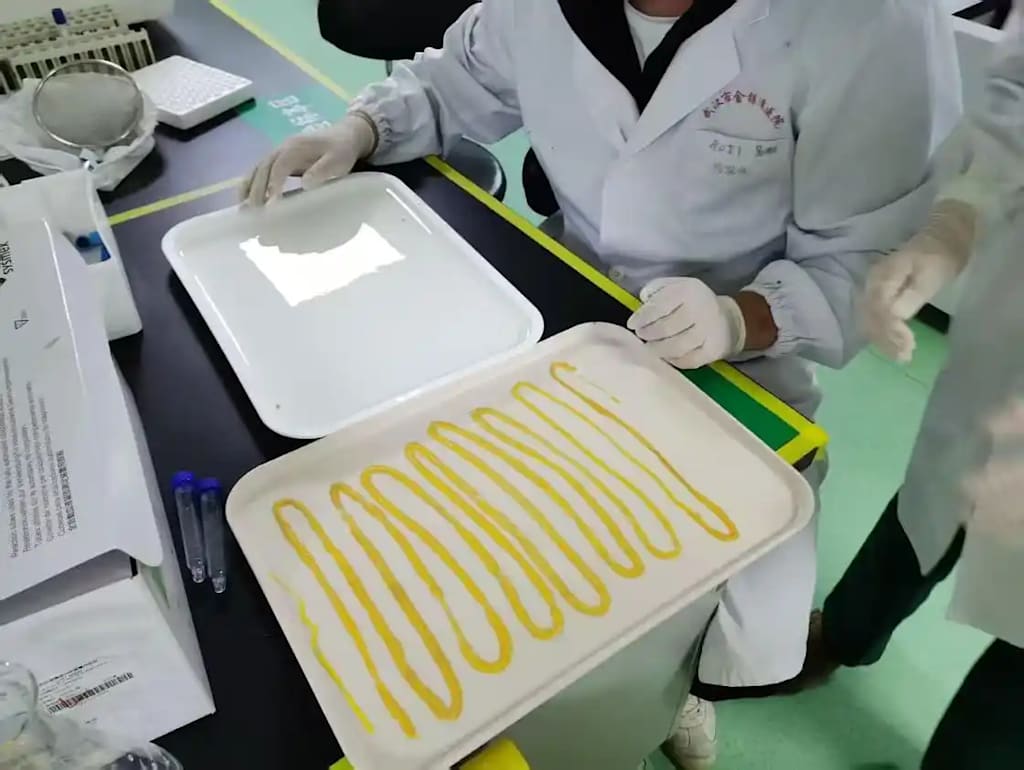
Xiao Jin looked down after using the toilet.
In his stool was a segment of worm more than a meter long. It was white, flat, and linked segment by segment, like a cut ribbon.
He went to the hospital. Doctors at the Specialized Parasitic Disease Center of Wuhan Jinyintan Hospital traced his travel and food history. He had studied abroad, where he got into the habit of eating raw fish. He kept eating it after returning to China. A stool sample showed a large number of eggs. After standard deworming treatment, medical staff untangled and pieced together the worm he passed. The result was a nearly complete adult about 4.5 meters long.
Hu Xudong, director of the hospital’s Specialized Parasitic Disease Center, has worked in the field for more than 30 years. He said it was the first time he had seen such a long tapeworm.
4.5 meters is more than twice the height of an adult. The worm had lived in Xiao Jin’s small intestine without causing pain or any obvious sign.
The worm is called Diphyllobothrium latum, or the fish tapeworm.
4.5 meters is normal for this worm
The adult Diphyllobothrium latum is usually 4 to 6 meters long. In a large host, such as a bear, it can pass 10 meters.
How does it grow that long?
The tapeworm’s body works like a train. Each car is called a proglottid. An adult has 3,000 to 4,000 proglottids linked together. The ones near the head are immature. The middle ones mature. The gravid proglottids at the end are packed with eggs.
It has no mouth or anus. It has no intestine. Nutrients diffuse in through its body surface. Waste diffuses out. It sits in the host’s intestinal fluid and absorbs ready-made nutrients through its whole body. Almost all its energy goes into growth and reproduction.
The scolex is the worm’s anchor. On the scolex are two longitudinal grooves called bothria. They are made of muscle and clamp onto the small intestinal wall like suction cups. As long as the scolex stays attached, intestinal peristalsis cannot push it out. It keeps growing downward, day by day, segment by segment, into a long white chain.
From a fish to a human small intestine
Eggs leave the infected person’s body in stool and enter fresh water. In the water they hatch into coracidia. These larvae are covered in cilia and swim. Their first target is a copepod, a tiny zooplankter. After a copepod swallows a coracidium, the larva develops inside it into a procercoid.
A freshwater fish swallows the infected copepod. The larva penetrates the fish’s intestinal wall, burrows into the flesh and organs, and grows into a plerocercoid. The plerocercoid is the infectious stage. It waits quietly in the fish flesh for the next host.
If the fish is cooked, the plerocercoid dies. If the fish is sliced thin, dipped in wasabi and soy sauce, and put into a person’s mouth, the plerocercoid enters the small intestine. After about 3 to 6 weeks, it grows into a sexually mature adult. Then it starts producing proglottids, laying eggs, and growing longer.
The human becomes its definitive host.
No stomach pain does not mean no harm
Xiao Jin said he was usually healthy. He had no stomach pain and no diarrhea.
Most infected people have no obvious symptoms. Some may have mild abdominal discomfort, diarrhea, or fatigue. These symptoms are common and easy to ignore. The worm grows quietly in the small intestine. It does not bite or burrow. It absorbs nutrients.
The most important nutrient it takes is vitamin B12.
Vitamin B12 comes from food and is absorbed in the terminal ileum. Diphyllobothrium latum takes in large amounts of vitamin B12 from the intestine. It competes with the host for a nutrient the body needs. A long infection can lead to vitamin B12 deficiency.
Vitamin B12 deficiency causes megaloblastic anemia. Patients feel tired, look pale, feel dizzy, and have numbness in the hands and feet. In severe cases, memory loss, mood changes, and balance problems appear. These symptoms come on slowly and are not easy to link to a parasite.
So no stomach pain does not mean no harm. The longer the worm grows, the more eggs it produces, and the more nutrients it drains.
The harm is more than disgust
A 4.5-meter worm leaving the body is disturbing to imagine. But the harm from Diphyllobothrium latum goes beyond the shock.
Anemia and nerve damage are the most common complications. The worm takes vitamin B12 and causes megaloblastic anemia. Without treatment, nervous system damage can become permanent.
When the body has many parasites, or when the worms twist into a mass, they can block the intestine. This causes intestinal obstruction. Patients develop abdominal pain, vomiting, bloating, and stop passing gas or stool. This is an emergency.
Sometimes the worm enters the biliary tract. This causes cholecystitis and cholangitis. Patients develop right upper abdominal pain, fever, and jaundice.
In rare cases, the worm damages the intestinal wall and causes perforation. Intestinal contents leak into the abdominal cavity and cause peritonitis. This is a life-threatening emergency.
Praziquantel makes the scolex let go
The first-line drug is praziquantel.
It makes the worm’s cell membranes more permeable to calcium ions. Calcium ions flood in, and the worm’s muscles contract tetanically. The bothria on the scolex are made of muscle. Under the drug, they lose their grip. Once the scolex lets go, the worm slides down the intestine.
Treatment is not just taking a pill and passing a worm.
Doctors need to confirm whether the scolex came out. If the scolex stays on the intestinal wall, the worm can grow again. In this case, medical staff untangled and pieced together the passed worm to check for a complete adult and a scolex. If the scolex is missing, a follow-up stool test after treatment is still needed. Only when no eggs are found can the patient be considered cured.
Wasabi, baijiu, and garlic do not save raw fish
Many people believe that wasabi, baijiu, or garlic can kill parasites in raw fish.
Wasabi, baijiu, vinegar, soy sauce, scallions, garlic, and short marinating times do not reliably kill plerocercoids in fish flesh. They add flavor and kill some bacteria. They do not kill parasites.
The only reliable method is to cook the fish.
The key word is raw fish. Raw freshwater fish can carry Diphyllobothrium latum, Clonorchis sinensis, and other parasites. Raw saltwater fish can carry Anisakis, certain bacteria, and viruses. No matter what kind of fish it is, cooking is the safest choice.
If you must eat raw fish, it needs freezing that meets a standard. The U.S. Food and Drug Administration recommends freezing fish for raw consumption at -20°C for 7 days, or at -35°C for 15 hours. A home freezer usually cannot reach these conditions. Cooking is still the safest method.
Keep raw and cooked foods separate. Do not share cutting boards, knives, or containers. Do not drink untreated water. Copepods may be in it. Wash your hands after handling raw fish.
If you have unexplained anemia, fatigue, or abdominal discomfort, and you have eaten raw fish, see a doctor and mention it.
Raw fish has a risk you cannot taste
Raw fish is a popular food. It is tender and fresh. It can carry the scent of the sea or a river.
Xiao Jin’s case is not isolated. As raw-food culture spreads, this parasite is spreading too. It was once limited to certain regions. Now it has more chances to find hosts.
A 4.5-meter worm does not grow in a day. It needs time and a host. It also needs repeated ignored risks. It lives quietly in the small intestine and takes vitamin B12. One day, a white segment appears in the toilet.
Cooking is not a betrayal of flavor. Between raw and cooked there is a line. On one side is appetite. On the other is health.
The next time you pick up a slice of raw fish, you can ask a simple question. Is there a plerocercoid in that flesh, waiting for a host? And is your small intestine going to be the next stop in its 4.5-meter life?
Raw fish can carry a parasite that grows for years. Cooking removes the risk. If you choose to eat raw fish, use a freezer that meets the FDA standard, or accept the risk. The choice is on your plate.
About the Creator
Jin
Writer of reamstories
https://reamstories.com/jin
Enjoyed the story? Support the Creator.
Subscribe for free to receive all their stories in your feed. You could also become a paid subscriber, letting them know you appreciate their work.
Comments
There are no comments for this story
Be the first to respond and start the conversation.