
Britain Rationed Sugar for 11 Years. 50 Years Later, the Children Had Lower Cancer Rates.
A natural experiment from postwar Britain suggests the first 1,000 days of life may shape cancer risk decades later.
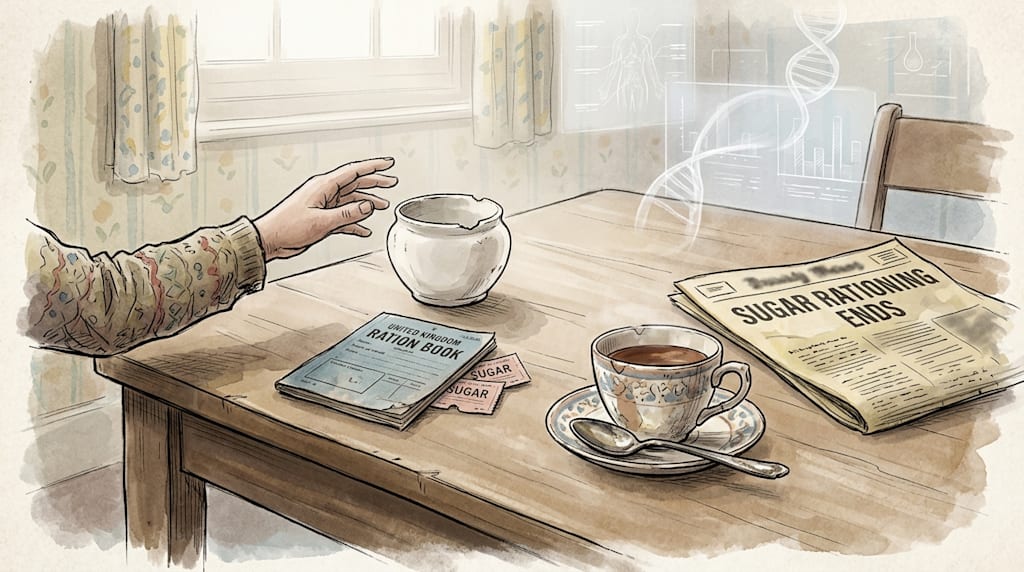
In September 1953, Britain ended sugar rationing. Queues formed outside sweet shops. People bought toffee and chocolate. Tea got two spoons of sugar. Sweetness returned.
That same year, a child born in 1952 had just turned two. His mother had received 8 ounces of sugar a week and 12 ounces of candy a month. Children under two had no sugar ration. In his first 1,000 days, added sugar averaged about 40 grams a day. Fifty years later, his health record sat in the UK Biobank.
Researchers from China Agricultural University and the University of Cambridge pulled records for 64,761 people born between 1951 and 1956. They grouped them by conception date. People conceived before September 1953 spent their first 1,000 days under rationing. People conceived after did not. Policy, not a questionnaire, divided the groups. No ethics review. No informed consent.
In January 1940, Germany attacked British import ships. Food ran short. Ration books began. From 1942 to 1953, each person got about 8 ounces of sugar a week and 12 ounces of candy a month. Infants under two got no sugar ration. Britain’s per capita sugar intake was about 40 grams a day. The WHO later recommended keeping added sugar below 10 percent of daily energy, about 50 grams. Its stricter target was 5 percent, about 25 grams. Forty grams fell between the two. In September 1953, rationing ended. Per capita sugar intake doubled to about 80 grams a day. Fat, dairy, grains, and meat did not rebound the same way. Sugar did.
The researchers compared cancer. People who experienced sugar rationing in their first 1,000 days had nearly 69 percent lower risk of liver cancer and intrahepatic bile duct cancer as adults. If each group had 100 people, and 10 in the unrationed group got liver cancer, about 3 in the rationed group would. Rectal cancer fell by about 40 percent. Lung cancer fell by 41 percent. Prostate cancer fell by 52 percent. Breast cancer fell by 36 percent. The longer the exposure, the lower the risk. In utero exposure alone was not significant. Postnatal exposure was key.
In the womb, maternal insulin and epigenetic pathways affect fetal metabolic set points. During breastfeeding, insulin in breast milk participates in metabolic development. After weaning, taste preferences take shape. Each stage adds its own effect. The risk curve falls as exposure lengthens.
The researchers looked at dietary questionnaires. The unrationed group ate 50 to 100 grams more food per day. They scored 1 to 1.5 points lower on the Healthy Eating Index. They scored 0.5 to 1 point lower on food diversity. The rationed group ate less, ate more healthily, and ate a greater variety. The difference was driven mainly by sugar. Fat and protein fell slightly. Starch and fiber remained stable. The paper wrote: fifty years after rationing ended, the rationed group consumed less sugar, ate smaller amounts, and maintained a healthier, more varied diet. The sweetness tasted before age two may follow a person for life.
Telomeres also appeared in the data. The rationed group had longer white blood cell telomeres, by 0.05 standard deviations. That is equivalent to about 2.2 fewer years of biological aging. Granzyme B was lower. Their immune systems looked younger, with less chronic inflammation and more complete immune surveillance. Immune surveillance is the body’s process of recognizing and clearing precancerous cells. Early sugar restriction reduced metabolic stress, slowed telomere wear, and preserved immune surveillance. Healthier dietary preferences further reduced lifetime sugar exposure. Early biology and learned taste reinforced each other: less sugar early, less sugar later.
The study has limitations. Wartime rationing covered not only sugar but also meat, butter, and cheese. That generation also lived through postwar austerity, changes in medical care, and differences in lifestyle. The researchers argue that sugar rationing was a “one-size-fits-all” policy. Birth before or after September 1953 approximated random grouping. That makes causal inference stronger than in ordinary observational studies. During the war, a generation of children had their sugar intake pressed down to near WHO-recommended levels. Their cancer registry data were lower.
The sugar coupons were gone. On the rationed group’s dietary questionnaires, there were 50 to 100 fewer grams of food per day and a Healthy Eating Index 1 to 1.5 points higher. The tongue remembers.
About the Creator
Jin
Writer of reamstories
https://reamstories.com/jin
Enjoyed the story? Support the Creator.
Subscribe for free to receive all their stories in your feed. You could also become a paid subscriber, letting them know you appreciate their work.
Comments
There are no comments for this story
Be the first to respond and start the conversation.