
Silence Comes Slowly
She didn’t stop loving you all at once. She stopped explaining herself, one quiet moment at a time.
The day she changed his WeChat contact name back to his full name, she said nothing.
The light from the phone screen fell across her face. Outside the window, the city was at 2:17 a.m. The sign of the convenience store downstairs was still lit, and the humming current sounded like an insect trapped in a glass bottle. She stared at the name for a long time. Three characters, horizontal and vertical, neat. Once she had saved him under a nickname only she understood, with a tiny star after it. She had changed it in the middle of the night, a little embarrassed, a little unable to hide the sweetness. Now she pressed and held, deleted, typed his full name, confirmed. The motion was smooth. She had done it many times in her head.
Three days earlier, she had made a pot of soup. Pork ribs and lotus root, simmered over low heat for three hours. The lotus root was soft and starchy, and a thin sheen of oil floated on the surface. She ladled out two bowls, one in front of his usual seat, one for herself, which she drank slowly. He came home at 11:40, his tie half loosened, and glanced at the table.
“I already ate.”
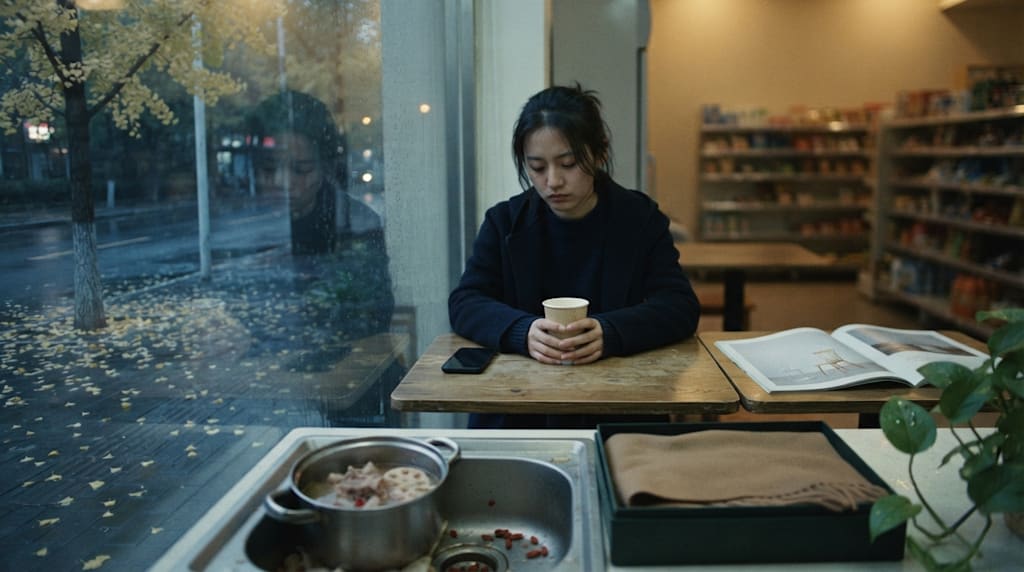
Just those three words. Her chopsticks hovered above the rim of the bowl and paused for a beat. She had wanted to say, “I simmered it for three hours.” She had also wanted to say, “Just taste a little.” In the end she said nothing. She only picked up that bowl of soup and poured it into the sink. A few leaves from lunch were still caught in the strainer. The soup made no sound as it poured. The lotus root knocked against the stainless steel, a dull thud, like a fist against cotton. She turned on the tap and let it run for a long time, until only a few goji berries remained at the bottom, stuck to the edge of the drain, like a few drops of blood not wiped clean. She picked at them with her finger. The goji berries broke apart and stuck to her fingertip. She rubbed twice, but they would not come off.
She was not angry. Anger had been three months ago.
Three months earlier, she would still raise her voice when he said “whatever.” She would still reach for his phone when he stared at it and murmured “mm-hm.” Back then she cried, tears pattering onto the dinner table. He would wipe them with a tissue, and she would push the tissue away. After she pushed it away, he would say, “What’s wrong with you now?” Three words with that rising tail, like asking a fill-in-the-blank question repeated too many times. Back then she would still answer. She would still explain. She would still count them off one by one. You promised last week to see that movie with me, but you didn’t. Last month you said you’d take me to that new restaurant, but you didn’t. Every day you come home and hold your phone. When I talk to you, do you even hear me?
He said he heard her.
Then he went back to his phone.
Later, she stopped crying. She wanted to cry. But before crying she would think first, think for a long time, and realize there was nothing left to say. Like the time she had a stomachache in the middle of the night, tossing and turning, unable to sleep. He slept deeply, breathing evenly, one hand resting outside the blanket. She looked at that hand and remembered how, before, if she so much as turned over, he would drowsily reach out and feel her forehead. She did not wake him. She got up, poured herself a cup of hot water, and sat on the living room sofa until dawn. The next morning he asked why she had been on the sofa. She said she had fallen asleep watching a show.
He said, “Oh.”
The silence began at dinner. She no longer asked, “What do you want to eat today?” because the answer was always “Anything.” She no longer waited for him to come home before picking up her chopsticks, because the food would cool and be reheated, then cool again. The lotus root would break apart. The ribs would turn dry. She began serving herself one bowl, eating, washing the dishes, wiping the stove, going into the bedroom, closing the door. The sound of the door closing was very soft. So soft that she stood behind it for three seconds to confirm there was no reaction outside. No footsteps. No “Why are you going to bed so early?” No door pushing open.
He thought she had become sensible.
Last month was her birthday. He had not forgotten. Before leaving in the morning, he placed a box on the dining table, wrapped in dark green paper, tied with a ribbon, meticulous. She opened it. It was a scarf. Camel-colored, cashmere, very soft to the touch. She wrapped it around her neck once. It was a little scratchy. She folded it neatly, put it back in the box, and put the box on the top shelf of the wardrobe, where she had to stand on tiptoe to reach. That night when he came home, she said thank you.
“Do you like it?”
“Mm.”
“Good.”
The conversation ended. She went back to wiping the stove. He took off his jacket and went to shower. While the water roared in the bathroom, she stood on the balcony and saw that the ginkgo tree downstairs had begun to turn yellow. The leaves yellowed from the edges first. Half-yellow, they fell at the first wind. They landed on the ground, were swept into the soil of the planting strip, and squished underfoot. She remembered when they had first moved in, the tree had still been green. They stood on the balcony. He said, “In autumn, when the ginkgo leaves fall, the whole road turns gold.” She said, “We’ll take pictures then.” Autumn came three times after that. She never took a single picture.
The scarf was still pressed on top of the wardrobe. She never opened the box again. One day he asked why she did not wear it. She said it was not time yet. He said, “It’s already winter. Still not time?” She said, “When it gets colder.” He nodded and did not ask again.
When it gets colder. She did not know what she was waiting for either.
Last night, he did not come home until one in the morning. She was still awake, leaning against the headboard, reading a magazine. She had stopped at page three. The sound of the lock turning was especially clear at night. Click. The key pulled out. The shoe cabinet opened. Leather shoes hit the floor. Slippers shuffled over. She turned a page. He pushed the bedroom door open and glanced at her.
“Still awake?”
“Mm.”
“I have to get up early tomorrow. I’m going to sleep first.”
“Okay.”
He lay down, his back to her. Three minutes later, his breathing was even. The magazine in her hands was still open to page three, an article about minimalist living. The accompanying photo was a white, empty room with only a wooden chair and a glass of water on it. The surface of the water was so still there was not a single ripple. She closed the magazine and put it on the nightstand. Turned off the light. In the dark, she lay with her eyes open and saw a sliver of light through the gap in the curtains, the sign of the convenience store downstairs. The light fell on the ceiling, white with a tinge of blue. She remembered one winter when they had squeezed into this bed. Her feet were cold, and he had tucked them between his calves. Back then she would still act spoiled. She would press her icy hands to the back of his neck. He would hiss, then laugh, then grab her hands and stuff them into his pockets.
Now when her feet are cold, she wears socks.
This morning, she got up earlier than he did. Washed her face, brushed her teeth, changed her clothes. While she was putting on her shoes in the entryway, he came out of the bedroom, his hair sticking up, his eyes half open.
“So early?”
“Mm.”
“Coming home for dinner tonight?”
Her hands did not pause in tying her shoelaces. She pulled the bow tight, stood up, took her bag from the coat rack.
“We’ll see.”
She opened the door. Wind rushed in from the hallway, a little cold. She did not look back, but she heard him say behind her, “Be careful on the road.” The door closed, and that phrase “Be careful on the road” was caught in the crack, standing with her by the elevator. The elevator was still stopped on the top floor, the number motionless. She stared at that number and suddenly felt that “We’ll see” was the most honest thing she had ever said to him. Not perfunctory, not out of spite. She truly did not know which sentence to say next. Every sentence was like dropping a stone into a dry well. She had dropped too many. She no longer wanted to hear the echo.
She did not go to the office. She took a half day off and sat in the convenience store downstairs, ordering a cup of soy milk, no sugar. The plastic cup was hot in her hand, burning her fingertips red, but she did not switch hands. Outside the floor-to-ceiling window, the ginkgo leaves had turned yellow another layer. The wind blew, and two or three leaves spun down onto the sidewalk. A child ran over and stepped on one. The leaf shattered, stuck to the sole of his shoe, and was carried far away. She took a sip of soy milk. Bland. The raw bean smell floated at the base of her tongue. When she swallowed, her throat felt a little tight.
She opened her phone and tapped into their chat. The last exchange was from three days ago. She had sent, “Coming home for dinner tonight?” He had replied, “Overtime.” She scrolled up. There was her message: “Your shirt is ironed. Hanging on the left.” He replied, “Okay.” Further up: “Mom’s birthday next week. What should we buy?” He replied, “You decide.” Further up: a photo she had sent. The pothos on the balcony, a new leaf unfurling, a water droplet hanging from its tip. Sunlight passed through it like a tiny glass bead. Below that photo, he had replied with a thumbs-up.
She stared at that thumbs-up for a long time. Golden yellow, like a thumbtack pinned to the bottom of the chat. She remembered how he used to reply. Typing, voice messages, those ugly but earnest stickers. There was one sticker of a cat falling off a table. He had loved it. Every time she said something funny, he sent that one. Later, he stopped sending it. Later, it was the thumbs-up. Later still, not even the thumbs-up. In the chat, only her voice remained, green bubbles one after another, like talking to herself.
She put down the soy milk and opened her notes app. Her fingers hovered over the keyboard. She typed a few words, then deleted them. Finally she typed one line:
“Leaves don’t turn yellow in a day.”
Then she locked the screen and put the phone face down on the table. The soy milk in the cup had gone lukewarm, a thin film forming on the surface. She poked through the film with her straw. The sound was very small, like a needle piercing paper. She remembered the day he first held her hand. Crossing the street, the green light flashing, he grabbed her wrist. His palm was sweaty and warm. After they crossed, he did not let go, and she did not pull away. Back then she thought being held tight felt wonderful.
Now she put her hands in her pockets. She held her own hand. Her nails pressed into her palm, leaving four shallow crescent marks.
She stood up and threw the soy milk into the trash. When she pushed the door open, the convenience store’s wind chime rang once, crisp. She walked a few steps. A ginkgo leaf landed on her shoulder. She did not brush it off. After she had walked farther, the leaf fell by itself, landing in the footprint she had just made. She glanced back. The leaf was nestled right in the middle of the footprint, yellow and translucent, like a tiny specimen no one would pick up.
She kept walking. The wind blew from behind, lifting the hem of her coat. She took her hands out of her pockets and pulled her collar closer. Her hands were cold, but she did not put them back. She let them hang at her sides, fingers naturally curved, palms empty, like an empty house with the door open and the lights off.
Her phone buzzed in her bag. She did not take it out. It buzzed again. She still did not take it out. At the intersection, the light was red. She stopped and stared at the pedestrian signal across the street. The little red figure stood still, motionless. She suddenly remembered he had said he hated waiting for red lights and always pulled her across. She used to follow him, heart pounding, and after crossing she would still look back to check for cars. Now she stood before the red light, waiting quietly, waiting for the little red figure to turn green.
The green light came on. She stepped forward and crossed the zebra crossing. The wind blew over, carrying the oily smoke of a breakfast stall and the faint sweetness of osmanthus not quite gone. She reached the other side, turned into the office building, swiped her card, entered the elevator, pressed the floor. As the elevator doors closed, she saw her face reflected in the glass. No expression, no tears, no dark circles. Just an ordinary face that had just decided not to wait for someone who did not reply.
That evening she came home. He was already there. Sitting on the sofa, phone tossed aside, TV on but not watching. Two takeout boxes sat on the table, one of rice, one of dishes. Chopsticks were unwrapped and placed on both sides. She changed her shoes, washed her hands, sat down at the table. He pushed the untouched box of rice toward her.
“I brought it for you.”
“Mm.”
She picked up the chopsticks, took a piece of eggplant, and put it in her mouth. It was very salty, and the skin was a little tough. She chewed twice and swallowed. He watched her, as if waiting for something. Waiting for her to ask why he had suddenly bought food. Waiting for her to smile. Waiting for her to say anything at all.
She said nothing. She ate quietly, stacked the boxes, threw them into the trash, wiped the table, went into the bedroom, and closed the door. The sound of the door closing was as soft as yesterday.
He sat in the living room for a long time. The TV was still on, its volume low. She lay in bed and heard a very soft sigh from outside. Then the TV went off. Footsteps approached. The doorknob turned, then stopped. A few seconds later, the footsteps receded, heading to the second bedroom. The second bedroom door closed.
She turned over and pulled the blanket up to her chin. Outside, the ginkgo tree downstairs glowed dim yellow under the streetlamp. Leaves had fallen all over the ground. The street sweeper had not come yet. She closed her eyes. Her mind was empty. No sadness, no grievance, no “if only.” Just emptiness. Like the white room in that magazine. One chair, one glass of water, the surface so still it could reflect a person.
She finally fell asleep. Her breathing was light and steady.
Just like the few goji berries left in the sink after the soup was poured away. Soaked for a long time, the water long cold, and still no one reached in to fish them out.
He did not call again. She did not send another message.
The chat still stopped at that photo of the pothos with the thumbs-up. The leaf was green, the water droplet bright, and sunlight passed through the droplet, bending into a tiny rainbow on the screen.
Only no one opened it to look anymore.
The pothos was still on the balcony, still growing, new leaves one after another. Every few days she watered it, no more, no less. It was doing very well.
About the Creator
Jin
Writer of reamstories
https://reamstories.com/jin
Enjoyed the story? Support the Creator.
Subscribe for free to receive all their stories in your feed. You could also become a paid subscriber, letting them know you appreciate their work.
Comments
There are no comments for this story
Be the first to respond and start the conversation.