
I Used to Think Love Was Enough. Then I Watched How He Fought.
The one trait I look for now, and why it matters more than chemistry.
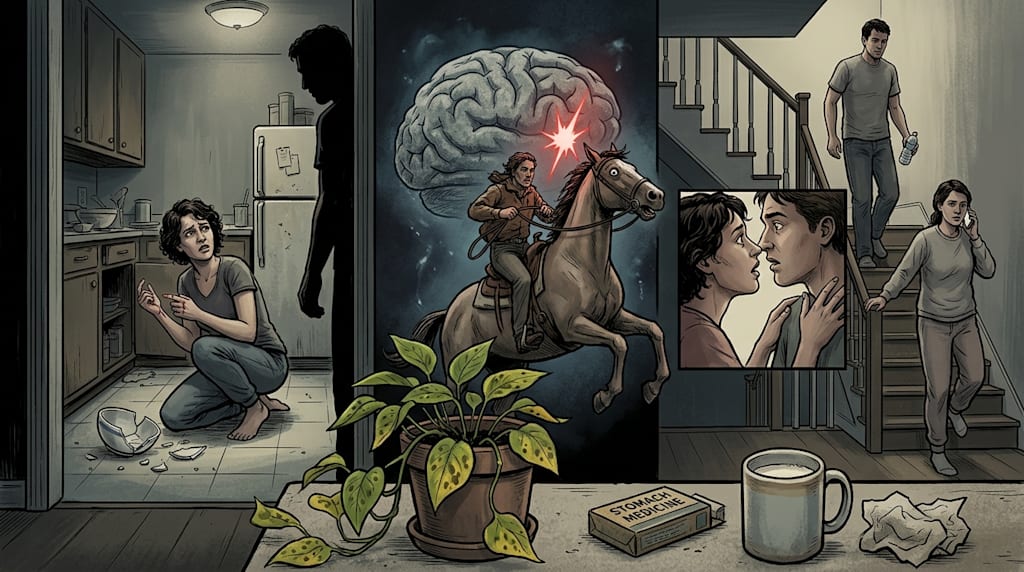
At 1 a.m., there was a broken bowl on the kitchen floor.
She squatted to pick up the pieces. A shard cut her finger. From the living room, he said, “Someone like you deserves to be alone.”
The next morning, he bought soy milk and fried dough sticks, stood at the door, and cried. He said it was not what he meant. She looked at the soy milk. She did not drink it.
She left me a message: Should I stay?
I have received several messages like this. Different stories, same structure. He is good most of the time. In a fight, he becomes someone else. Afterward, he apologizes. Then it loops. Friends say, He just has a temper. He is not a bad person. She knows he loves her.
She is still afraid.
“Not a bad person” and “good to be with long-term” are two different things.
Whether he loves you, only you know. But another question can be answered: In the moment his emotion rises, does he still have the ability not to hurt you?
People talk about “emotional stability.” What does that map to in the brain? The prefrontal cortex.
At the front of the brain is the prefrontal cortex. Neuroscientists call it the brain’s CEO. It handles impulse control, emotion regulation, delayed gratification, perspective-taking. Deep in the brain is the amygdala, an older system that detects threats. Its reaction is fast. Before you know what happened, your heart speeds up, your fist tightens, the words are already at your lips.
Think of it as a horse and a rider.
The amygdala is the horse. Strong, fast, easily spooked. The prefrontal cortex is the rider. It cannot stop the horse from spooking, but it can pull the reins.
An emotionally stable person still has emotions. The difference is a gap between emotion and action.
That gap may be two or three seconds. A person whose prefrontal cortex is online will, in those seconds, have a thought: I am angry, but if I say this, I cannot take it back.
A person whose prefrontal cortex is offline does not have those seconds. Stimulus in, reaction out. Later he regrets it. He apologizes. The damage is done.
When he says, “That was not what I meant,” he is being honest in a way. In that moment, the one deciding was not me. It was my amygdala.
Intimacy is a stress test for the prefrontal cortex.
Outside, we hold ourselves together. We do not snap at colleagues. We endure clients. We keep some dignity with friends. At home, with the closest person, many people let go of the reins. Self-control is expensive. People lower the cost where they feel safest. So many people give their best temper to strangers and their worst to the person they love.
Conflict in intimacy is also easily read by the brain as a threat.
Gottman observed thousands of couples arguing in a lab, recording them and monitoring their heart rates. He found that when a person’s heart rate rises above about 100 beats per minute during an argument, the brain enters fight-or-flight. At that point, he cannot hear what the other person is saying. He cannot think rationally. The argument is no longer two people communicating. It is two amygdalae hitting each other.
Gottman named four communication patterns that predict divorce: criticism, contempt, defensiveness, stonewalling. The Four Horsemen. The most destructive is contempt.
Look at those four. Almost all are products of a prefrontal cortex that has lost control.
Watch him when he is not good to you. That is the test.
Psychology has a concept called “accommodative response.” When a partner does something that bothers you, says something harsh, do you hit back, or do you hold the impulse and choose a more constructive response? In 2001, Finkel and Campbell found that people with stronger self-control were more likely to give an accommodative response when their partner messed up. When researchers depleted participants’ self-control resources first, accommodative responses dropped.
A 2011 study found that people with stronger executive control were better able to restrain themselves when faced with an attractive alternative. Loyalty is not only about love. It is also about the ability to hold a momentary impulse. Executive control is a core function of the prefrontal cortex.
How do you tell if someone’s prefrontal cortex is well developed?
Intelligence does not predict this. Neither does education. Intelligent people blow up. Educated people say cruel things in fights. Some smart people are worse in arguments because they are better at finding the soft spot, better at making one sentence precise and sharp. Intelligence decides how cruel a sentence can be. The prefrontal cortex decides whether it leaves the mouth.
This is not coldness or suppression. A person with a working prefrontal cortex can often say, “I am sad right now.” “This disappointed me.” “I need a minute.” He expresses, but not in a way that wounds.
Even good people lose control sometimes. The difference is whether they come back and repair. Whether the loss of control gets less frequent or more frequent.
Look at a person not when he is at his best, but at his worst.
She thought back to Chen Mo. Almost late for a flight, he cursed the driver. Waited an hour in line, the waiter brought the wrong dish, he slammed the table. The navigation took a wrong turn, he hit the steering wheel and took it out on her in the passenger seat. When he was tired, hungry, or a mess, his prefrontal cortex went dark. The good parts happened. The loss of control happened too.
She first noticed Zhou Ye on a team-building hike.
No signal in the mountains. The group was irritable. Some complained. Some called the leader and cursed. Zhou Ye said, “I will go check ahead. Ten minutes.” Ten minutes later he came back with a bag of water. He did not say, “Do not panic.” He did not say, “I will fix it.” He handed out the water, then squatted by the road and looked at the map.
Her stomach hurt. She lay on the desk. Zhou Ye put a box of stomach medicine next to her keyboard and said nothing. She looked up. He had already walked away. She never let people know when her stomach hurt. She was used to enduring. The box of medicine was like someone lifting a corner of her cover.
Zhou Ye never ate spicy food. She loved hot pot. He went with her, ordered a split pot, and cooked his own food in the mild broth. She asked why he did not say anything. He said, “You wanted it. I can eat mild broth.” It was a small thing. For him, it was an exception. He did not explain the exception.
The day the project ended, they were in the stairwell. He moved closer. She smelled the laundry soap on his clothes. Her phone rang. A work call. He stepped back and said, “Take it.” She finished the call. He was already at the stairs. She stood there, phone in hand, screen dark.
Later, Chen Mo came back. He said he had changed. He was seeing a counselor. He would never throw things again. She wavered. She was afraid of choosing wrong again. She was afraid of repeating it. She was afraid of another 1 a.m. on the kitchen floor, picking up broken bowl pieces.
Zhou Ye asked her, “Are you okay?”
She said, “I am fine.”
He said, “Okay.”
He did not push. Her heart sank. She wanted him to push. She wanted him to say, “You are clearly not fine.” But he did not. She said, “Leave me alone.” He stepped back. She thought he did not care.
She went back to her rented apartment. There was an expired yogurt in the fridge. Three leaves on the pothos had turned yellow. Two stomach medicine pills were left on the desk. She did not contact Zhou Ye. She scrolled on her phone and saw Chen Mo’s message: “I bought your favorite soy milk.” She did not reply.
The empty daily life is small. No “Did you get there?” in the morning. No “What do you want to eat?” on the way home. The pothos turns yellow. You do not know whether to water it.
She used to run when she was afraid. Her whole life, she had used running to deal with fear. Zhou Ye used restraint to deal with fear. When they most wanted to come close, they used the wrong methods. She ran. He waited. She thought he did not care. He thought she needed space.
A week later, she went to Zhou Ye.
She said, “When I said leave me alone, I did not mean it.”
He said, “I know.”
She froze.
He said, “But I need you to tell me what I can do.”
She cried. He did not hug her. He handed her a tissue. It was the convenience-store kind, a little rough.
Later, she bought a cup of soy milk. No sugar. She took a sip and set it on the table. The next day, she bought a new pothos and put it on the windowsill. She sent Zhou Ye a message: “See you tomorrow.”
He said, “See you tomorrow.”
About the Creator
Jin
Writer of reamstories
https://reamstories.com/jin
Enjoyed the story? Support the Creator.
Subscribe for free to receive all their stories in your feed. You could also become a paid subscriber, letting them know you appreciate their work.
Comments
There are no comments for this story
Be the first to respond and start the conversation.