Ancient
Julius Caesar's Real Killers Weren't in Rome. They Were in Pergamum.
Three days before the Ides of March, a bannerless ship docked at Pergamum. It carried no cargo except a single leather satchel. The courier rode directly to the Athena Nikephoros temple complex, which served as the city's treasury, and did not emerge until dawn. No Roman official was informed of the visit.
By Chronicle and Void5 months ago in History
The Cattle Raid of Fraoch Eoin:The River of Red Rowan
In the rugged borderlands between Ireland and Scotland, stories often gather where heather meets wind, where cattle paths cross old fairy ground, and where a single tree can mark the boundary between worlds. The tale of Fraoch Eoin, John of the Heather, belongs to that kind of landscape. It is a story of cattle raiding, sacred trees, and the dangerous negotiations that take place when human need meets Otherworld claim. Set in the late days of May, when Beltane’s fire has dimmed but summer’s wildness still rises, it tells of a river turned red by berry juice and blood, and of the fragile peace won between mortals and the unseen.
By The Celtic Spirit- A modern Guide to Celtic Belief and Practice5 months ago in History
The Dragon and the Eagle: China vs. USA Tensions Heat Up Ahead of Historic Trump-Xi Summit:. AI-Generated.
As of May 1, 2026, the world’s two largest economies stand at a delicate crossroads. With U.S. President Donald Trump scheduled to visit Beijing on May 14-15 for his first trip to China in his second term—and the first by a sitting U.S. president in nearly a decade—the stage is set for high-stakes diplomacy amid simmering trade frictions, technological rivalry, supply chain battles, and lingering geopolitical flashpoints. A fragile truce forged in late 2025 after months of tariff escalation is holding, but new Chinese measures and American strategic concerns threaten to unravel it. This is not just another chapter in the ongoing great-power competition; it is a test of whether Washington and Beijing can manage their differences without plunging the global economy into fresh turmoil.Weforum
By @HiddenHistory5 months ago in History
The Gates of Bursa
The snow falling over the peaks of Mount Olympus—the great Uludağ—did not wash away the scent of smoke. For Orhan, son of Osman, that scent had defined the last nine years. He sat atop his stallion, his gaze fixed on the shimmering walls of Bursa. It was a jewel of the Byzantine East, a city of silk and stone that had defied his father until the old man’s final breath.
By shahid khan5 months ago in History
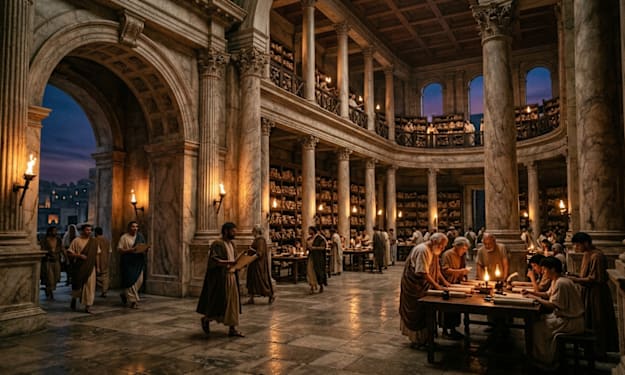
The Library of Alexandria Wasn't Destroyed Once — It Was Dismantled for Centuries
The Library of Alexandria is one of history's most famous casualties. Mention it in most conversations and you will hear about Caesar's fires, or the Muslim conquest, or some combination of both. The story that most people carry is a simple one: an extraordinary repository of ancient knowledge was destroyed in a single cataclysmic event, and with it went irreplaceable wisdom that changed the trajectory of human civilization.
By Mxolisi Makhubela6 months ago in History
Significant Genetic Variability Found in Native Americans
The broadest and most complete genetic dataset of Indigenous American populations to date has been assembled by a ground-breaking worldwide study. The study, which was published in the journal Nature, sequenced 128 high-coverage entire genomes from persons in eight Latin American nations, providing fresh insight into the intricate evolutionary history, distinctive genetic diversity, and health consequences for Indigenous peoples. The study unearths a third wave of migration into South America and identifies more than a million genetic variants that were previously unknown.
By Francis Dami6 months ago in History
Greek City Turned Into a Playground: Ptolemais Found More Than 100 Game Boards
In the ruins of Ptolemais, one of the largest ancient Greek towns in modern-day Libya, archaeologists have discovered something fascinating. Researchers from the University of Warsaw have documented over 100 ancient gaming boards carved into the abandoned city. This finding offers a detailed look at people's daily activities long after the city had fallen.
By Francis Dami6 months ago in History
Researchers Uncover the Mysteries of 9,000-Year-Old Rock Paintings in Kenya
The complex rock paintings at Kakapel, a well-known archaeological site in western Kenya, have a millennium-long history, according to a fascinating new study. Researchers were perplexed for decades by the thick overlapping of photos at this historic rock shelter. The artwork was produced over a period of 9,000 years by at least three different populations, according to careful digital tracing, archaeological excavation, and ancient DNA analysis.
By Francis Dami6 months ago in History
An Ancient Mass Grave Shows How a City Was Destroyed 1,500 Years Ago by a Pandemic
A recently discovered mass grave in the ancient Jordanian city of Jerash provides disturbing information about one of the earliest known pandemics in history. The Plague of Justinian destroyed entire communities, as evidenced by the hundreds of plague victims that were buried in a matter of days. The results demonstrate that individuals who were typically dispersed throughout different areas were abruptly consolidated in death.
By Francis Dami6 months ago in History
Digital reconstruction of a Pompeii victim's fate based on evidence
Artificial intelligence has been employed for the first time by archaeologists and scholars at the ancient Roman site of Pompeii to digitally reconstruct the fate of an individual who perished during the devastating eruption of Mount Vesuvius in AD 79. The innovative digital image provides a profoundly new means of connecting with one of the most well-known natural disasters in history and the people who lost their lives in it.
By Francis Dami6 months ago in History
Secrets of Hyperborea: The Discovery of an Ancient Arctic Civilisation?
The story of a paradise concealed at the top of the earth has fascinated explorers, historians, and mythologists for generations. Ancient Greek writings describe this as a region of perpetual spring where a race of giants lived for a millennium without illness or conflict. It was referred to as Hyperborea, a world that existed "beyond the North Wind." But could this fabled utopia have been more than a myth?
By Francis Dami6 months ago in History